Turkiye and India’s Westward Strategic Problem
Why Ankara Matters, Why New Delhi Must Take It Seriously, and What Comes Next
Frontline Strategy | 31 May 2026
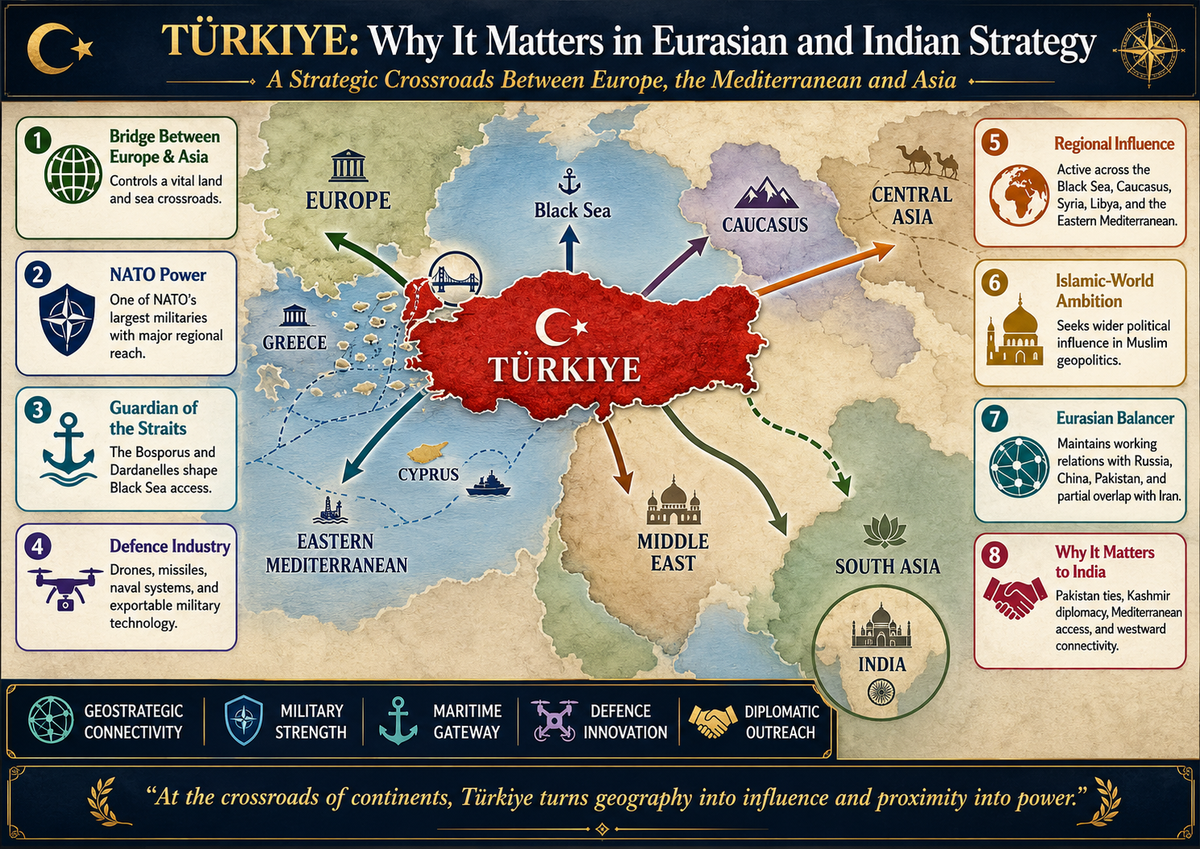
Turkiye is not a nuisance state. It is not merely a rhetorical ally of Pakistan or an episodic critic of India on Kashmir. It is a serious geopolitical actor: historically conscious, militarily capable, institutionally embedded in NATO, strategically located between Europe, Asia and the Middle East, and increasingly ambitious in the Islamic and Eurasian worlds. To underestimate Turkiye because some of its recent postures appear theatrical would be a grave Indian error.
The first requirement of serious strategy is respect for the adversary, competitor or difficult partner. Turkiye deserves that respect. It possesses one of NATO’s largest armed forces, controls the Turkish Straits, borders the Black Sea, sits astride the eastern Mediterranean, projects power into Syria, Libya, the Caucasus and the Red Sea littoral, and has built a defence-industrial ecosystem that now exports drones, naval platforms, armoured systems and air-defence technologies to multiple theatres. Ankara has also mastered the art of strategic ambiguity: it remains a NATO member, maintains working relations with Russia, deepens economic and diplomatic engagement with China, supports Pakistan, competes with Iran, speaks for Palestine, quarrels with Israel, negotiates with Europe, and presents itself as an independent pole in an increasingly fragmented world.
This is why Turkiye matters to India.
For decades, India’s western strategic gaze was focused largely on Pakistan, the Gulf, Iran, Afghanistan and the Indian Ocean. Turkiye was peripheral: historically important, diplomatically cordial but not central to India’s security calculus. That era is over. Turkiye has moved into India’s strategic field through four pathways: its Pakistan partnership, its vocal position on Kashmir, its growing defence footprint in Asia, and its influence across the Mediterranean and West Asian corridors through which India’s trade, energy, connectivity and diaspora interests increasingly pass.
The question for India is therefore not whether Turkiye is friendly or unfriendly. That is too simple. The question is how India should deal with a powerful middle state that is simultaneously a NATO actor, an Islamic-world aspirant, a Eurasian balancer, a Pakistan partner and a Mediterranean gatekeeper.
The Turkish Power Base
Turkiye’s power rests first on geography. It is one of the few states whose location is itself a strategic instrument. It links Europe and Asia; it touches the Black Sea, the Aegean and the eastern Mediterranean; it controls access between the Black Sea and the Mediterranean through the Bosporus and Dardanelles; it sits near the Caucasus, the Levant, the Balkans and the energy routes of West Asia. Geography gives Turkiye relevance even when its economy is weak or its diplomacy is abrasive.
Its second asset is military capacity. The Turkish Armed Forces are large, experienced and expeditionary. They have operated in Syria, Iraq, Libya, Qatar, Somalia and the Caucasus-related theatres. Turkiye’s defence industry has become one of the major success stories of contemporary middle-power militarisation. Turkish drones acquired a global reputation after their use in Libya, Nagorno-Karabakh and Ukraine. Ankara’s ambitions now go beyond drones: it is investing in naval systems, missiles, armoured vehicles, air defence, electronic warfare and aerospace projects. Turkish defence firms have signed major contracts for the country’s integrated “Steel Dome” air-defence architecture, reflecting Ankara’s desire for technological autonomy and layered deterrence.
Its third asset is historical memory. Modern Turkiye is not the Ottoman Empire, but Ottoman memory remains politically usable. President Recep Tayyip Erdoğan has fused nationalism, Islamic symbolism and civilisational nostalgia into a foreign-policy language that resonates across parts of the Muslim world. Turkiye presents itself not simply as a nation-state but as the heir to a great imperial past — a state wronged by history, constrained by Western hypocrisy, and destined to resume a wider role. This self-conception explains much of Ankara’s activism: Palestine, Kashmir, Libya, Syria, the Balkans, the Caucasus, Africa and Central Asia are not isolated theatres but fragments of a larger Turkish imagination.
Its fourth asset is diplomatic elasticity. Turkiye does not behave like a subordinate ally. It belongs to NATO but purchases energy from Russia, talks to Moscow, engages Beijing, seeks influence in Central Asia, operates in the Islamic world, and uses its territory, military assets and diplomatic channels as bargaining chips. Contemporary analyses of Turkish foreign policy increasingly describe Ankara as a broker, arms supplier and mediator that tries to balance rival blocs while preserving NATO membership and exploring wider Eurasian options.
This combination — geography, military strength, historical self-confidence and diplomatic flexibility — makes Turkiye one of the defining middle powers of the present age.
Why Turkiye Matters to India
India’s Turkiye problem begins with Pakistan but does not end there. Turkiye’s support for Pakistan has acquired sharper strategic meaning in recent years. Ankara has repeatedly raised Kashmir at international forums, including the United Nations, in ways that New Delhi views as intrusive and hostile. For India, Kashmir is a sovereign question, not an issue for external Islamic solidarity. Turkiye’s decision to echo Pakistani formulations has therefore produced resentment in New Delhi.
The defence dimension compounds the problem. Turkiye and Pakistan have built a growing military-industrial relationship. Their cooperation has involved naval platforms, drones, training, military technology and political signalling. Turkiye’s defence exports to Pakistan matter because they potentially improve Pakistan’s surveillance, strike, naval and air-defence capacity. Even where individual systems do not transform the balance of power, the cumulative effect is significant: Pakistan gains a partner that brings NATO experience, indigenous defence technology, Islamic legitimacy and political support.
Turkiye’s Asian outreach also reaches beyond Pakistan. Its engagement with Bangladesh, Central Asia, Afghanistan-related diplomacy, and the wider Muslim world adds to Indian concerns. India does not need to exaggerate this trend. Bangladesh, for instance, has its own defence-modernisation logic and should not be reduced to a Turkish proxy. But New Delhi cannot ignore the possibility that Turkish defence systems, training networks and political messaging may gradually enter India’s eastern and western peripheries.
The third reason Turkiye matters is connectivity. India’s westward strategy increasingly runs through the Arabian Sea, Gulf, eastern Mediterranean and Europe. The India-Middle East-Europe Economic Corridor, the relevance of Haifa, the India-Greece relationship, Cyprus, Israel, UAE, Saudi Arabia and European markets all bring the Mediterranean closer to India’s national interest. Turkiye sits near many of these routes, and Turkish influence in the eastern Mediterranean can affect the larger strategic environment through which India seeks access to Europe.
The fourth reason is ideological. Turkiye aspires, at least rhetorically, to leadership within the Muslim world. It does not possess the oil wealth of the Gulf, the demographic weight of Indonesia, the clerical centrality of Saudi Arabia or Iran, or the institutional role of Egypt’s Al-Azhar. But it possesses something else: a successful narrative of military confidence, Islamic symbolism, anti-Western grievance, economic modernisation and civilisational resurrection. For Muslim societies frustrated with Arab stagnation, Iranian sectarianism or Pakistani instability, Turkiye can appear as a more dynamic model. That makes Ankara’s Kashmir activism more than a bilateral irritant; it becomes part of a symbolic contest over Muslim political imagination.
What India Has Done
India has not remained passive. New Delhi’s response has been gradual, indirect and largely calibrated.
First, India has deepened relations with Greece. Prime Minister Narendra Modi’s 2023 visit to Athens and subsequent diplomatic engagement elevated India-Greece relations into a strategic partnership. Greece matters because it is Turkiye’s historic rival, a European Union member, a Mediterranean maritime state and a potential partner in connectivity, shipping, defence and energy. For India, Greece is not merely a counter-Turkiye card; it is a gateway into Europe and the Mediterranean.
Second, India has strengthened ties with Cyprus. Cyprus occupies a central place in the eastern Mediterranean dispute system involving Turkiye, Greece, the European Union and energy routes. The May 2026 India-Cyprus strategic upgrade, including reported Cypriot interest in Indian defence systems such as BrahMos and UAVs, has understandably attracted Turkish attention. For India, Cyprus provides both diplomatic symbolism and strategic geography: it is a small state, but small states in contested maritime spaces often carry disproportionate value.
Third, India has expanded defence cooperation with Armenia. This is perhaps the most direct counter-pressure point. Armenia’s military vulnerability after the Nagorno-Karabakh wars, combined with Azerbaijan’s close ties with Turkiye and Pakistan, has opened space for Indian defence exports. Indian systems supplied to Armenia do not amount to an anti-Turkiye alliance, but they do signal that India can respond to the Turkey-Pakistan-Azerbaijan alignment by supporting states under pressure from that axis.
Fourth, India has built a thicker relationship with Israel. India-Israel defence cooperation predates the current Turkiye problem, but the eastern Mediterranean triangle of Israel, Greece and Cyprus gives this relationship added geopolitical value. India has interests in Haifa, technology, defence, intelligence and maritime connectivity. However, this relationship must be handled carefully. India cannot afford to appear as an ideological participant in every Israeli regional project, especially given its Gulf interests, Iran equation and domestic sensitivities. The wiser Indian posture is practical cooperation without rhetorical entanglement.
Fifth, India has reduced political warmth toward Ankara. Turkish companies have faced greater scrutiny in India; public sentiment hardened after Turkish statements on Kashmir; and Indian diplomacy has increasingly discovered Turkiye’s own sensitivities. Yet India has not severed relations, and that is sensible. Turkiye is too important to be handled through anger alone.
What India Should Not Do
India should not pretend that Turkiye can be “encircled” in any crude military sense. Turkiye is not Pakistan. It is not isolated, fragile or dependent on one patron. It has NATO cover, European economic linkages, Russian channels, Chinese engagement, Gulf openings, Central Asian cultural reach and an expanding defence-industrial base. Any Indian strategy based on humiliating Turkiye would be unserious.
India should also avoid open interference in Turkiye’s internal fault lines. That would be strategically tempting but normatively dangerous. India objects, rightly, when Turkiye speaks on Kashmir. It cannot then adopt a doctrine of meddling in Turkish domestic politics. The better approach is not covert destabilisation but diplomatic reciprocity: if Ankara internationalises Indian sensitivities, New Delhi can legitimately deepen ties with states affected by Turkish power.
India should not over-militarise the Mediterranean imagination. India’s primary strategic theatre remains the Indian Ocean and the continental challenge from China and Pakistan. The Mediterranean is important, but India’s presence there must be selective, not theatrical. Maritime domain awareness, port access, defence exports, technology cooperation, shipping security, diaspora protection and connectivity are more realistic than fantasies of Indian naval power routinely operating as a resident Mediterranean actor.
India should not push Turkiye completely into Pakistan’s arms. The Indian objective should not be permanent enmity. It should be behavioural modification. India must make it clear that anti-India activism carries costs, but it should also keep open the possibility of functional cooperation on trade, tourism, connectivity, disaster relief, multilateral diplomacy and selective Eurasian issues.
What India Can Do
India needs a five-part Turkiye policy.
First, India should name Turkiye as a consequential middle power in official and strategic discourse. Ignoring Turkiye will not make it disappear. Indian think tanks, military institutions and diplomatic training establishments need far better Turkiye expertise: language capacity, Ottoman and republican history, Turkish defence industry mapping, study of political Islam in Turkish statecraft, and monitoring of Turkish influence networks in Asia and Africa.
Second, India should build counter-leverage, not encirclement. Greece, Cyprus, Armenia, Israel, France, the UAE and Egypt can all be part of issue-based convergences. These should not be presented as an anti-Turkiye alliance. They should be framed around maritime security, connectivity, defence industry, energy resilience, counter-terrorism, supply chains and international law. The difference matters. Counter-leverage is sustainable; encirclement rhetoric is provocative and often empty.
Third, India should use defence exports as strategic signalling. Armenia is the model. Cyprus could become another case. Greece may offer more advanced industrial and maritime possibilities. India’s defence exports should be disciplined: not reckless proliferation, but carefully selected systems that build partnerships, create dependencies, and signal that India can be a security provider beyond South Asia.
Fourth, India should treat Pakistan-Turkiye defence cooperation as a serious intelligence and military-planning issue. Turkish drones, naval collaboration, electronic systems, training patterns, air-defence cooperation and missile-related developments must be monitored in detail. India’s armed forces should study Turkish operational methods, not dismiss them. The Bayraktar phenomenon revealed that Turkiye understands the politics of affordable, exportable, combat-tested technology. India must learn from this model even while countering its implications.
Fifth, India should offer Turkiye a diplomatic off-ramp. New Delhi should communicate privately and publicly that relations can improve if Ankara stops using Kashmir as a platform for Islamic leadership. India and Turkiye have areas of possible cooperation: trade, tourism, infrastructure, pharmaceuticals, disaster response, civil aviation, Central Asia, Afghanistan stabilisation, and Eurasian connectivity. India should not close the door. A confident power punishes hostility but also leaves space for correction.
The Larger Future
Turkiye’s future will be shaped by the tension between ambition and constraint. Its ambition is vast: leadership in the Muslim world, strategic autonomy from the West, influence in the Caucasus and Central Asia, a decisive role in the Black Sea, permanent leverage over Europe through migration and security, and a defence industry that gives it autonomy from traditional suppliers. Its constraints are also real: inflation, currency weakness, political polarisation, Kurdish unrest, overextension, uneasy relations with the West, suspicion from Arab states, rivalry with Iran, and the limits imposed by NATO membership.
India should understand both sides. Turkiye is powerful, but not omnipotent. It is agile, but not frictionless. It is ambitious, but often overextended. Its Islamic leadership claim is real, but contested by Saudi Arabia, Iran, Egypt, Indonesia and others. Its Pakistan partnership is meaningful, but Pakistan itself is unstable. Its China and Russia ties are useful, but Ankara does not want to become subordinate to either. Its NATO membership gives it leverage, but also imposes constraints.
For India, the right policy is neither hostility nor romanticism. It is strategic maturity.
India must recognise that Turkiye has entered its extended neighbourhood. It must respond where Turkiye damages Indian interests. It must cultivate Turkiye’s rivals and anxious neighbours without announcing a crusade. It must expand its presence in the Mediterranean without losing sight of the Indian Ocean. It must monitor Turkish defence exports without panic. It must answer Kashmir rhetoric firmly, but without descending into reciprocal irresponsibility. And it must preserve diplomatic channels because great powers, and aspiring great powers, must know how to compete without foreclosing future accommodation.
Turkiye’s rise is one of the major middle-power stories of our time. It represents the return of history, geography and civilisational memory to world politics. India, too, is a civilisational state with strategic depth, historical consciousness and continental ambition. The India-Turkiye relationship therefore cannot be reduced to Pakistan or Kashmir alone. It is part of a larger story: how post-Western middle and major powers negotiate status, memory, religion, sovereignty and access in a fractured world.
The Indian answer to Turkiye should be clear: respect its power, resist its interference, study its methods, build counter-leverage, and keep the door open for a more balanced relationship. That is not weakness. It is statecraft.
Colonel Maqbool Shah, SM (Veteran), based at Jammu (J&K), is Founding Editor of Frontline Strategy.