Do Not Harden Too Early
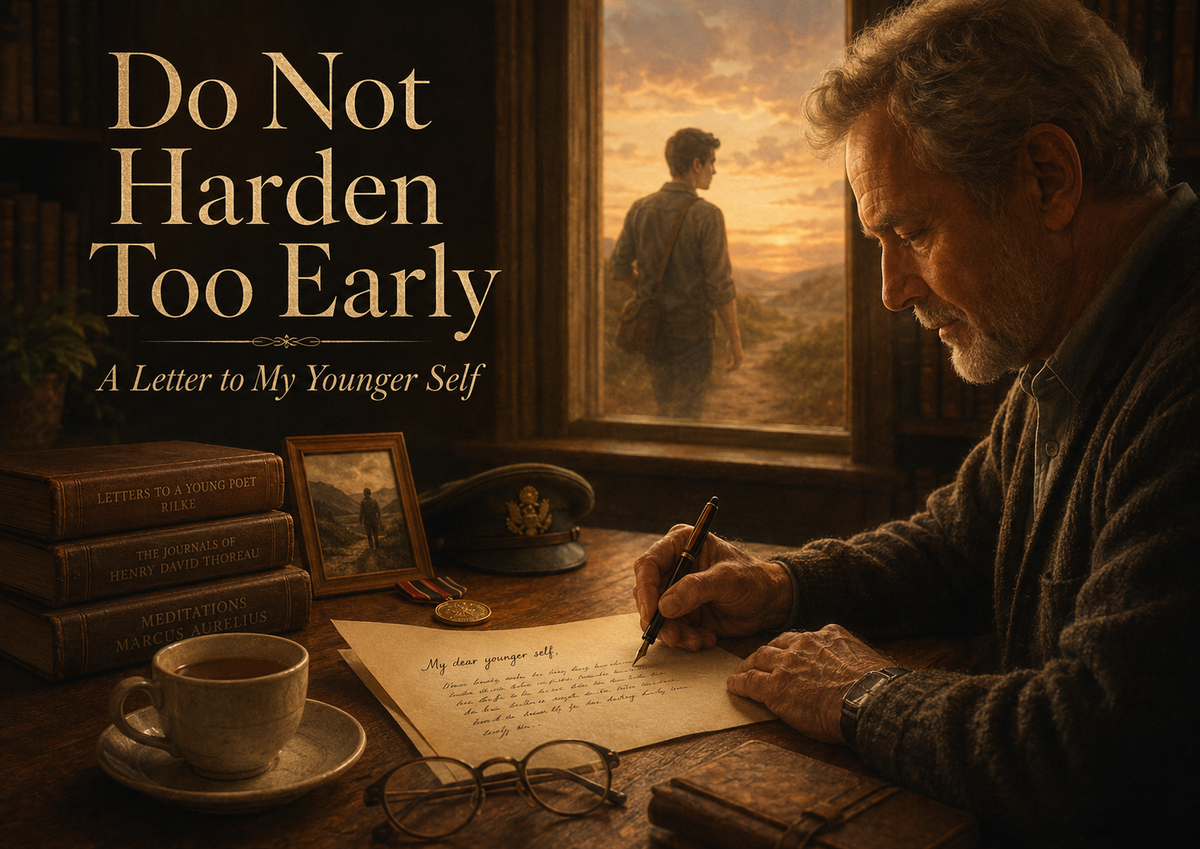
A Letter to My Younger Self
(Zara umar-e-rafta ko aawaaz dena)
My dear younger self,
I write to you from a far shore of time.
You will not recognise me at first. My hair has thinned, my stride has slowed, the body has begun to issue its own orders, and the certainties with which you once walked into the world have been softened by weather. But do not be alarmed. I am still you. Or perhaps more truthfully, I am what remains of you after ambition, love, defeat, duty, illness, betrayal, memory, longing, and forgiveness have all taken their share.
I know you are impatient. I know you want life to begin quickly, grandly, and decisively. You want to prove yourself before the world has even finished looking at you. You want honour, recognition, dignity, and a place in the great procession of men who did something worthy. You are carrying within you a hunger that is not merely personal. It comes from the soil, from poverty, from ancestral silences, from rooms where there was never enough, from the sharp awareness that the world does not naturally make space for boys like you unless they force it to.
I understand that hunger. I will not ask you to abandon it.
Without it, you would not have crossed the distances you crossed. Without it, you would not have read under pressure, stood your ground, worn the uniform, carried responsibility, endured humiliation, and risen each time life attempted to teach you your supposed place. Ambition, in those years, was not vanity. It was oxygen. It was the refusal of invisibility.
But listen to me carefully: do not allow the hunger to eat the heart that carries it.
The world will try to harden you early. It will praise toughness and mistake tenderness for weakness. It will tell you that a man must not reveal hurt, must not confess fear, must not pause too long before beauty, must not forgive too easily, must not trust too deeply. It will teach you the grammar of command before it teaches you the music of mercy. It will offer you armour, and for a time you will need it. Wear it when you must. But never mistake armour for skin.
You will see many things.
You will see mountains under snow and men under fire. You will see courage in unlikely faces and cowardice in decorated rooms. You will learn that discipline can hold a man together when hope is unavailable. You will discover that a soldier’s life is not made only of battle, but also of waiting, letters, mess conversations, cold dawns, boots drying near a stove, the memory of home, and the strange fraternity of those who know that death is not an abstraction.
You will serve a country that will not always understand you. It did not understand your father either. In October 1947, he stood against the tribal raiders who came from Pakistan and helped organise resistance at a time when fear had entered the valley like fire. For that courage, he was tortured, his back burned with a hot coal press. Nearly half a century later, in August 1992, men animated by the same hatred assassinated him because he refused to let a place of worship belonging to another faith be torched. This is the inheritance you will carry: not merely pain, but moral clarity. You will belong to several worlds and be fully owned by none. You will learn what it means to be a Kashmiri, a Muslim, a soldier, an Indian, a reader, a doubter, a son of wounded history, a man always yearning for love and belonging, and a man who cannot be reduced to any single label. There will be times when others will try to name you before you have spoken. Do not let their smallness become your bitterness.
There will be moments when your heart will ask: where do I belong?
دل ہی دل میں یہ صدا اٹھتی رہی شام و سحر
میں کہاں کا ہوں، مرا گھر ہے کہاں، کس کا ہوں میں
(Dil hī dil mein yeh sadā uṭhtī rahī shām-o-sahar
Main kahān kā hūn, mirā ghar hai kahān, kis kā hūn main)
(Again and again, within the heart, this cry kept rising: where do I belong, where is my home, and to whom do I truly belong?)
The answer will not come easily. It will not come from slogans, certificates, uniforms, flags, or the applause of others. It will come quietly, after many years, as such answers usually do. You belong wherever you can stand without lying about your wounds. You belong wherever your conscience can breathe. You belong to the language of justice, to the memory of those who loved you, to the books that rescued you, to the soil that formed you, and to the fragile republic of those who still believe that human dignity is not negotiable.
You will love books before you fully understand why. Keep loving them. They will be among your most loyal companions: the photocopied books you gathered because originals were beyond reach; the old, bruised volumes you found in the flea markets of Baghdad and Delhi after long Sunday wanderings in search of affordable treasure; the books your father bought for you when you were still a child and the world had not yet revealed its full severity. These books will not merely sit on shelves. They will carry the smell of dust, ink, longing, thrift, affection, and survival. When the loved ones disappoint you, books will wait without accusation. When public life becomes coarse, poetry will restore the lost temperature of tenderness. When language is corrupted by power, literature will remind you that words were once instruments of truth, consolation, rebellion, and grace. Look occasionally at Frank Kermode, who teaches us to respect the power of endings, meanings, and fictions; and at Umberto Eco, placed in your library behind the glass-doored cabinet, as if quietly guarding the deeper mysteries of language, signs, and civilisation. Read not to decorate your mind, but to save your soul from becoming crude.
There will come a time when Faiz will mean more to you than he does now. Not merely Faiz the poet of revolution, but Faiz the healer of invisible bruises. You will understand one day what it means for poetry to place a soft hand on the cheek of your heart. You will see that the finest words do not always thunder. Sometimes they arrive like a hand on the forehead of a fevered child. Sometimes they do not solve grief; they simply sit beside it until grief no longer feels abandoned.
Remember this when the world becomes too loud.
You will be tempted by anger. I do not blame you. There will be sufficient reasons. You will see injustice dressed in legality, cowardice dressed in prudence, cruelty dressed in patriotism, prejudice dressed in faith, and falsehood dressed in the robes of public virtue. You will see people bend when they should stand, speak when silence would have preserved dignity, and remain silent when speech is demanded by conscience. You will also discover that betrayal rarely announces itself as betrayal. It often comes wearing the face of familiarity: a smile, a compliment, a hand on the shoulder, a word of admiration spoken too quickly. Some will praise you not because they rejoice in your gifts, but because they are studying where to wound you. Some will come near your light only to measure how it may be dimmed. Remember this without becoming bitter: the world often tries to cut down what it cannot equal. Be alert. But let your alertness remain wisdom, not paranoia, discernment, not hatred. The task is not merely to survive treachery, but to survive it without becoming treacherous yourself.
Anger will visit you. Let it visit. Offer it a chair. Listen to what it has to say. But do not let it build a house inside you.
Anger can sharpen judgment, but it cannot nourish life. It may help you recognise injustice, but it cannot teach you how to love. If you allow anger to become your permanent climate, you will begin to lose the very tenderness for whose sake you were angry in the first place. Guard against this. The world needs your clarity, but it also needs your softness.
You will make mistakes. This may be the hardest thing for you to accept because you are severe with yourself. You believe that a man must master his life through discipline, intelligence, courage, and will. These things matter, but they are not enough. Life is larger than character. It has accidents, illnesses, losses, betrayals, absurdities, bureaucracies, storms, and silences that no amount of discipline can command.
So forgive yourself in advance.
Forgive yourself for trusting some people longer than they deserved. Forgive yourself for speaking sharply when you were tired. Forgive yourself for the letters you did not write, the visits you postponed, the words of affection you assumed could wait. Forgive yourself for the ambition that sometimes made you restless. Forgive yourself for moments when pride stood where tenderness should have stood. Forgive yourself even for your naivety. It was not always foolishness; sometimes it was the last surviving evidence that you had not yet been corrupted by suspicion.
You will learn, painfully, that the world does not reward goodness in any predictable way. Do not let this discovery ruin your faith in goodness. Goodness is not a transaction. It is not an investment from which one must expect returns. It is a way of keeping one’s own house lit when the streets are dark.
Learn early, my dear younger self, not to build a ledger out of kindness. Do what you can for others, but do not keep account of every favour, every sacrifice, every door opened, every word spoken in someone’s defence, every burden carried on another’s behalf. The moment generosity begins to wait for repayment, it loses its innocence and becomes commerce. Help because help was needed. Stand by someone because at that hour standing by them was the right thing to do. Give because your hand was full enough to give, even if your own heart was tired. But do not expect memory to be fair, gratitude to be punctual, or people to remember your goodness in the hour when you need theirs. Many will forget. Some will turn away. A few may even wound you with the very strength they drew from you. Do not let this make you small. The sun does not ask the tree for acknowledgement; the river does not demand thanks from the field it nourishes. There is a form of giving that must remain larger than return. Keep your heart wide enough for that. Let your favours disappear into the world like lamps lit at dusk — some seen, some unseen, some protecting travellers who will never know your name. If gratitude comes, receive it gently. If it does not, let the act return to God, to conscience, to the silent dignity of having done what was humanly required. Never allow ingratitude to make you regret kindness. That would be the final victory of those who failed to understand it. True kindness does not choose its recipient like a banker; it falls like rain.
Perhaps Nida Fazli understood this best when he compared generosity to a wandering raincloud:
برسات کا بادل تو دیوانہ ہے، کیا جانے
کس چھت پہ برسنا ہے، کس راہ کو بھگونا ہے
Barsāt kā bādal to dīwāna hai, kyā jāne
Kis chhat pe barasnā hai, kis rāh ko bhigonā hai
The raincloud does not maintain accounts. It does not ask which roof deserves water, which road will remember its kindness, which field will return its gift. It simply passes, gathers, darkens, breaks, and gives. Be like that when you can — not careless, not foolish, but abundant. Let your kindness fall where it must, without always waiting to see who looks up in gratitude.
Some people will take advantage of your trust. Some will misunderstand your restraint. Some will mistake your decency for weakness. Let them. Their failure to recognise dignity does not reduce its worth.
You will carry your father within you in ways you do not yet understand. You will spend years discovering what inheritance really means. It is not only land, name, blood, or memory. It is also an unfinished conversation. It is the desire to be worthy of those who struggled before you. It is the invisible pressure of a hand on your shoulder when you are about to take the easier road. It is the ache of wanting to ask questions when the person who could answer them is no longer there. And you will carry your mother too — not as memory alone, but as warmth, refuge, and quiet strength. You will remember the tenderness of her work-worn hands, hands made coarse by labour yet softened by love; hands that held you through the worst upheavals of your life, steadied your fear, and returned you again and again to the world. In time, you will understand that some forms of love do not announce themselves grandly. They simply remain — like a lamp in a dark room, like bread placed before hunger, like a hand on the forehead when no words are enough.
Do not postpone tenderness with your parents, your elders, your friends, or those who love you quietly. The young imagine that time is abundant. It is not. Time is patient only in appearance. It withdraws without noise.
Say the kind word earlier.
Hold the hand longer.
Return the call.
Write the letter.
Do not assume that love understands everything without being told. Sometimes love, too, needs language.
There will be seasons when you will feel defeated. Not dramatically, not publicly, but in the private chamber where a man sits alone with his own life. You will wonder whether your sacrifices were seen, whether your work mattered, whether the institutions you served deserved your faith, whether truth has any power against organised falsehood, whether decency survives in a world that rewards manipulation.
In such moments, do not search immediately for grand answers. Grand answers often fail us when pain is intimate. Instead, return to small things.
A cup of tea.
A page of poetry.
The smell of old paper.
A child’s laughter.
A walk in winter sunlight.
The call to memory from a distant village.
The face of someone who does not require you to perform strength.
You will discover that life is not saved all at once. It is saved in fragments. A sentence saves it for an hour. A friend saves it for an evening. A poem saves it for a season. A memory saves it when nothing else can.
Do not despise the small consolations. They are not small.
There is another thing I must tell you. Life will not give you everything in the form in which you desired it. Many dreams will arrive altered. Some will not arrive at all. Some victories will come too late to taste like victory. Some wounds will heal, but not into the original skin. You will be asked, again and again, to make the best of the second-best.
Do not treat the second-best as humiliation.
Often it is life’s hidden mercy. The road denied may save you from a destination that would have emptied you. The recognition delayed may protect you from arrogance. The modest success may leave your soul more intact than the spectacular triumph. The unchosen life may contain forms of grace the chosen life could never have held.
One day you may wake and see that the second-best was not a punishment. It was a different kind of blessing, arriving in plain clothes.
This will take time to understand. Do not hurry wisdom. It has its own seasons.
You will also learn that forgiveness is not a single noble act. It is a discipline of return. You forgive, then remember, then hurt again, then forgive again, each time a little differently. Do not force yourself into false saintliness. Some wounds have to be respected before they can be released. Forgiveness does not mean pretending that harm did not happen. It means refusing to let harm become the final author of your character.
Forgive those who failed you, where you can.
Forgive those who could not love you in the language you needed.
Forgive those who were prisoners of their own fear, vanity, insecurity, or ignorance.
Forgive the younger versions of others, just as I am now trying to forgive you.
But remember: forgiveness is not the same as surrendering judgment. You may forgive and still draw a boundary. You may forgive and still speak the truth. You may forgive and still refuse to return to the place where your dignity was wounded.
Softness is not servility.
Tenderness is not blindness.
Compassion is not consent.
Learn these distinctions early. They will save you from much confusion.
My dear younger self, I know you want to be strong. You will be. But strength will not finally mean what you think it means. It will not mean never trembling. It will not mean never needing anyone. It will not mean always winning, always commanding, always enduring without complaint. Real strength will mean keeping the inner lamp alive after the winds have done their worst.
It will mean not becoming cruel after being hurt.
It will mean not becoming small after being humiliated.
It will mean not abandoning beauty after seeing ugliness.
It will mean not mocking love because love once disappointed you.
It will mean remaining capable of tears without being ashamed of them.
There is no shame in tears. The eye that cannot weep may also be unable to truly see.
If I could place my hand on your shoulder now, I would not tell you to be less ambitious, less brave, or less serious. Those qualities will carry you far. I would only tell you to be gentler with the boy inside the man. Do not exile him in the name of maturity. Do not silence him because the world prefers stern faces. Let him keep his wonder. Let him keep his capacity for affection. Let him be moved by a poem, a landscape, a memory, a line of music, a gesture of kindness. Let him remain alive.
For in the end, this is what survives us: not the titles, not the designations, not the arguments won, not the enemies answered, not even the public record of our labours. What survives is the tenderness we protected, the dignity we offered, the courage with which we loved an imperfect world, and the forgiveness we extended before darkness could turn us into stone.
You will walk through fire. But do not worship fire.
You will carry wounds. But do not become only wound.
You will meet cruelty. But do not become its mirror.
You will know disappointment. But do not let it cancel gratitude.
You will lose many illusions. But do not lose wonder.
And when, after many years, you find yourself sitting quietly with an old book, a cup of tea, and a heart that has been cracked but not destroyed, you will understand that softness was never the opposite of strength.
It was strength’s most secret form.
With affection, regret, pride, and forgiveness,
Your older self.
Colonel Maqbool Shah is a retired Indian Army officer. This essay is dedicated to his children, and to their children after them — as a small offering of memory, tenderness and counsel for the far years ahead.