The Bazaar and the Briefing Room: A Portrait of Abbas Araghchi
A study in civilisational diplomacy — with comparative reflections on Kennan, Kissinger, Zhou Enlai, Gromyko, Talleyrand, Abba Eban, and Wang Yi
I. The Making of a Statesman
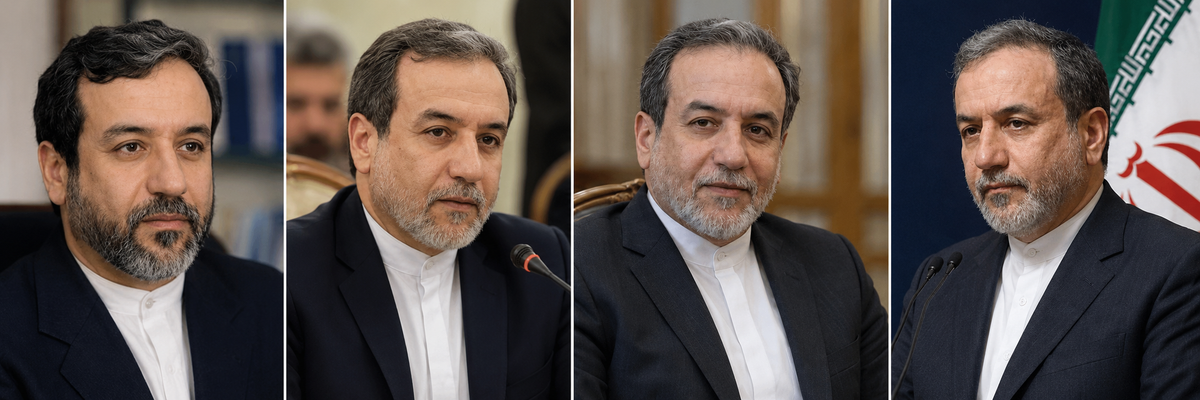
Abbas Araghchi was born in Tehran on 5 December 1962, into a family whose mercantile roots ran deep into Isfahan's carpet trade. His grandfather was a celebrated carpet merchant; his late mother, he recalls in The Power of Negotiation (2024), was a natural and relentless haggler. It is a detail he shares not as anecdote but as epistemology — for in Araghchi's view, the art of the bazaar and the art of diplomacy are not merely analogous. They are the same art, conducted at different altitudes.
He was seventeen when the Revolution came. Like many of his generation, he joined the Islamic Revolutionary Guard Corps (IRGC), fought through nine years of the Iran–Iraq War, and sustained combat injuries in the field. This formative experience is indispensable to understanding him. He is not a diplomat who learned politics in seminar rooms. He is a soldier who chose scholarship, and that sequencing matters — it gives his institutional loyalty a quality not merely careerist but almost theological. He did not join the Islamic Republic's foreign service despite its ideology; he entered it through its most ideologically consecrated institution.
From that hardened foundation, however, he built an intellectual architecture that is genuinely eclectic. He earned a bachelor's degree from the School of International Relations of the Ministry of Foreign Affairs, a master's in political science from Islamic Azad University, and — most significantly — a doctorate in political thought from the University of Kent in England. His doctoral research examined the intersection of Western liberal democracy and Islamic governance: not to reconcile them, but to map the terrain between them. That cartographic instinct defines his career.
His diplomatic postings trace the arc of a patient, deliberate ascent: Charge d'Affaires at the Organisation of Islamic Cooperation in Jeddah (1989); Ambassador to Finland (1999–2003); Dean of the School of International Relations (2004–2005); Deputy Foreign Minister (2005–2007); Ambassador to Japan (2008–2011); Political Deputy at the Foreign Ministry (2017–2021); and finally, Foreign Minister in August 2024 under President Masoud Pezeshkian.
Crucially, he served as deputy to Mohammad Javad Zarif throughout the negotiations that produced the Joint Comprehensive Plan of Action (JCPOA) in 2015 — arguably the most complex multilateral arms control negotiation of the post-Cold War era. He did not merely participate; he is widely credited with managing the technical granularity that Zarif's public brilliance could not accommodate alone. He is, by consensus of Western interlocutors, the most substantively equipped Iranian diplomat they have faced across the table.
II. The Mind Behind the Method
Araghchi published The Power of Negotiation in 2024, and its subsequent translation into Arabic, Armenian, Spanish, and other languages — including an unveiling at the Muscat Book Fair on the sidelines of nuclear talks with the United States — is itself a diplomatic act of considerable audacity. No other serving foreign minister has literally launched a textbook on how to negotiate at the negotiations. It signals something important about how Araghchi sees himself: not as a tactical mouthpiece for the Supreme Leader, but as a theorist of statecraft who happens also to be its practitioner.
His framework rests on several pillars. First, institutional primacy: the individual negotiator represents not himself but a civilisation with millennia of statecraft. This is not rhetorical flourish — it is a structural constraint that Araghchi converts into an asset. Second, taarof as strategy: the Persian system of elaborate, ritualised politeness and deference is weaponised in the negotiating room to mask unyielding positions behind courteous form. Third, temporal leverage: the longer negotiations run, the more the Western counterpart's domestic electoral urgency becomes a liability. Patience is not obstruction — it is power. Fourth, smart power as his explicit intellectual category, combining hard national capabilities with soft diplomatic skill, which he defines as the precise blend of institutional authority and personal cultivation.
Shashi Tharoor, writing in The Indian Express on 18 June 2026, frames the US–Iran impasse precisely through this lens: the collision between Trump's Art of the Deal — transactional, zero-sum, personality-driven — and Araghchi's Power of Negotiation — institutional, civilisational, marathon-oriented. This is not merely a tactical disagreement. It is a philosophical one about what an agreement is. Washington wants a headline; Tehran wants a permanent state of managed leverage that preserves national dignity through "an incredibly dense, complex web of technical clauses." One side wants a final contract; the other wants a perpetual process.
The bazaar analogy, which Araghchi himself embraces, is more sophisticated than critics allow. In a bazaar, no transaction is truly zero-sum; relationships outlast individual deals; reputation is capital; and the merchant who sells under pressure, below value, does not merely lose money — he loses face, which in the Eastern diplomatic imagination is irreversible. "When you sell snow under the sun," Araghchi writes, "bargaining more than necessary is a loss." He knows equally well that the snow is melting — and the metaphor applies to both sides.
III. Comparisons in Depth
George F. Kennan: The Scholar-Strategist in an Adversarial System
The parallel with George Kennan is the most intellectually productive. Kennan's genius lay in translating historical depth and psychological insight into actionable strategic doctrine — the Long Telegram, the "X Article," the theory of containment. Araghchi operates in a comparable register: he has theorised his nation's strategic position academically and then implemented it personally. His doctoral work on liberal democracy versus Islamic governance is, in spirit, his own version of Kennan's studies of Soviet political culture — an effort to understand the adversary's internal logic deeply enough to engage it without being seduced or consumed by it.
Both men brought a rare quality to their craft: the willingness to sit with moral and philosophical complexity rather than resolve it prematurely into policy slogans. Kennan's containment was always more nuanced than the military doctrine it spawned; Araghchi's nuclear diplomacy is always more layered than the "we will never abandon enrichment" headlines suggest.
But the parallel fractures instructively. Kennan was ultimately a tragic figure — marginalised by the very establishment he had equipped, a strategist whose nuanced doctrine was vulgarised into military confrontation he deplored. He spent the second half of his career as a prophet not heard in his own house. Araghchi has suffered no such fate. He enjoys, by consistent report, the full confidence of the Supreme Leader, and is described by political insiders as possibly the most powerful Foreign Minister in the Islamic Republic's history. Where Kennan's tragedy was that Washington's system could not accommodate its own strategist's sophistication, Tehran's system has placed Araghchi precisely where his sophistication serves the state's deepest interests.
The divergence is also institutional. Kennan was, by temperament, a romantic individualist — his memoirs drip with aesthetic sensibility and personal anguish. Araghchi is a disciplined collectivist who subordinates personality to institution. He would be a better Kennan if Kennan had actually wanted to be part of the machine.
Henry Kissinger: Realpolitik With and Without a Superpower's Margin
Kissinger is the most obvious comparison, and therefore the most dangerous to make carelessly. Both men combine academic theory with operational cunning; both prefer structural analysis to moral posturing; both carry civilisational weight as a negotiating resource. Araghchi's vision of Iran as a state with millennia of civilisational history, whose diplomat is never merely a lone wolf but a representative of that accumulated depth, is pure Kissingerian architecture translated into Persian idiom.
Where they converge most precisely is in the use of ambiguity as strategic resource. Kissinger famously refused to clarify Nixon's intentions to the Chinese, the Soviets, and the North Vietnamese simultaneously — the uncertainty itself was leverage, not indecision. Araghchi's prolonged nuclear ambiguity — Iran's enrichment at 60%, its refusal to commit to full cessation — performs the same function. The bomb not-yet-built is, paradoxically, more powerful than the bomb built. Once built, it invites pre-emption; perpetually potential, it perpetually deters. Both men are masters of the productive half-move.
But Kissinger operated from the commanding heights of a superpower in its imperial noon. He reshaped the international order from a position of overwhelming structural advantage; his triangulation with China and the Soviet Union was leverage available only to a hegemon. Araghchi operates under crippling sanctions, with Iran's regional networks degraded — Hezbollah's leadership decapitated, Assad's Syria fallen, air defences reduced by the 2025 Twelve-Day War, nuclear infrastructure struck in the 2026 conflict. Kissinger could afford boldness; Araghchi must manufacture it from strategic scarcity.
The deepest difference is in outcome. Kissinger achieved — the Shanghai Communiqué, the SALT framework, the Paris Accords. Whether Araghchi can convert his considerable sophistication into a durable settlement remains the unresolved question of this decade. Kissinger taught the world that realpolitik works; Araghchi is still in the process of proving it.
Zhou Enlai: The Civilisational Diplomat as Revolutionary Survivor
Zhou Enlai is the single richest comparison in this list, and the least frequently made in Western analysis of Araghchi — which is itself revealing, given how precisely the template fits.
Zhou served the People's Republic for twenty-six years as Premier and effective foreign policy architect, navigating the permanent turbulence of Mao's ideological storms without being consumed by them. He was the revolutionary state's indispensable face to the outside world: patient, elegant, historically grounded, personally magnetic, institutionally loyal to a system he sometimes privately doubted. At Bandung in 1955, he turned the Non-Aligned Movement into a vehicle for Chinese civilisational prestige. In the Nixon back-channel, he managed the most consequential diplomatic reversal of the Cold War without appearing to compromise a single principle publicly.
Araghchi operates in almost exactly Zhou's conditions. He represents a revolutionary state whose ideology is non-negotiable at the top but whose practical interests require sophisticated engagement with the world the ideology formally rejects. Like Zhou, he must signal firmness to the domestic revolutionary base while projecting reasonableness to foreign interlocutors — simultaneously, in the same conversation, often in the same sentence. Like Zhou, he operates within a supreme authority structure (Mao; Khamenei) that reserves final decisions while delegating the diplomatic texture entirely to the professional.
Zhou's operating principle was that China's civilisational continuity was the ultimate strategic asset — that a state with five thousand years of history would outlast any adversary's political cycle. Araghchi's Power of Negotiation encodes the same axiom in Persian cultural dress. The bazaar patience he celebrates is Zhou's "long view" restated in merchant idiom.
The key difference is that Zhou ultimately delivered transformation — the opening to Nixon, the restoration of China's UN seat, the foundations of what would become China's century. Araghchi's transformations, if they come, will be more modest: a nuclear framework, a partial sanctions relief, perhaps a managed normalisation. But the operating philosophy — civilisation as leverage, time as weapon — is the same.
Andrei Gromyko: Institutional Permanence as Power
Andrei Gromyko served as Soviet Foreign Minister for twenty-eight years across five General Secretaries, earning the sobriquet "Mr. Nyet" for his apparently indestructible capacity to refuse, obstruct, and outlast. His durability was itself a form of power: Western counterparts came and went while Gromyko remained, accumulating institutional memory and relationship leverage that no individual tenure could match.
The comparison with Araghchi illuminates a specific and underappreciated dimension. Araghchi too has the quality of permanence in a political landscape of volatility: he has served five Iranian presidents of radically different temperaments and survived each transition not merely intact but enhanced. Like Gromyko, he represents not himself but the permanent interests of the state beneath its rotating political leadership. His interlocutors in Washington, London, or Beijing know that whoever sits in the presidential palace in Tehran, Araghchi's analysis of Iran's core interests will not fundamentally change. This is a form of institutional reliability — paradoxically, even reassuring to adversaries — that Gromyko mastered and Araghchi has inherited.
But here the comparison requires a sharp qualification. Gromyko was intellectually lean — a formidable bureaucratic survivor and tactical stonewaller, but not a genuine strategist. He followed doctrine; he did not generate it. He is remembered for endurance and negation, not for intellectual architecture. Araghchi is emphatically the opposite: The Power of Negotiation marks him as a diplomat who has theorised his craft at serious academic depth, built a doctoral framework for thinking about ideological conflict, and written a work that is being taught in diplomacy schools across multiple languages. Where Gromyko was the revolutionary state's granite wall, Araghchi is its thinking mind. The "Nyet" quality is present in Araghchi — but it is reasoned rather than reflexive, principled rather than merely habitual.
Talleyrand: The Survivor Across Regimes
Talleyrand is the most historically distant comparison in this list, and for precisely that reason the most structurally revealing. He served the Ancien Régime, the Revolutionary Government, Napoleon's Empire, the Restoration, and the July Monarchy — five radically incompatible political orders — remaining indispensable to each while being fully captured by none. His genius was a form of disciplined detachment: he could serve any regime because he understood that the state's permanent interests outlasted any particular government's ideology.
Araghchi's career describes a comparable arc, though compressed into a single political system with multiple internal factions rather than successive regimes. He has served Khatami's reformism, Ahmadinejad's confrontationalism, Rouhani's pragmatic engagement, Raisi's hardline consolidation, and Pezeshkian's cautious opening — adapting his register to each without surrendering his analytical core. Like Talleyrand, he appears ideologically promiscuous but is in reality strategically consistent: beneath the surface accommodation lies a fixed calculation about what Iran needs, which does not change with electoral outcomes.
Talleyrand's famous principle — that "treason is a matter of dates" — has its Araghchi equivalent in the thesis that Iran's nuclear rights and strategic autonomy are permanent interests that transcend whichever faction holds the presidency. The Foreign Minister who negotiated the JCPOA under Rouhani and the Foreign Minister who faces Trump's maximum pressure under Pezeshkian is the same man pursuing the same objective through different tactical registers. That continuity within volatility is Talleyrandian in its essence.
The contrast is in moral register. Talleyrand was celebrated and condemned in equal measure for his self-serving flexibility — Napoléon called him "a piece of dung in a silk stocking." Araghchi projects something more austere: genuine ideological conviction nested within tactical flexibility. He is not navigating regimes for personal survival but managing a revolutionary state's foreign policy for national survival. The structure is Talleyrandian; the motivation is different in kind.
Abba Eban: The Mirror Image Across the Conflict Line
Abba Eban may be the most provocative comparison in this list — deliberately so, given that he was Israel's Foreign Minister from 1966 to 1974, and Araghchi currently represents the state most openly committed to challenging Israeli power in the region. Yet as diplomatic types, they are almost identical — which is perhaps the most instructive thing one can say about either of them.
Both are Cambridge-educated intellectuals who represent historically conscious, existentially threatened states using the weapons of Western discourse and philosophical sophistication. Both combined an ability to articulate their nation's cause in the idiom of universal principle with an underlying conviction that their civilisational claim was sui generis and ultimately non-negotiable. Both wrote seriously about diplomacy as a craft — Eban's Diplomacy for the Next Century occupies much the same intellectual space as Araghchi's Power of Negotiation. Both were, within their respective systems, the internationally presentable face of positions that were harder at the domestic core than they appeared in multilateral forums.
Eban's gift was converting Israel's existential vulnerability into moral authority — making the world feel that to oppose Israel was to repeat the crimes of history. Araghchi's parallel effort is to frame Iran's nuclear position not as defiance but as the legitimate demand of a sovereign civilisation for equal treatment under international law. Both are engaged in the same rhetorical project: domesticating their nation's exceptionalism within a language of universal norms.
The comparison works as mirror precisely because both men are products of the same Western intellectual tradition — the Cambridge philosophy of language, the architecture of post-war international law — applied to causes that the same tradition's practitioners find mutually incompatible. They are, in a sense, the same diplomat type deployed by history on opposite sides of the region's defining fault line.
Wang Yi: The Institutional Professional as Strategic Instrument
Wang Yi is Araghchi's closest contemporary analogue and his most instructive living mirror. Both are career foreign ministry professionals who rose through decades of patient institutional service to become the primary faces of their nation's foreign policy. Both operate under supreme leaders whose ideological frameworks are non-negotiable but whose practical foreign policy benefits from the professional diplomat's ability to translate revolutionary conviction into negotiable positions. Both deploy civilisational patience — the long view — as a structural alternative to the urgency of Western electoral cycles.
Wang Yi's occasional "wolf warrior" register — the sharp, publicly assertive pushbacks that signal Beijing's strategic confidence — has its parallel in Araghchi's principled defiance on enrichment rights and strategic autonomy. Both understand that assertiveness, deployed selectively, communicates resolve to domestic audiences at least as much as to foreign ones. Neither is a dove; both have learned to perform reasonableness as a strategic choice rather than as a disposition.
The key divergence is structural and consequential. Wang Yi manages the foreign policy of a rising economic superpower with expanding regional and global reach. Araghchi manages the foreign policy of a state in strategic contraction: degraded proxy networks, damaged air defences, sanctions-scarred economy, infrastructure struck by the 2026 conflict. Wang Yi's patience is underwritten by compounding national power — every year of waiting adds to China's leverage. Araghchi's patience is underwritten by historical grievance, theological conviction, and the logic of the bazaar: every concession made prematurely is leverage surrendered that cannot be recovered.
They are, in other words, the same diplomatic type operating under radically different material conditions. That Wang Yi's long game is visibly working, while Araghchi's outcome remains uncertain, tells us something important — not about the quality of the diplomacy, but about the weight of the structural hand each man was dealt.
IV. The Deeper Tension
What makes Araghchi genuinely fascinating as a diplomatic figure — and what no comparative framework fully captures — is the philosophical tension at the core of his formation. He is a man who wrote his doctorate on the collision between liberal democracy and Islamic governance; who spent nine years in the IRGC but earned his highest credential from a British university; whose mother taught him to haggle in the bazaar and whose career has been spent in the marble corridors of the UN; who represents a revolutionary state's permanence while being personally known in Western capitals for his composed reasonableness.
This tension is not hypocrisy. It is the condition of every thinking diplomatist who serves a state he did not build and cannot wholly remake. Kennan felt it; Zhou felt it across Mao's Cultural Revolution; Talleyrand institutionalised it into a system; Eban lived it at every Security Council session where the votes went against him. Araghchi appears to have metabolised it into a kind of disciplined dualism — holding his civilisational identity and his cosmopolitan education simultaneously, without letting either dissolve the other.
Tharoor's editorial ends on a precise and sobering note: until Washington understands it cannot treat a civilisational state like a distressed real-estate asset to be squeezed into submission, and until Tehran recognises that its infinite bazaar-style patience will continually be misread as bad faith by an impatient American political system, the anatomy of stalemate will persist regardless of who sits across the table.
Araghchi knows this. He has written as much. Whether his knowledge can outrun the system that employs him is the question on which Iran's trajectory, and perhaps the regional order, now turns.
V. An Assessment
Araghchi is not a great man in the Kissingerian sense — one who reshaped the world's structure from a position of superpower command. He is not a Zhou Enlai, who could convert diplomatic sophistication into civilisational transformation. He is not a Talleyrand, free to serve any master in the pursuit of personal as much as national survival.
He is, rather, something rarer and in certain historical moments more indispensable: a master of constraint. He operates within immovable ideological walls, under a supreme leader who reserves final authority, representing a state that has fought for four decades to preserve its strategic identity against extraordinary pressure. Within those constraints, he has built a sophisticated, theoretically grounded, practically executed diplomatic posture that has kept Iran at the negotiating table through wars, assassinations, and sanctions that would have broken a less disciplined system.
If Kennan was the theorist-diplomat, Kissinger the architect-diplomat, Zhou the civilisational survivor-diplomat, Gromyko the institutional-permanence diplomat, Talleyrand the regime-crossing pragmatist, Eban the rhetorician-diplomat, and Wang Yi the professional-instrument diplomat — then Araghchi is best understood as the constraint diplomat: the man who turns limitation into leverage, who makes the walls of his prison into the architecture of his strategy, and who negotiates not merely on behalf of a state but on behalf of a particular theory of what states are, what history means, and what "agreement" can legitimately require.
Whether that theory can produce a workable settlement with a transactional America is the open question of 2026. History, as Araghchi well knows, is patient. The bazaar always opens again tomorrow.
Sources: Britannica, Reuters, Al Jazeera, The Jerusalem Post, Bulletin of the Atomic Scientists, Library of Congress CRS Report, The Indian Express (Shashi Tharoor, 18 June 2026), Ynetnews, Iran International, ResearchGate.
#Araghchi #IranDiplomacy #CivilisationalDiplomacy #BazaarDiplomacy #JCPOA #MiddleEastGeopolitics #GrandStrategy #Kissinger #ZhouEnlai #FrontlineStrategy
Colonel Maqbool Shah is a retired officer from the Indian Army. He writes on strategic affairs and culture.