Kuch Baat Hai: On the Impossibility of Erasing a People
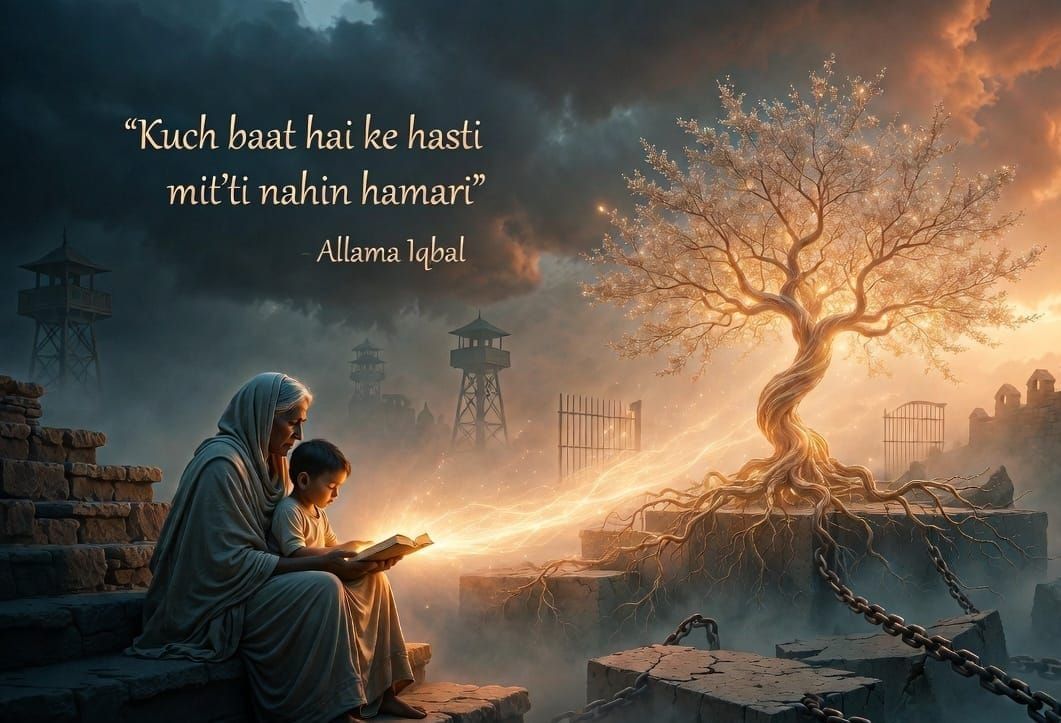
Sadiyon raha hai dushman daur-e-zaman hamara — the age itself has been our adversary, century upon century, and still we have not ceased to be. Iqbal did not write this line as consolation. He wrote it as observation, almost as a law of nature, the way one might note that water finds its level or that pressure seeks release. There is something in the persistence of the oppressed that resembles physics more than sentiment.
History is, among other things, a record of powers that mistook the temporary silencing of a people for their permanent erasure — and were wrong.
The mathematics of domination
Every system of oppression operates on an implicit arithmetic: enough force, applied for enough time, will reduce a people to nothing — no memory, no claim, no future tense. The logic is seductive because in the short run it appears to work. Populations are displaced. Languages are banned. Archives are burned. The oppressor experiences, in his own lifetime, what feels like total success.
But the arithmetic is wrong, and it is wrong in a specific way: it treats identity as a quantity that can be subtracted, when identity behaves instead like a seed — compressible, buriable, dormant for a generation or three, but not divisible by force into zero. The philosopher Ashis Nandy observed that the colonized carry the colonizer's violence not only as wound but as knowledge — a knowledge that eventually turns the instruments of domination back on their makers. What is meant to erase becomes, in time, the very archive of resistance.
Case studies in the failure of erasure
India under the Raj. For nearly two centuries an empire that controlled the printing press, the courtroom, the currency, and the army told a subcontinent it was incapable of governing itself. The empire had every instrument of permanence available to it — railways, cantonments, a civil service built to outlast generations. It ended in 1947, not because the empire ran out of force, but because it ran out of the one thing force cannot manufacture: the consent of the governed to their own disappearance.
Apartheid South Africa. A state apparatus — laws, prisons, a president's signature — spent four decades engineering the permanent subjugation of a majority by a minority. Robben Island was built to be the place where a man's public life ended. Instead it became the place from which Nelson Mandela's authority, on release, was unimpeachable. The prison meant to erase produced instead a moral stature the state itself could not survive.
The Berlin Wall. Concrete, watchtowers, a shoot-to-kill order — the most literal attempt in modern history to divide a people permanently in two. It stood twenty-eight years, long enough that a child born beside it could reach adulthood believing it eternal. It fell in a single November night, not through invasion but through the accumulated weight of people simply refusing, in ordinary and undramatic ways, to accept the permanence they were told to accept.
Slavery and the long abolition. For centuries, law across continents defined entire peoples as property — a category designed to place a human being permanently outside the reach of rights, memory, or futurity. The abolition movements that dismantled this took generations, cost enormous suffering, and remain incomplete in their afterlives. But the foundational claim — that a people could be legally and permanently reduced to objects — did not survive. The category collapsed under the same pressure Iqbal names: something in the enslaved that refused the arithmetic of the ledger.
What the pattern suggests
None of these victories were quick, clean, or free of loss. Judith Butler's notion of precarious life is useful here: populations marked for erasure are made grievable or ungrievable by design — the oppressor's first move is always to make the victim's suffering illegible, unworthy of witness. And yet in every case above, the suffering eventually became legible anyway — through testimony, through the sheer accumulation of documented cruelty, through the strange durability of memory passed hand to hand when it could not be passed through official channels.
Antonio Gramsci's account of hegemony offers the mechanism: domination that relies only on force is always temporary, because force cannot manufacture belief. A ruled people who never consent to their subjugation remain, at the level of culture and self-understanding, ungoverned — and that ungoverned interior is where every eventual reversal begins. The tank can occupy a square. It cannot occupy what a grandmother tells a child at night.
The couplet as thesis, not comfort
Iqbal's line is often read as an assertion of resilience for its own sake — beautiful, defiant, spiritually stirring. But read against this history, it is closer to an argument: erasure requires the erased to forget who they are, and no power yet devised has found a reliable way to compel that forgetting. Empires end. Walls fall. Ledgers that once counted men as cargo are burned by the descendants of the counted. The instruments of oppression are, without exception, more perishable than the thing they are built to destroy.
Kuch baat hai ke hasti mit'ti nahin hamari. Not sentiment — arithmetic. The oppressed have, so far, always outlasted the ledger.
Colonel Maqbool Shah is a retired Indian Army officer. He writes on politics, culture and strategy.