The Terror Label Expands
America’s New Counterterrorism Doctrine and the Politics of Threat
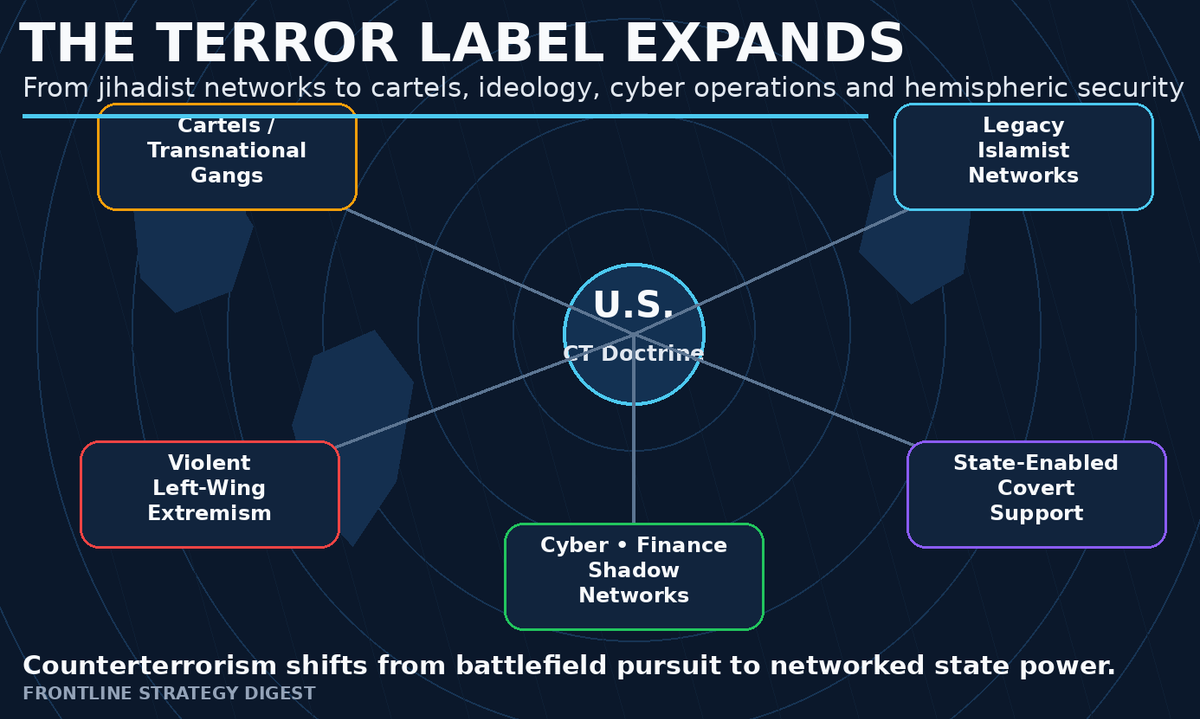
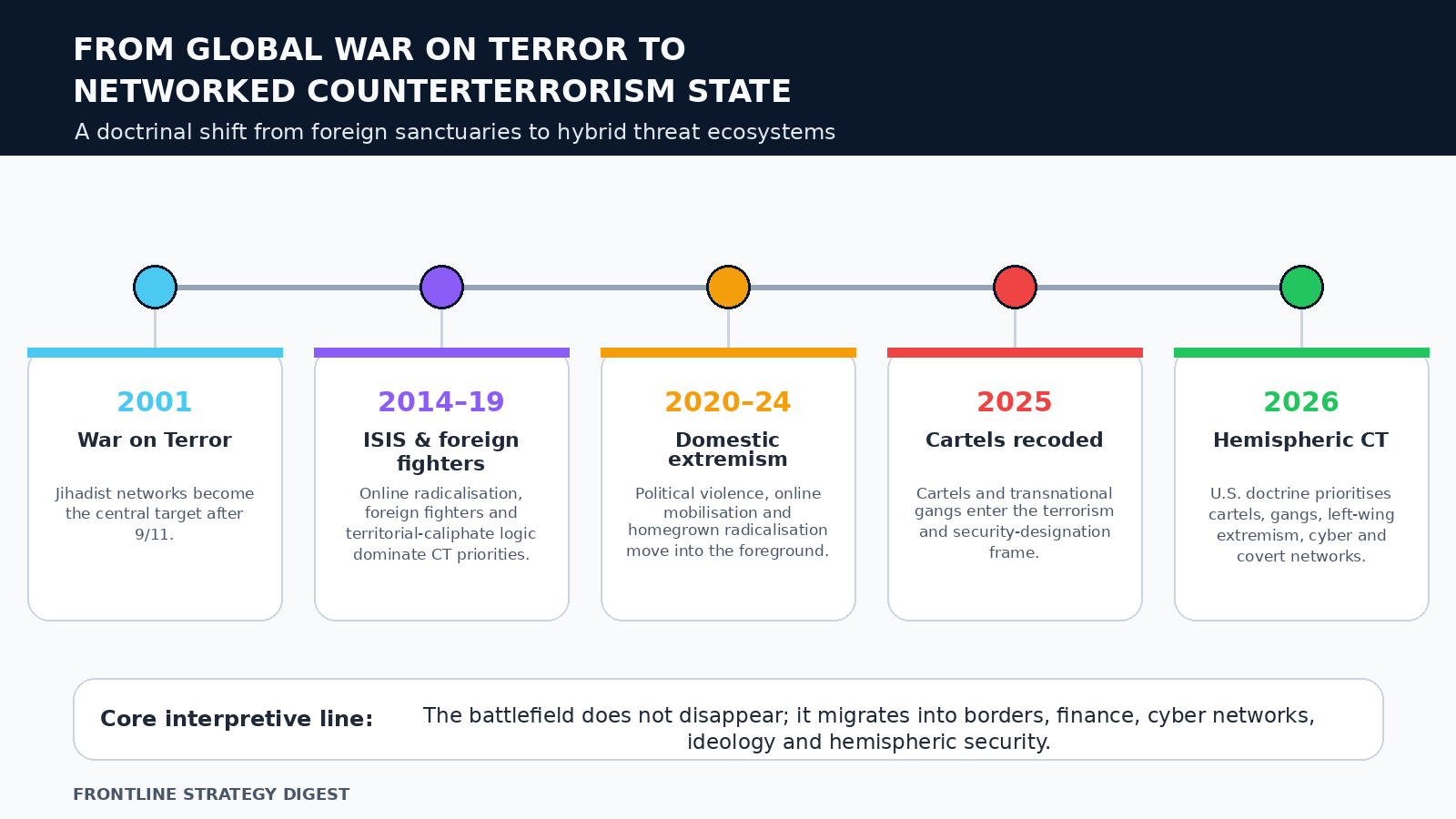
The new U.S. Counterterrorism Strategy is not a routine bureaucratic update. It is a doctrinal turn. It shifts American counterterrorism away from the post-9/11 centre of gravity — al-Qaeda, ISIS, jihadist networks, Middle Eastern safe havens, and foreign training camps — towards a broader and more politically charged conception of threat: cartels, transnational gangs, Islamist groups, state-enabled covert networks, and domestic ideological enemies.
The significance of this New CT Doctrine is deeper: Washington is no longer treating counterterrorism as a narrow campaign against organisations that use spectacular violence for political ends. It is converting counterterrorism into a larger security grammar through which drugs, migration, border control, political extremism, cyber operations, sanctions, and hemispheric dominance are brought under one umbrella.
The strategy identifies three principal threat categories: “narcoterrorists and transnational gangs”, “legacy Islamist terrorists”, and “violent left-wing extremists, including anarchists and anti-fascists.” It also explicitly prioritises the “neutralization of hemispheric terror threats” by incapacitating cartel operations.
This is the key phrase: hemispheric terror threats. It is the language of a repurposed Monroe Doctrine.
The United States is saying, in effect, that its first counterterrorism theatre is no longer Afghanistan, Iraq, Syria, Yemen or Somalia. It is the Western Hemisphere: Mexico, Venezuela, the Caribbean, Central America, maritime trafficking routes, migration corridors, criminal-financial networks, and regimes accused of complicity with cartel or anti-American activity. Reuters reported that Sebastian Gorka, the White House counterterrorism director, described the strategy as focused on “neutralization” of hemispheric threats and incapacitating cartel operations.
That is a major geopolitical reclassification. A cartel is not merely a criminal organisation. It becomes a terrorist-adjacent actor. A border is not merely an immigration-control line. It becomes a forward counterterrorism frontier. A smuggling boat is not merely a law-enforcement target. It becomes a military target. A hostile Latin American regime is not merely a bad neighbour. It becomes a covert sponsor or enabler of terror.
The strategy’s language is explicit about this fusion. It speaks of sanctions, shadow-fleet oil-tanker interdiction, covert operations, dual-use technologies, drones, advanced weapons, precursor chemicals and offensive cyber operations against those planning to kill Americans or supporting those who do.
In other words, the counterterrorism toolkit is being widened from kinetic strike and intelligence pursuit to include financial warfare, maritime interdiction, cyber disruption, covert action and supply-chain control. This is not simply “counterterrorism”. It is counter-network warfare.
There is a strategic logic here. Modern cartels are not primitive smuggling gangs. Some have logistics, intelligence, local political penetration, drone capability, money-laundering architecture, territorial control and transnational reach. The January 2025 executive order that began the process of designating cartels as Foreign Terrorist Organizations argued that cartels had become quasi-governmental entities in parts of Mexico and posed a national-security threat beyond traditional organised crime.
From Washington’s perspective, fentanyl deaths, migrant flows, cartel violence, money laundering and foreign-state penetration are no longer separate problems. They are being fused into a single strategic diagnosis: America is being attacked not only by terrorists in the old sense, but by criminal-political ecosystems that degrade sovereignty from below.
But the danger lies precisely in that fusion.
Once the word “terrorism” is attached to a problem, normal legal and political restraints weaken. Terrorism is not a neutral category. It is a category that authorises exceptional measures. It opens doors to surveillance, asset seizure, cross-border action, intelligence authorities, military force, preventive detention, sanctions, blacklisting, drone strikes, cyber actions and political delegitimisation. The terrorist is not merely a criminal. He is placed outside the normal moral community.
That is why the expansion of the terror label must always be watched carefully.
The first risk is mission creep. If cartels are terrorists because they traffic drugs, control territory and corrupt governments, then other violent criminal networks may be similarly designated. If ideological movements are treated as terrorism because some individuals commit violence in their name, then political dissent can gradually be securitised. If state support to adversarial networks is treated as terrorism, then counterterrorism begins to merge with great-power competition.
The second risk is sovereignty friction. The strategy says the United States will work with local governments where they are willing and able, but will still take necessary action where they cannot or will not act, especially where governments are complicit with cartels. That is a very consequential sentence. It leaves open the possibility of unilateral U.S. action in another state’s territory. This may result in potential land-based strikes against Mexican cartels and is therefore not fanciful. Although, at this moment it remains an inference rather than a formally declared policy.
If such action ever occurs, it will produce a crisis not merely with cartels but with states. Mexico, in particular, cannot easily accept a doctrine that treats portions of its security landscape as a permissible American battle-space. Even friendly governments in Latin America will worry about precedent. A doctrine created for cartels today can be used for insurgents, militias, gangs, political movements or regime-linked actors tomorrow.
The third risk is politicisation at home. The strategy insists that counterterrorism powers will not be used against Americans who merely disagree with the government. Yet its threat taxonomy gives special emphasis to violent left-wing extremism, anarchists, anti-fascists and “radically pro-transgender” ideology. That language is not technocratic. It is politically loaded.
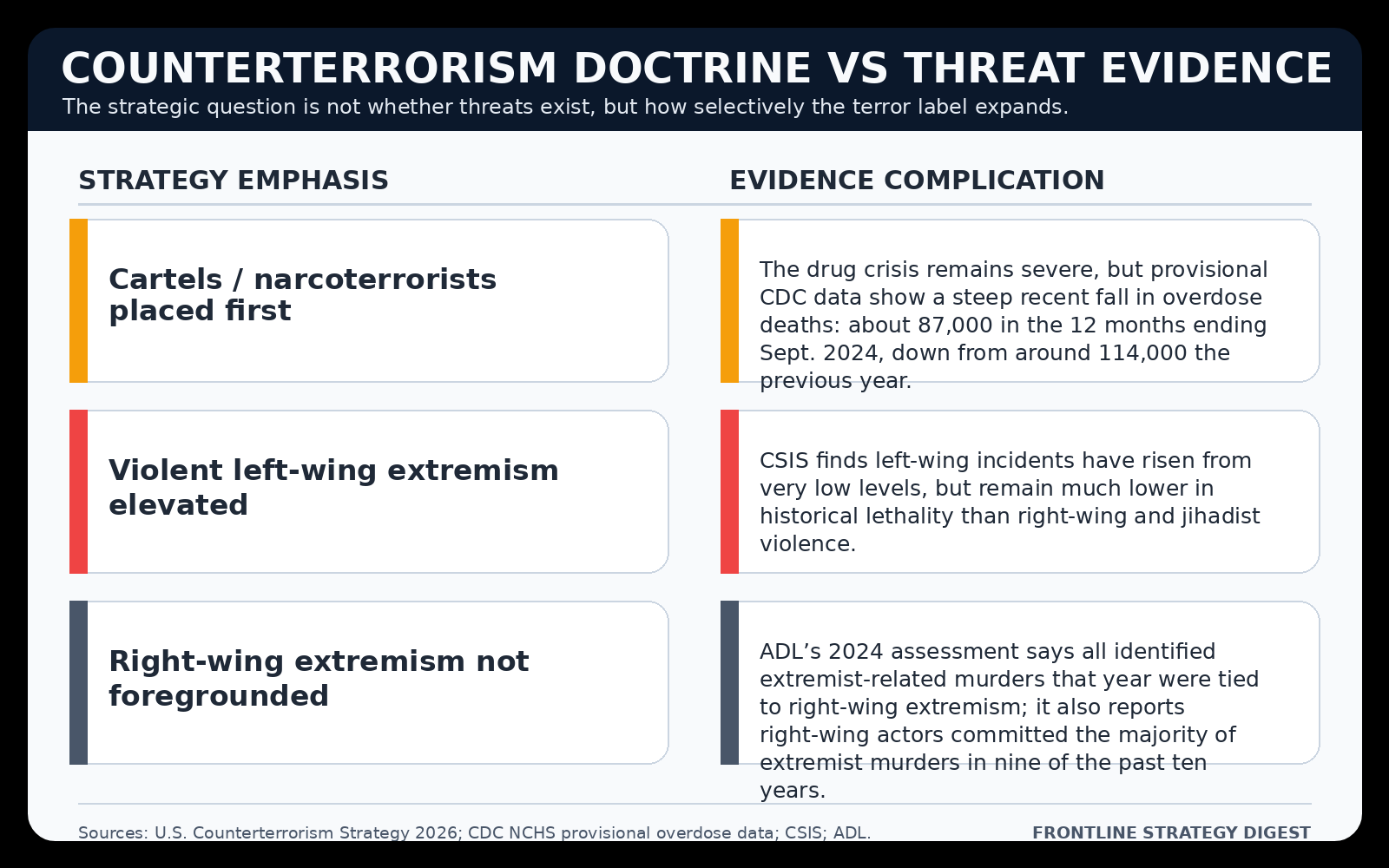
This is where the omission of far-right extremism becomes analytically significant. The document’s central taxonomy names left-wing extremism but does not include far-right or white-supremacist extremism as a comparable category. Lawfare’s summary likewise notes that the strategy focuses on cartels, jihadists and left-wing actors.
That omission sits uneasily with available terrorism data. CSIS found that left-wing terrorism and political violence in the United States have risen in recent years, but also that such violence rose from low levels and remains much less lethal historically than right-wing and jihadist violence. ADL’s 2024 assessment found that all extremist-related murders in the United States that year were committed by right-wing extremists, and that far-right extremists had committed most extremist-related murders over the previous decade.
This does not mean left-wing violence is imaginary. It is not. Any ideological violence — left, right, Islamist, racial, sectarian or anti-state — must be treated seriously. But threat doctrine must be proportional to evidence. When doctrine highlights one ideological enemy and downplays another, counterterrorism begins to resemble political sorting.
That is corrosive for a republic.
The deeper issue is that terrorism is no longer just a security description. It is becoming a sovereignty instrument. The state names the terrorist, and by naming him it decides who is inside the circle of legitimate politics and who stands outside it. After 9/11, this power was largely directed outward. Now it is moving inward and southward: towards the border, towards Latin America, towards domestic ideological movements, towards digital networks, towards adversarial states, and towards contested social identities.
This is where the strategy becomes a document of our age. The twentieth-century state was preoccupied with armies, borders and ideologies. The post-9/11 state was preoccupied with jihadist networks. The present state is preoccupied with hybrid insecurity: drugs, drones, migrants, militias, cyber actors, online radicalisation, money flows, proxy networks, social unrest and failing borders. The new American CT strategy is a response to that world — but also an acceleration of it.
Its strategic premise is powerful: threats are networked, so the response must be networked. Its political weakness is equally clear: when everything becomes part of the terror ecosystem, the state acquires too much discretion over who may be treated as an enemy.
For India and the wider world, the lessons are instructive.
First, the American strategy confirms that the distinction between crime, terrorism and insurgency is narrowing. States will increasingly use counterterrorism authorities against non-traditional actors: cartels, narco-networks, separatist financiers, cyber-enabled criminal syndicates, proxy militias and ideological mobilisation platforms.
Second, it shows that border security is returning to the heart of national-security doctrine. Migration, trafficking, drugs and terrorism are being fused in the strategic imagination of powerful states. This will influence Europe, India, Israel, Russia, China and many middle powers.
Third, it warns that counterterrorism can easily become a language of domestic politics. Governments everywhere may be tempted to classify inconvenient dissent, minority assertion, street mobilisation, radical student politics, ethnic unrest, religious mobilisation or ideological protest under elastic security categories. Once this begins, democratic space contracts quietly, often under public applause.
Fourth, the strategy suggests that the Western Hemisphere may become an active theatre of coercive U.S. policy. The Middle East will not disappear from American CT priorities; the strategy still names al-Qaeda, ISIS, ISIS-K, AQAP, Iran, Hezbollah, Hamas and the Houthis. But the operational imagination has moved closer to home. America’s “forever war” is not ending; it is being territorialised nearer the homeland.
The next phase may include expanded maritime interdiction, intensified cyber operations, deeper sanctions against cartel-linked businesses, financial pressure on precursor-supply chains, intelligence-led captures, covert operations, and possibly limited kinetic action. But the more consequential development will be conceptual: the terror label will travel more easily from jihadist camps to cartel routes, from foreign networks to domestic movements, from battlefield to border, from enemy combatant to political deviant.
That is the real story.
America’s new counterterrorism doctrine is not merely about who threatens the United States. It is about who gets to define threat in an age of disorder. It reflects a world in which sovereignty feels porous, society feels polarised, borders feel vulnerable, and governments feel compelled to act before law and politics can catch up.
The doctrine may produce tactical successes. It may hurt cartel finances. It may disrupt drug routes. It may deter some hostile state activity. It may sharpen intelligence focus after years of bureaucratic diffusion. But it may also create intelligence blind spots, alienate partners, provoke sovereignty crises, and legitimise selective ideological policing.
The strongest counterterrorism doctrines are disciplined by evidence, law and restraint. The weakest ones are driven by fear, theatre and domestic political appetite. The danger in the new U.S. approach is not that cartels are harmless or that left-wing violence should be ignored. The danger is that counterterrorism may become too elastic, too ideological, and too useful to power.
The old war on terror began with a terrible morning in September 2001. The new war on terror begins in a foggier world — a world of fentanyl, failed borders, proxy regimes, digital rage, collapsing trust and ideological fury. Its battlefield is no longer “over there”. It is the hemisphere, the border, the internet, the street, the financial system, and the inner life of the republic itself.
Frontline Judgment:
The United States is not abandoning counterterrorism. It is redefining it. The centre of gravity is shifting from jihadist sanctuaries to hybrid threat ecosystems — cartels, covert state networks, ideological violence, cyber support structures and hemispheric insecurity. The strategic logic is understandable. The political danger is immense. When the category of terrorism expands, the power of the state expands with it.
Maqbool Shah is a strategic analyst, retired Indian Army Colonel, and founder-editor of Frontline Strategy Digest. His work focuses on geopolitics, security doctrine, civil–military affairs, and the moral consequences of state power.