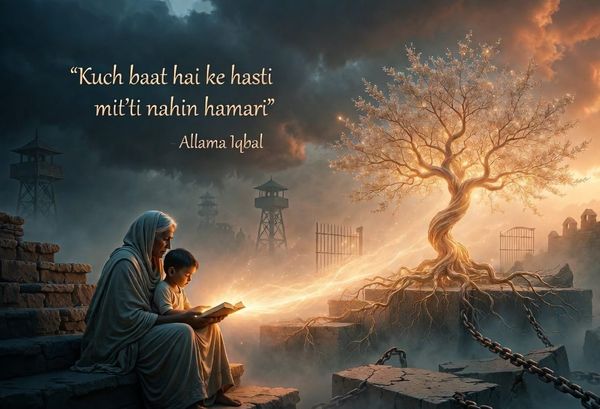
The Mahfil and the Unheard Heart

On the Longing for a Listener Who Truly Understands
ये महफ़िल है ख़िरद-मंदों की महफ़िल, (Yeh mahfil hai khird mandoon ki mahfil)यहाँ किस से कहूँ दिल की कहानी… (Yahan kis se kahein dil ki kahani) - Minhaj Ali
There are gatherings in which one is admired, welcomed, even heard—and yet remains, in the deepest sense, untouched. The room is bright with intelligence. Speech moves with polish. Ideas arrive dressed, prepared, and persuasive. Every thought is received with the seriousness accorded to structure, coherence, and command. And yet the heart, carrying its old weather in silence, finds no climate in which to open.
This is not the loneliness of neglect. It is the loneliness of being among the eloquent and still finding no language adequate to grief. For there are rooms in which everything may be discussed except the wound in its native form. One may bring sorrow there, but only if it has first been translated into insight. One may speak of love, but only if love has already become philosophy. One may mention pain, but only after pain has been rendered intelligible.
And so one learns to belong while remaining inwardly absent.
The Brilliant Room
There is a peculiar sadness in the company of the gifted. Not because intelligence is hostile to feeling, but because intelligence often arrives with habits that feeling cannot survive. The brilliant room listens quickly. It names swiftly. It places each utterance into a framework almost before the sentence has ended. It is generous, attentive, alert—and fatally inclined to convert confession into material.
That is why the anonymous couplet wounds so deeply. The complaint is not against indifference, nor against vulgarity, nor against the crude failures of companionship. The complaint is subtler. The speaker is surrounded by ख़िरद-मंद (khirdmand)—people endowed with reason, refinement, interpretive skill. Yet precisely there he asks: यहाँ किस से कहूँ दिल की कहानी…(Yahan kis se kahein dil ki kahani) - To whom here shall the story of the heart be told?
The question is not rhetorical alone. It is existential. It asks whether the heart can survive in a world where it must always first pass through the tribunal of intellect.
What the Heart Needs
The heart does not always seek agreement. It does not even seek consolation. More often, it seeks a listener before whom it need not become coherent in order to be held. There are sorrows still forming themselves, griefs that do not yet know their own grammar, longings that recoil the moment they are forced into explanation. To speak them too early is to injure them. To define them too soon is to lose them.
That is why being analyzed when one longs to be received can feel like a subtle dispossession. Nothing violent occurs. No obvious cruelty is done. And yet the inward life comes away diminished, as though something intimate has been turned, in mid-utterance, into an object of thought. The listener may understand the structure of the wound while remaining untouched by its temperature.
This is one of the oldest human griefs: not that no one listens, but that so few know how to listen without mastery.
Darwish and Exile
Mahmoud Darwish, among the great poets of estrangement, wrote with unmatched intimacy about the condition of being present and yet unplaced. Again and again, his voice returns to the ache of standing at once inside and outside one’s own life. In one of his most haunting formulations, he says: I am from there. I am from here. I am not there and I am not here. Few lines speak more exactly to the inward dislocation of one who moves among others with outward fluency and inward homelessness.
That is the condition of the unheard heart. It is not mute. It may be highly articulate. It may write, speak, persuade, publish. But articulation is not recognition. One can be perfectly understood at the level of statement and remain entirely unaccompanied at the level of being.
Darwish also understood that silence is not emptiness but burden. The unsaid is not always a lack; often it is the final dignity of what cannot survive reduction. Some griefs refuse utterance not because they are weak, but because language, in ordinary company, cannot bear their full weight.
Faiz and the Long Evening
Faiz Ahmed Faiz remains one of the indispensable poets of deferred speech, of sorrow disciplined by music. His voice does not wail so much as endure, and that endurance is precisely what breaks the reader. दिल ना-उमीद तो नहीं, नाकाम ही तो है / लंबी है ग़म की शाम, मगर शाम ही तो है—(Dil na umeed to nahin, nakaam hi to hai; Lambi hai gham ki shaam magar shaam hi to hai) - the heart is not without hope, only unsuccessful; the evening of grief is long, but it is only an evening.
Yet for many, the evening does not lift. It lingers as a permanent half-light. One continues to function, to speak with elegance, to participate in the republic of intellect, while inwardly inhabiting an hour that never advances. In such a state, Faiz offers not escape but companionship. He does not dissolve sorrow; he gives it cadence.
Elsewhere, memory in Faiz enters the heart like a secret season: रात यूँ दिल में तेरी खोई हुई याद आई / जैसे वीराने में चुपके से बहार आ जाए (Raat yun dil mein teri khoyi huyi yaad aayi; Jaise veerane mein chupke se bahar aa jaye) — your lost memory came into my heart at night as spring enters quietly into a wilderness. But even this beauty has its own cruelty. For memory may arrive with tenderness and still leave nothing altered. The heart blooms for an instant only to discover that the landscape around it remains barren.
Faraz and the Limits of Speech
Ahmad Faraz belongs to that rare class of poets whose simplicity is a form of devastation. His lines often sound as though they were uttered after the argument had ended, when only truth remained. अब के हम बिछड़े तो शायद कभी ख़्वाबों में मिलें / जिस तरह सूखे हुए फूल किताबों में मिलें (Ab ke hum bichhde to shayad kabhi khaboon mein milein; Jis tarah sookhe huye phool kitaboon mein milein) —if we part this time, perhaps we shall meet only in dreams, like dried flowers found in books.
This is not merely a couplet about separation in love. It is also an image of how feeling survives in the modern world: preserved, beautiful, and no longer alive. So much of what passes for intimacy now resembles Faraz’s dried flower—proof that something once bloomed, but no longer possessing fragrance, weather, or breath.
Faraz also understood the final solitude of the heart: कि दिल की बात क्या है, दिल ही जाने और ख़ुदा जाने (Ki dil ki baat kya hai?; Dil hi jaane ya khuda jaane) —what the heart contains, only the heart and God know. This is not an argument for despair. It is a recognition that some inward realities do not become more true by becoming public. They remain real even when unsaid. Perhaps they remain most real there.
Rumi and Recognition
Long before modern psychology, Jalaluddin Rumi understood the wound of separation as the condition of consciousness itself. The reed flute at the opening of the Masnavi does not ask to be decoded; it asks to be heard in the register of separation. Listen to the reed, how it tells a tale, complaining of severances. The reed’s cry is not analysis. It is the sound of torn belonging.
This is why the Sufi inheritance remains so vital to the question of listening. In the Sufi imagination, the deepest truths are not always propositions to be mastered but states to be entered. One does not stand over the sorrow of another as an interpreter. One stands beside it until one’s own soul begins to recognize its vibration. Understanding, here, is less a matter of explanation than of resemblance.
To be heard in this sense is to be recognized before being resolved. It is to encounter a presence that does not rush to translate one’s pain into wisdom. Such presence is rare because it demands the suspension of mastery. It asks the listener to surrender the prestige of interpretation and accept the humility of company.
Blake and the Wound of Perception
William Blake, though formed in another tradition, speaks powerfully to this divide between perception and reality, between what is seen and what is known. His work repeatedly warns against the deadening effects of habitual vision, the mind’s tendency to imprison life inside categories of its own making. The wound, under such a gaze, ceases to be a wound and becomes an example.
Blake’s lines often feel like prophecies against the violence of reduction. To see only with the eye and not through it is to mistake surface for truth. Much the same happens in the brilliant room: one sees the composure, the eloquence, the discipline, and mistakes them for wholeness. One does not notice the inward life paying for every sentence with concealment.
There are sufferings that become more invisible the more articulate the sufferer is.
The Performed Self
Perhaps that is the deepest sorrow of all: that one gradually becomes skilled in one’s own disappearance. The world rewards composure. It values lucidity, proportion, irony, resilience. A person learns to present fractures as insights, confusion as depth, longing as style. The performance is not false. It may even be admirable. But over time one begins to suspect that what is being admired is precisely the mask necessity has perfected.
This is why the heart sometimes falls silent not out of weakness, but out of self-preservation. It knows that not every room deserves its vulnerability. It knows that what cannot be received whole should not be offered in pieces. Silence, then, is not always failure. Sometimes it is the last uncolonized province of truth.
Darwish, Faiz, Faraz, Rumi, and Blake meet here—in that dark territory where language approaches its limit and must either become prayer, music, or fragment. None of them offers the easy optimism of resolution. What they offer instead is far more necessary: the dignity of recognition. They make solitude audible. They allow pain to remain pain without forcing it prematurely into lesson or cure.
Poetry as the Last Refuge
And perhaps that is why the heart, denied a listener in ordinary speech, turns instinctively toward poetry. Poetry is the one form that does not demand full explanation before granting legitimacy. It allows contradiction, fracture, silence, and incompletion to stand. It permits sorrow to arrive as image, cadence, and echo rather than argument.
The person who cannot speak plainly in the mahfil may still write a line that enters the bloodstream of strangers. What fails in conversation may survive in verse. What cannot be discussed may yet be sung. This is not a remedy so much as a transfiguration of the wound: isolation is given form, and form becomes a secret companionship with unseen others.
To say, then, यहाँ किस से कहूँ दिल की कहानी…(Yahan kis se kahein dil ki kahani….) - is not only to lament the absence of a listener. It is also to explain the necessity of literature. The unheard heart does not fall silent forever. It creates another chamber of hearing. It fashions from metaphor, rhythm, and borrowed voices the listener it could not find in life.
Coda
In the end, the longing is simple, though almost never fulfilled. It is not for agreement. Not for applause. Not even for comfort. It is for one human being before whom one need not perform coherence.
Such people are rare. More often one is left with poems.
And perhaps that is why the great poets continue to matter: because they do not interrupt the sorrow to improve it. They stand near it. They give it speech without robbing it of mystery. They let the heart remain a heart.
The mind seeks answers. The heart seeks recognition. Between the two stretches the whole sadness of being human.
Colonel Maqbool Shah is a retired Indian Army officer living in Jammu - India.