The Greenland Gambit: Strategic Capture Without Annexation
Special Issue | 24 May 2026
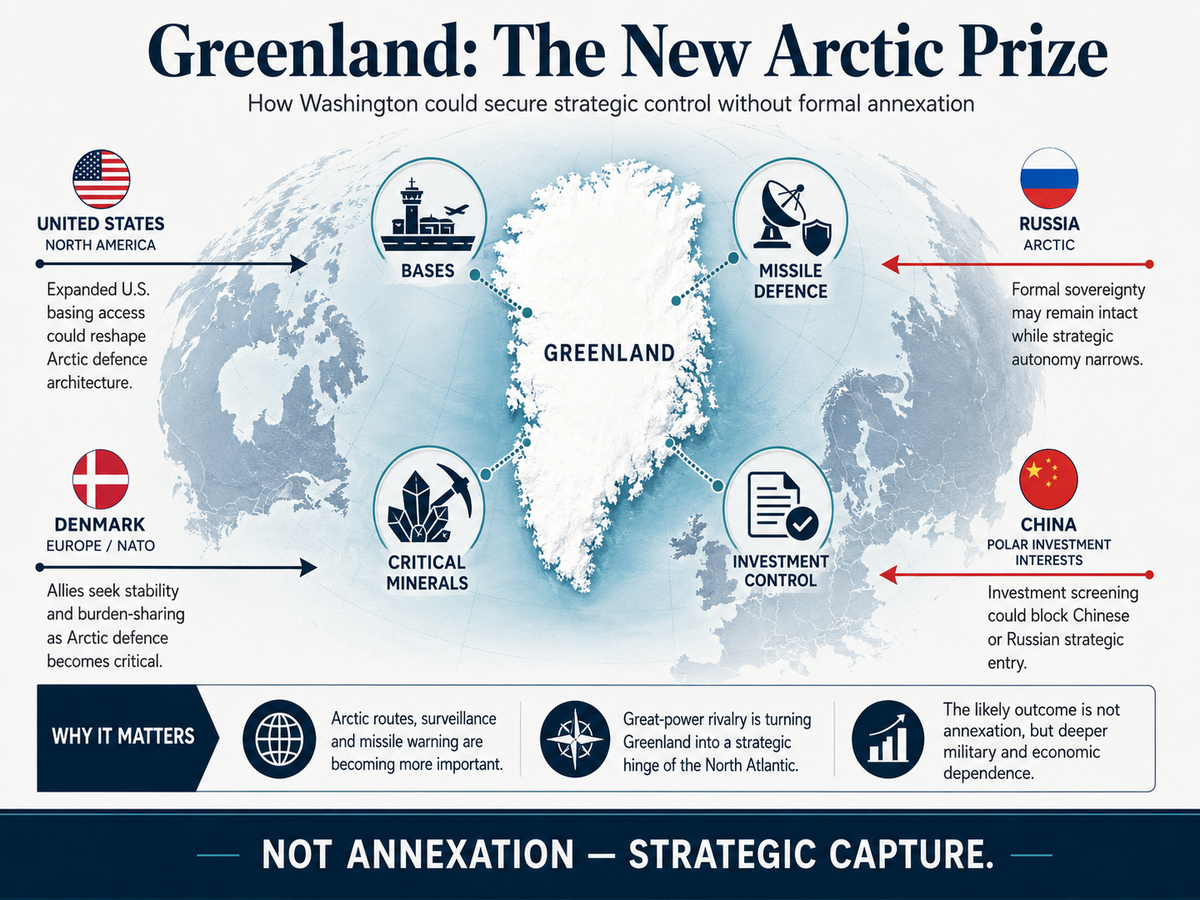
Greenland is again at the centre of world politics, but the real story is not the dramatic question of whether the United States can “buy” or annex the island. That language is useful for headlines, but misleading as strategy. The deeper contest is over something subtler and more durable: whether Washington can secure practical strategic control over Greenland’s military geography, mineral future, investment regime and Arctic defence role without formally altering sovereignty.
That distinction matters. Greenland may never become an American territory. Its flag may remain unchanged. Denmark may retain formal sovereignty within the Kingdom. Nuuk may continue to insist, correctly and forcefully, that Greenland is not for sale. Yet the United States may still gain much of what it wants if it secures expanded basing access, privileged mineral channels, investment-screening influence and long-term integration of Greenland into American missile-defence and Arctic-surveillance systems.
Recent public reporting points in precisely this direction. Greenland’s prime minister, Jens-Frederik Nielsen, has stated that Greenland is not for sale and that self-determination is non-negotiable, even as talks with Washington and Copenhagen continue. Reuters has reported that the United States is seeking a greater military presence on the island and wants Greenland incorporated into President Trump’s proposed “Golden Dome” defence architecture.
The legal foundation is already present. The 1951 US-Denmark defence agreement provides for American defence areas in Greenland under agreed arrangements connected to North Atlantic security. Later documentation confirms that the existing Thule/Pituffik facility is not necessarily the outer limit of the framework; the agreement’s provisions can apply to the establishment of new defence areas.
This is why annexation may be the wrong lens. Washington does not need Greenland’s formal transfer if it can obtain the operational substance: bases, sensors, airfields, radar coverage, missile-warning infrastructure and political influence over strategic investment. In imperial terms, this is not the old model of possession. It is the newer model of strategic dependency.
The geography explains the urgency. Greenland sits between North America and Europe, close to the Arctic approaches, the North Atlantic sea lanes and the GIUK gap. During the Cold War it mattered because of Soviet bombers, submarines and missile trajectories. In the present era it matters because of Russia’s Arctic posture, China’s polar ambitions, undersea infrastructure, space-domain awareness, long-range missile warning and future polar shipping routes.
The mineral dimension is just as important. Greenland contains globally significant rare-earth and critical-mineral potential. CSIS has identified the Kvanefjeld and Tanbreez deposits as central to renewed interest in Greenland’s mineral wealth, while also noting the island’s severe infrastructure, climate and political constraints. For Washington, this is not merely a commercial question. Critical minerals now sit at the intersection of defence production, clean-energy transition, electronics, advanced manufacturing and supply-chain security.
China is the shadow presence in this debate. Beijing’s actual footprint in Greenland remains limited, and some analyses suggest Chinese companies have struggled to convert interest into major projects. But in Washington’s strategic imagination, even the possibility of Chinese or Russian entry into Greenlandic infrastructure, mining or logistics is treated as a national-security risk. Reuters has reported that Greenlandic lawmakers have been moving toward foreign-investment screening rules, partly because of concern over politically motivated foreign capital.
The emerging compromise, therefore, may take the form of sovereignty preserved but autonomy narrowed. Greenland would not be annexed. Denmark would not be forced to surrender it. Europe could claim that territorial integrity had been protected. The United States could claim that Arctic security had been strengthened. But the underlying balance would shift: Greenland’s military and economic future would become more tightly embedded in American strategic planning.
That is the essence of the Greenland gambit. The United States may fail to obtain Greenland as territory but still obtain Greenland as platform. It may not own the island, but it may shape the terms under which others can invest, operate, mine, build or defend there. Formal sovereignty would survive. Strategic discretion would shrink.
For Greenlanders, this is a difficult historical moment. The island seeks development, investment, self-government and eventual political maturity. Yet the more valuable Greenland becomes, the harder it becomes for Greenland to act as an ordinary small polity. A vast island with a small population, immense resources and decisive geography cannot remain untouched by great-power rivalry. Its aspiration is self-determination. Its predicament is strategic exposure.
For Denmark and Europe, the dilemma is equally severe. They cannot accept American coercion against a territory linked to a European NATO ally. Yet they cannot ignore the reality that the United States remains indispensable to Arctic defence, NATO deterrence and North Atlantic security. This creates a paradox: Europe resists Trump’s language but may ultimately accommodate much of America’s strategic demand.
The likely outcome is therefore not a clean victory for any side. It is more likely to be a layered arrangement: additional American access; stronger US-Danish-Greenlandic defence coordination; investment-screening mechanisms to block adversarial capital; preferential Western access to critical minerals; and a public formula affirming that Greenland’s sovereignty and self-determination remain intact.
But that formula will conceal the deeper transformation. Greenland will not be bought. It may instead be absorbed into a security architecture from which it will find it increasingly difficult to detach. The map may remain unchanged, but the operating code of the Arctic will change.
This is the pattern of twenty-first-century power. Control no longer always requires annexation. It can be exercised through bases, contracts, screening regimes, supply chains, military interoperability, intelligence architecture and infrastructure finance. The flag remains local; the strategic logic becomes external.
Greenland is therefore not only a territorial question. It is a warning about the emerging world order. The coming age will be fought not only over states, but over chokepoints, seabeds, minerals, ports, islands, polar corridors, cables, satellites and airfields. The language will remain one of partnership and rules. The practice will increasingly be one of strategic capture.
The most important sentence in the Greenland story is not “Trump wants Greenland.” It is this: America may not need to annex Greenland in order to get what it wants from it.
Colonel Maqbool Shah, SM (Veteran), Indian Army, served 33 years in the Indian Army, including tenures in the Military Operations Directorate and command of an infantry battalion on the Line of Control. He also served with the United Nations as Liaison Officer across 42 nations in Iraq after the First Gulf War. He is Founding Editor of Frontline Strategy.