The Fracture Lines Harden
Civilizational Conflict, Resource Wars, Maritime Chokepoints and the Remaking of World Order
A Strategic Working Paper by Colonel Maqbool Shah (Veteran) Version 4 Updated: 19 May 2026
Editor’s Note
The argument developed in this essay has troubled me for more than three decades. I first read Samuel Huntington’s essay, “The Clash of Civilizations?”, in Foreign Affairs in August 1993, while I was still in service. I also followed, with great interest, the fierce debate that erupted after its publication. Many dismissed Huntington as alarmist, reductive, even dangerous. Yet, whether one agreed with him or not, his thesis compelled serious readers to look at the post-Cold War world with a different lens.
For me, that lens became sharper after my own tenure in Baghdad following the First Gulf War, earlier to the publication of the Huntington essay. There, in the broken landscape of power, humiliation, sanctions, occupation anxieties and strategic manipulation, I could see more clearly what Huntington may have been pointing towards: not a neat clash of sealed civilizations, but a world in which memory, power, identity, resentment, resources and imperial interest were becoming violently entangled. International politics was not merely about treaties, institutions and formal diplomacy. Beneath them moved older fears, civilizational wounds, religious memories, strategic ambitions and the cold arithmetic of power.
In that sense, the essay placed below has been in the making in my mind for over three decades. I began drafting it seriously around December 2023, after the horrific Hamas attack on Israeli civilians and the devastating retribution that the whole of Gaza began to suffer thereafter. Even then, I hesitated to place the draft in the public domain because events were moving with such speed and ferocity that any fixed analysis risked becoming outdated almost immediately.
The February 2026 US-Israel-Iran war altered the draft substantially. It seemed to mark a deeper rupture in the international order: the abandonment of restraint, the normalisation of decapitation logic, and the arrival of a more naked civilizational and strategic contest. The subsequent Xi-Trump summit, in my reading, marked another threshold — perhaps the first visible milestone in the remaking of a Huntingtonian world order, though not exactly in the form Huntington himself had imagined.
This essay is therefore not offered as a final verdict. It is a strategic working paper, an analytical backgrounder, and an invitation to critique. It seeks to examine the hardening fracture lines of the present world through the lenses of civilizational conflict, maritime chokepoints, nuclear insecurity, resource competition, technological disruption, and the politics of the global precariat. Its purpose is not to endorse fatalism, nor to celebrate conflict, but to provoke serious reflection on the dangerous architecture now taking shape before us.
I place it here for wider public circulation, comment and critique. Corrections, disagreements, empirical challenges and alternative readings are not only welcome; they are necessary. The times are too grave for certainties lightly held.
I. Huntington’s Ghost: A Prophet Revisited
When Samuel Huntington published his essay in Foreign Affairs in 1993 — later expanded into The Clash of Civilizations and the Remaking of World Order — the liberal academy largely dismissed him as a prophet of doom: a man who had mistaken his own anxieties for geopolitical theory. Francis Fukuyama’s “end of history” was then the preferred vocabulary of triumph. Liberal democracy, it was assumed, had won. The world’s remaining task was not to search for a new structure of conflict, but to extend the blessings of the victorious order to those still outside its gates.
Huntington was accused, not without reason, of essentialising civilizations, flattening cultures into blocs, and giving intellectual respectability to prejudice. Yet more than three decades later, the world has not had the decency to refute him. The fracture lines he identified — between the West and the Islamic world, between the Sinic sphere and the liberal order, between an assertive Russia and a disdainful Western Europe — have not disappeared. They have hardened, deepened, and in several theatres been drenched in blood.
The reported killing of Iran’s Supreme Leader Ali Khamenei in a joint American-Israeli operation on 28 February 2026 was not merely a tactical escalation. It marked a deeper rupture: the point at which decapitation warfare, regime-destabilisation and civilizational signalling converged in one act of state violence. Reuters reported that US-Israeli strikes hit Iranian leadership, military, missile and air-defence targets as the war opened.
This essay does not seek to celebrate Huntington’s thesis. It seeks to update it, contest its silences and carry it forward into the reality of the mid-2020s: a world simultaneously more connected and more violently fragmented than even Huntington imagined. Where he saw civilizations as blunt, monolithic actors, the twenty-first century has revealed them as internally fractured, economically stratified and haunted by the rage of those whom globalisation left behind.
The civilizational conflict now underway is not simply between the West and the Rest. It is also a conflict within each civilizational bloc: between elites and precariats, between beneficiaries and discarded populations, between those for whom identity is a political choice and those for whom it has become a cage.
II. The Architecture of the New Disorder
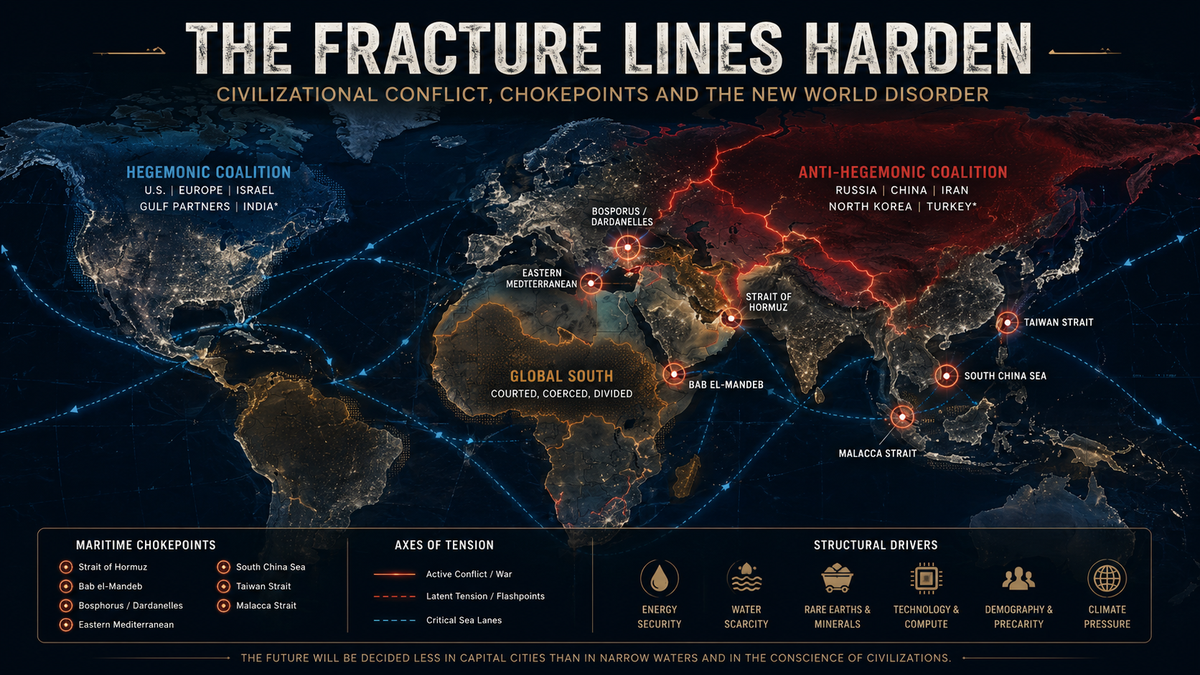
The world of 2026 is not bipolar in the Cold War sense. It is not yet multipolar in any stable sense either. It is instead entering a condition of armed fragmentation: overlapping alignments, transactional coalitions, opportunistic middle powers and increasingly weaponised interdependence.
On one side stands what may be called the hegemonic coalition: the United States, its European allies and dependencies, Israel, and — by compulsion, fear or calculation — several Arab monarchies of the Gulf. India, under the majoritarian nationalism of the Bharatiya Janata Party, has moved closer to this coalition emotionally, technologically and strategically, even while retaining the diplomatic language of the Global South.
On the other side stands a looser anti-hegemonic coalition: Iran, Russia, China, North Korea, and an increasingly self-confident Turkey whose long oscillation between West and East has become a strategy in itself. This is not an alliance in the NATO sense. It is a convergence of grievance, necessity and strategic opportunity.
Between these poles stands the Global South — Africa, Latin America, Southeast Asia and much of the postcolonial world — anxious, courted, coerced and divided. BRICS reflects this ambiguity. Officially, BRICS now includes Brazil, Russia, India, China, South Africa, Egypt, Ethiopia, Iran, Saudi Arabia, the UAE and Indonesia; its own institutional language presents it as a diplomatic coordination forum of the Global South. Yet its May 2026 foreign ministers’ meeting in New Delhi failed to produce a joint statement because of internal differences over the Middle East war, Gaza, maritime security and Red Sea/Bab el-Mandeb issues.
This is the essential fact of the new order: the West is no longer strong enough to command universal obedience, but the non-West is not yet coherent enough to replace it with a stable alternative.
What animates the competing coalitions is not merely ideology. It is fear. The hegemonic coalition fears demographic decline, loss of technological monopoly, the erosion of the dollar-centred financial order, and the passing of unipolarity. The anti-hegemonic coalition fears encirclement, sanctions, civilizational humiliation, technological dependence and regime destruction.
These fears are not equally justified, but they are equally real. And it is the collision of two sets of fears — not merely two sets of interests — that produces wars with civilizational resonance.
III. Turkey: The Indispensable Balancer
Of all the actors in the current civilizational drama, none is more strategically consequential — and more consistently underestimated — than Turkey.
Huntington placed Turkey in the category of a “torn country”, suspended between its Kemalist Western vocation and its Ottoman-Islamic inheritance. That ambiguity once made Turkey useful to both sides. Under Recep Tayyip Erdoğan, ambiguity has not disappeared; it has been converted into leverage.
Turkey has not chosen in the simple alliance sense. It has chosen leverage over loyalty.
Its assets are formidable. Turkey controls the Bosphorus and the Dardanelles, the only maritime passage between the Black Sea and the Mediterranean. It sits at the junction of Europe, the Middle East and Central Asia. It possesses the second-largest military in NATO. Its defence industry, particularly in drones, has altered tactical battlefields from Ukraine to Nagorno-Karabakh. Its military spending and regional deployments underline a state no longer content to be a flank power. SIPRI recorded global military expenditure at $2.887 trillion in 2025, with major increases across Europe and Asia; Turkey forms part of this wider militarised transformation of the Eurasian theatre.
Erdoğan’s project is not Islamism in the narrow ideological sense. It is Ottoman strategic memory with Islamic civilizational branding: the ambition to restore Turkey as an organising power in the political and military life of the Muslim world. Turkey’s military presence in Qatar, Somalia and Libya; its interventions in Syria and Libya; its support for the Palestinian cause; and its ability to talk simultaneously to Moscow, Washington, Tehran, Kyiv and Brussels make it one of the few states able to operate across fracture lines.
This is why Germany’s foreign minister stated in May 2026 that Turkey had the potential to influence both the Ukraine and Iran wars, while also urging stronger EU-Turkey strategic and defence ties. Europe knows that Turkey cannot be treated merely as a difficult NATO member. It is now an autonomous Eurasian actor.
For the anti-hegemonic coalition, Turkey is both asset and complication. Ankara sells drones to Ukraine, negotiates with Russia, challenges Kurdish forces in Syria, hosts NATO infrastructure, cultivates Qatar, contests Greek and Cypriot claims in the Eastern Mediterranean, and seeks influence across the Turkic world. This unreliability is not weakness. It is Turkey’s strategic genius.
The future question is not whether Turkey formally leaves NATO. It may never need to. The more important question is whether NATO can continue to function coherently when one of its most important members increasingly behaves like an independent civilizational power.
IV. Pakistan: The Fragile Bomb and the Unlikely Mediator
If Turkey is the most strategically important Muslim state in the coming civilizational conflict, Pakistan is the most dangerous.
It is a country of nearly 250 million people, a nuclear-armed state, a military-dominated polity, a fragile economy, and a geography that places it at the intersection of every significant Asian crisis: Afghanistan to the west, Iran to the southwest, India to the east, China to the north, and the Arabian Sea below.
Pakistan’s nuclear arsenal is estimated at roughly 170 warheads, broadly comparable with India’s, though all such numbers must be treated cautiously because nuclear-armed states do not fully disclose their stockpiles. The danger is not simply the existence of these weapons. It is the fragility of the state that contains them.
Pakistan’s civilian institutions are weak. Its economy remains dependent on IMF support, remittances and external financing. The IMF’s May 2026 review noted Pakistan’s progress under its programme but also highlighted the more challenging global environment created by the Middle East war and commodity-price pressures.
Yet Pakistan is not merely a risk object. It has also become a diplomatic channel. Reuters reported on 18 May 2026 that Pakistan had conveyed a revised Iranian proposal to the United States aimed at ending the ongoing war, with Iran using Pakistan as an intermediary.
Pakistan’s paradox is therefore stark: it is simultaneously a mediator and a tinderbox.
The trajectory of Israeli-American operations against Iran carries an implicit logic that Pakistan cannot ignore. Israel has long opposed hostile Muslim nuclear capability. Iran’s nuclear programme was the central target of that doctrine for decades. With Iran’s leadership decapitated and its nuclear infrastructure attacked, Pakistan’s generals cannot avoid the question: if Iran could be struck so decisively, what prevents a future crisis from placing Pakistan’s own nuclear infrastructure under similar scrutiny?
China remains Pakistan’s most important external guarantee. Beijing has invested deeply in the China-Pakistan Economic Corridor, Gwadar, and Pakistan’s strategic depth against India. But China cannot repair Pakistan’s internal political contradictions. It can underwrite infrastructure; it cannot manufacture legitimacy.
The most dangerous scenario in South Asia is therefore not a deliberate Pakistani first strike. It is a state crisis in which command and control becomes uncertain, and Indian, Chinese, American and possibly Israeli planners are forced into simultaneous calculations about pre-emption, intervention, denial and containment.
In the civilizational imagination, Pakistan’s nuclear arsenal has sometimes been described as the “Islamic bomb”. In strategic reality, it is a national deterrent held by a brittle state in an unforgiving neighbourhood. That difference may determine whether it remains a stabilising instrument — or becomes the most dangerous liability in world politics.
V. North Korea: The Hermit Kingdom as Strategic Disruptor
North Korea defies easy civilizational categorisation. It is not meaningfully part of a Sinic civilization, nor of any broader ideological bloc except its own dynastic theology of Juche. It is a totalitarian hereditary state organised around the Kim family, military survival and nuclear deterrence.
Yet precisely because it defies classification, it has become useful to the Russia-China axis. North Korea does not need to be controlled by Moscow or Beijing in order to serve their purposes. It merely needs to impose cost, uncertainty and planning burden on Washington and its allies.
The war in Ukraine has accelerated this process. North Korea has supplied Russia with munitions, missiles and manpower, and its military relationship with Moscow is no longer episodic. Recent reporting indicates that North Korea has institutionalised its role in Russia’s war effort, including commemoration of its soldiers’ participation and sacrifice in Ukraine.
For Russia, North Korea is a sanctions-proof military supplier. For China, it remains a buffer state between Chinese territory and American-aligned South Korea. For the broader anti-hegemonic coalition, it is a nuclear-armed disruptor that ties down American military attention in the Pacific.
Kim Jong Un’s recent emphasis on fortifying the border with South Korea and adapting military training to modern warfare suggests that Pyongyang is studying Ukraine, Iran and the drone-missile revolution carefully.
This is North Korea’s strategic value: it imposes disproportionate cost. Every American carrier group, missile-defence asset or planning cell absorbed by the Korean Peninsula is one less available for Taiwan, the Gulf, the Red Sea, the Eastern Mediterranean or the Arctic.
The danger is that managed crises sometimes escape management. A succession crisis in Pyongyang, an American administration tempted by pre-emption, or a North Korean miscalculation near the Northern Limit Line could ignite a war that draws in China and reshapes the entire Pacific theatre.
VI. Khamenei’s Martyrdom and the Shia Civilizational Memory
History records very few events that create wounds in civilizational consciousness so deep that they shape political behaviour across generations. The massacre at Karbala in 680 CE, in which Husayn ibn Ali, grandson of the Prophet Muhammad, was killed by the forces of Yazid, created such a wound in Shia Islam. It is not metaphorical. It is liturgical, ritualised, mourned and renewed every year.
Fourteen centuries later, the theology of martyrdom and the politics of resistance remain central to Shia historical consciousness. This is not primitive tribalism. It is one of the world’s most durable frameworks for making meaning out of suffering, injustice and defeat.
The killing of Ali Khamenei must be understood within this framework. Whatever his political failings — authoritarian governance, repression, clerical rigidity, theocratic control — in the Shia civilizational imagination he will not be remembered primarily as a flawed ruler. He will be remembered as a martyr killed by the enemies of Iran, Islam and resistance.
The American-Israeli operation did not merely eliminate a political leader. It created a sacred grievance.
Sacred grievances are not easily dissolved by diplomacy. They accumulate. They deepen. They become recruiting narratives, liturgical memories and intergenerational obligations.
In the immediate term, this martyrdom narrative will feed asymmetric retaliation: Hezbollah in Lebanon, Iraqi Shia militias, the Houthis in Yemen, Iranian intelligence networks, cyber operations and attacks on American, Israeli and Gulf-linked infrastructure.
In the medium term, it will make any easy normalisation between Israel and the Muslim world more difficult. The Abraham Accords and their successors depended on the assumption that Arab regimes could detach strategic alignment from popular sentiment. That assumption is now under severe stress.
In the long term, Khamenei’s death may enter the civilizational memory of the Muslim world alongside Karbala, the Crusades, colonial partition, Sykes-Picot, the Nakba, Iraq and Gaza. The historical details will be contested; the moral tale will not. Civilizational memory does not operate as archival history. It operates as grievance, myth, warning and mobilisation.
VII. From Sea Control to Chokepoint Coercion
Halford Mackinder argued in 1904 that control of the Eurasian heartland would determine world power. Alfred Thayer Mahan argued that maritime power — command of sea lanes, naval logistics and oceanic commerce — was the foundation of great-power status.
The twenty-first century is proving that both were right, but incompletely. The new contest is not simply for heartlands or oceans. It is for chokepoints: narrow maritime arteries through which energy, food, fertiliser, data, military logistics and global commerce must pass.
The Strait of Hormuz is now the central example. What was once a hypothetical scenario in strategic literature has become an active crisis. Reuters reported in May 2026 that the US had maintained a blockade of Iranian ports while Iran had lifted and then reimposed restrictions on marine traffic through Hormuz, a route that normally handles roughly one-fifth of the world’s oil supply. Another Reuters analysis described how the Iran war and disruption around Hormuz have tested the petrodollar system and pushed Asian states toward opaque, government-led energy arrangements outside normal Western-centred markets.
This is not merely maritime disruption. It is geoeconomic coercion.
The lesson is simple: a state that cannot defeat the United States Navy can still impose costs on the world economy by threatening the arteries through which the global system breathes.
The Bab el-Mandeb Strait has already revealed this logic. The Houthis, a non-state actor with Iranian support and relatively inexpensive drones and missiles, have demonstrated that a militia can disrupt one of the world’s critical maritime passages. The Red Sea crisis showed that sea control is no longer only the business of great navies. It can be contested by non-state actors armed with precision weapons, drones, mines and political will.
The Turkish Straits are another critical theatre. The Montreux Convention gives Ankara extraordinary authority over naval passage between the Black Sea and the Mediterranean. In a deepened civilizational conflict, Turkey’s control of the Bosphorus and Dardanelles becomes not a local issue but a global lever.
The Indian Ocean is becoming the most contested maritime theatre of the century. China’s port access, from Gwadar to Djibouti, challenges Indian and American maritime assumptions. India’s response through the Quad, naval modernisation and island partnerships reflects a correct reading of the stakes: whoever controls the Indian Ocean controls the energy artery between the Gulf and East Asia.
This is why India’s foreign minister, at the May 2026 BRICS meeting, stressed the importance of safe and unimpeded maritime flows through Hormuz, the Red Sea and other international waterways. India knows that maritime disruption is not an abstract problem. It is an inflation problem, an energy-security problem, a food-security problem and a domestic-political problem.
The future of world order may be decided less in capital cities than in narrow waters: Hormuz, Malacca, Bab el-Mandeb, the Bosphorus, the Taiwan Strait, the Suez Canal and the South China Sea island chains.
VIII. India’s Civilizational U-Turn and Its Historic Cost
Of all the geopolitical realignments of the past decade, none is more historically vertiginous than India’s.
The country that under Nehru helped found the Non-Aligned Movement, that spoke for the formerly colonised world, that maintained civilizational ties with Iran, Arab nationalism, Palestine and Africa, has moved under Narendra Modi toward a close strategic and emotional alignment with Israel and the United States.
The India-Israel relationship is now openly elevated. In February 2026, India and Israel issued a joint statement describing a “Special Strategic Partnership for Peace, Innovation and Prosperity.” That phrase is more than diplomatic decoration. It signals a deeper convergence across defence, technology, intelligence, agriculture, cyber capability and political imagination.
This pivot is not merely strategic. It is civilizational in Huntington’s sense.
The BJP’s project is the reimagining of India as a Hindu civilizational state. Israel, in the imagination of Hindu nationalism, becomes not simply a defence partner but a model: a state that has fused ancient grievance, national security, religious memory and military modernity into one political identity.
The problem is that India is not Israel. India is a subcontinent. It contains within itself multiple civilizations, languages, faiths, castes, memories and wounds. India’s 200 million Muslims cannot be treated as a civilizational inconvenience to be absorbed, disciplined or permanently suspected.
Human Rights Watch’s 2026 India chapter states that India’s authoritarian slide under the BJP-led government continued, including increased vilification of Muslims and critics. Freedom House similarly notes that India remains a multiparty democracy but has seen discriminatory policies and rising persecution affecting Muslims, alongside harassment of journalists, NGOs and critics.
India is attempting a difficult double act: civilizational intimacy with Israel and the United States, while still claiming the diplomatic vocabulary of the Global South. This double act may be sustainable diplomatically for some time. It may not be sustainable domestically.
A nation of 1.4 billion people cannot build its future on the conditional belonging of its largest minority without paying a price. That price may not arrive immediately. But history rarely forgets postponed contradictions.
The danger is not merely communal violence. It is civilizational rupture: the gradual corrosion of the constitutional settlement that allowed India to survive Partition, linguistic reorganisation, caste conflict, insurgencies and wars.
India’s greatest strategic asset was never only its army, market or demography. It was its plural civilizational legitimacy. If that is squandered, no foreign alignment can compensate for the loss.
IX. Resource Wars: Energy, Water, Rare Earths and Compute
Civilizational conflict is never purely cultural. Beneath every clash of values lies a contest over material life: energy, water, land, minerals, labour, technology and routes.
The Middle East remains central because it sits atop the world’s most consequential concentration of hydrocarbons. The Gulf is not merely a region. It is an energy machine on which Asia, Europe and the global economy still depend.
The Arctic is being opened by climate change, revealing new sea routes and mineral possibilities. The South China Sea remains a shipping and sovereignty theatre. The Democratic Republic of Congo, the lithium triangle of South America, Inner Mongolia’s rare earths, African cobalt, Central Asian uranium and Gulf energy corridors are all parts of a new resource geography.
The transition to renewable energy will not abolish resource conflict. It will reorganise it.
Oil wars may give way to lithium wars, cobalt wars, rare-earth wars and semiconductor wars. The old map of energy security is being overlaid by a new map of technological sovereignty.
The next resource conflict will not be fought only over wells, pipelines and dams. It will also be fought over compute: chips, data centres, cloud infrastructure, subsea cables, electricity grids and the water required to cool the machines of artificial intelligence.
AI is not immaterial. It is steel, silicon, copper, rare earths, electricity, water, land and military-security architecture. Every sovereign AI ambition is therefore also a resource ambition.
Water may become the most politically explosive resource of all. The Himalayan glaciers feed rivers on which India, Pakistan, China, Bangladesh and much of Asia depend. The Indus Waters Treaty, long one of the subcontinent’s most durable diplomatic instruments, is under increasing political strain. The Nile basin has already seen dangerous tensions between Ethiopia, Sudan and Egypt over the Grand Ethiopian Renaissance Dam.
Where water scarcity meets civilizational identity, politics becomes combustible. A river is never only a river. It is agriculture, memory, sovereignty, livelihood and fear.
X. The Precariat: Huntington’s Forgotten Variable
Huntington’s deepest blind spot was class.
He saw civilizations as large cultural units. He did not adequately theorise the dispossessed: the unemployed graduate, the informal worker, the indebted farmer, the migrant labourer, the deindustrialised worker, the semi-educated urban young man, the humiliated lower-middle class, the citizen who has absorbed aspiration but not opportunity.
Guy Standing called this class the precariat: those trapped in insecure, inadequate and undignified work, or in no work at all.
The precariat is not a civilizational category, but it is civilizational conflict’s most combustible fuel.
In the Arab world, the youth bulge helped produce both the Arab Spring and the Islamic State. In the United States, the deindustrialised white working class became an electoral base for Trumpism. In India, majoritarian mobilisation draws much of its street energy from young men who have absorbed enough modernity to desire status but not enough economic opportunity to achieve it.
Artificial intelligence will intensify this crisis. It will not merely eliminate jobs. It will destroy the psychological bargain by which education promised mobility.
The betrayed graduate may become the decisive political subject of the coming decade.
This is where civilizational identity becomes politically useful. When the economy cannot offer dignity, identity offers revenge. When the state cannot produce employment, it can produce enemies. When the future closes, the past becomes a weapon.
This is the danger Huntington missed. Civilizations do not clash because scriptures instruct them to. They clash because elites mobilise wounded populations through stories of humiliation, purity and destiny.
XI. Predictions: Trajectories of a Fracturing World
Prediction is a dangerous craft. The honest analyst proceeds with humility. Yet certain trajectories are now visible.
1. The Middle East: Permanent Fragmentation
The killing of Khamenei has not ended the Iranian project. It has transformed it. Iran’s institutional leadership may be damaged, but the martyrdom narrative may outlive the structures that produced it.
The region is likely to see extended asymmetric retaliation: Hezbollah pressure from Lebanon, Houthi maritime threats, Iraqi militia attacks, cyber operations, infrastructure sabotage and pressure on Gulf energy systems.
The Middle East emerging from this war will be more fragmented, more sectarianised, more militarised and more hospitable to non-state actors than before.
2. Hormuz: The New Global Thermometer
The Strait of Hormuz will now function as a global thermometer of crisis. When Hormuz heats, oil, LNG, fertiliser, shipping insurance, Asian inflation and global recession risks rise with it.
The contest over Hormuz has already demonstrated that a regional war can instantly become a world economic crisis.
3. Pakistan: The Fragile Bomb
Pakistan will remain one of the most dangerous variables in the global system: nuclear-armed, economically fragile, politically unstable, militarily dominant and geographically indispensable.
Its role as a mediator between Iran and the United States does not cancel its fragility. It magnifies its importance.
4. Turkey: NATO’s Internal Eurasian Power
Turkey will continue to balance. It will not easily surrender the benefits of NATO, but neither will it behave like a subordinate Western ally.
Its future lies in strategic ambiguity: NATO member, Eurasian power, Muslim-world claimant, Black Sea gatekeeper and Mediterranean actor.
5. North Korea: The Managed Crisis That May Escape Control
North Korea will remain a strategic disruptor for the Russia-China axis. Its battlefield learning from Ukraine, nuclear capability and capacity to distract Washington make it far more consequential than its economy suggests.
The risk is miscalculation.
6. BRICS: Mass Without Coherence
BRICS will continue to expand symbolically, but its internal contradictions will remain severe. India, China, Iran, Saudi Arabia, the UAE, Russia and Brazil do not share one worldview. They share dissatisfaction with Western dominance.
That is enough to disrupt the old order. It is not yet enough to build a new one.
7. Nuclear Proliferation: The Cascade Temptation
The decapitation doctrine gives every insecure state a rational argument for nuclear capability. If leaders can be killed and regimes attacked despite international law, then deterrence becomes the supreme insurance policy.
Turkey, Saudi Arabia, Egypt, South Korea, Japan and others will draw their own conclusions.
8. The Global South: Non-Alignment 2.0 or Strategic Confusion
The Global South has learned from the Cold War that choosing sides can be costly. But refusing to choose is not the same as strategy.
A serious Non-Alignment 2.0 would require institutional discipline, financial mechanisms, food and energy cooperation, climate bargaining power and diplomatic unity. At present, the Global South has grievance. It does not yet have architecture.
XII. Against Inevitability: The Margins of Agency
To map these trajectories is not to endorse them.
Structural analysis can become fatalism. Fatalism serves power because it teaches the weak that nothing can be changed.
The world described in this essay is not inevitable. It is probable only if present tendencies continue unchallenged: militarised nationalism, technological monopoly, civilizational hatred, elite indifference, climate delay, sanctions as routine warfare, and the abandonment of international law by those who once claimed to defend it.
The killing of Khamenei may prove to be a turning point not in the direction its authors intended. It may not mark the end of the anti-hegemonic coalition. It may mark the final collapse of the fiction that the so-called rules-based international order applies equally to all.
India’s present government may also be forced to confront the consequences of its civilizational bet. A great civilization cannot be secured by humiliating a large part of itself. Nations decay not only when they are defeated from outside, but when they are morally partitioned from within.
The crisis of the precariat may force governing elites to rediscover the redistributive question they buried under the language of markets, growth and aspiration. If they do not, the politics of resentment will continue to seek civilizational answers to economic wounds.
The tragedy of Huntington is not that he was simply wrong. It is that he was partly right in diagnosis and barren in prescription. He saw the return of civilization as a unit of conflict, but offered no adequate ethic of coexistence. His implicit counsel was that one civilization must manage, contain or dominate the others.
That counsel has been followed. Its consequences are visible.
The alternative is not to pretend that civilizations do not exist. They do. They give meaning, memory and moral grammar to human communities. But civilization need not become destiny. It can be inheritance without becoming hatred.
The solidarities that may yet save the century will have to cross civilizational lines: the solidarity of the dispossessed, the solidarity of the ecologically imperilled, the solidarity of workers displaced by machines, the solidarity of peoples whose rivers, coasts, farms and cities are being sacrificed to the ambitions of states and corporations.
The human species cannot survive a war conducted at civilizational scale in a world of nuclear weapons, contested sea lanes, martyrdom theologies, artificial intelligence and climate breakdown.
The fracture lines have hardened. But fractures can still be repaired, if the will and wisdom are present. History has surprised pessimists before.
Select Bibliography and Further Reading
Civilizations, World Order and Post-Cold War Conflict
Samuel P. Huntington, The Clash of Civilizations and the Remaking of World Order, Simon & Schuster, 1996.
Samuel P. Huntington, “The Clash of Civilizations?”, Foreign Affairs, Summer 1993.
Francis Fukuyama, The End of History and the Last Man, Free Press, 1992.
Edward W. Said, “The Clash of Ignorance”, The Nation, 2001.
Amitav Acharya, The End of American World Order, Polity, 2014.
Hedley Bull, The Anarchical Society: A Study of Order in World Politics, Columbia University Press, 1977.
Henry Kissinger, World Order, Penguin Press, 2014.
Zbigniew Brzezinski, The Grand Chessboard: American Primacy and Its Geostrategic Imperatives, Basic Books, 1997.
John J. Mearsheimer, The Tragedy of Great Power Politics, W. W. Norton, 2001.
Geopolitics, Sea Power and Strategic Geography
Alfred Thayer Mahan, The Influence of Sea Power upon History, 1660–1783, Little, Brown and Company, 1890.
Halford J. Mackinder, “The Geographical Pivot of History”, The Geographical Journal, 1904.
Nicholas J. Spykman, The Geography of the Peace, Harcourt, Brace and Company, 1944.
Robert D. Kaplan, The Revenge of Geography: What the Map Tells Us About Coming Conflicts and the Battle Against Fate, Random House, 2012.
Robert D. Kaplan, Monsoon: The Indian Ocean and the Future of American Power, Random House, 2010.
Colin S. Gray, The Geopolitics of Super Power, University Press of Kentucky, 1988.
Paul Kennedy, The Rise and Fall of the Great Powers, Random House, 1987.
Middle East, Iran, Islam and the Politics of Resistance
Vali Nasr, The Shia Revival: How Conflicts within Islam Will Shape the Future, W. W. Norton, 2006.
Vali Nasr, Iran’s Grand Strategy: A Political History, Princeton University Press, 2024.
Faisal Devji, Landscapes of the Jihad: Militancy, Morality, Modernity, Hurst, 2005.
Faisal Devji, Muslim Zion: Pakistan as a Political Idea, Harvard University Press, 2013.
Rashid Khalidi, The Hundred Years’ War on Palestine, Metropolitan Books, 2020.
Avi Shlaim, The Iron Wall: Israel and the Arab World, W. W. Norton, 2000.
Ilan Pappé, The Ethnic Cleansing of Palestine, Oneworld, 2006.
Bernard Lewis, The Crisis of Islam: Holy War and Unholy Terror, Modern Library, 2003.
Edward W. Said, Orientalism, Pantheon Books, 1978.
India, Nationalism and Civilizational Politics
Sunil Khilnani, The Idea of India, Farrar, Straus and Giroux, 1997.
Ramachandra Guha, India After Gandhi: The History of the World’s Largest Democracy, Macmillan, 2007.
Christophe Jaffrelot, Modi’s India: Hindu Nationalism and the Rise of Ethnic Democracy, Princeton University Press, 2021.
Perry Anderson, The Indian Ideology, Verso, 2012.
Martha C. Nussbaum, The Clash Within: Democracy, Religious Violence, and India’s Future, Harvard University Press, 2007.
Romila Thapar, The Past as Present: Forging Contemporary Identities Through History, Aleph, 2014.
Pakistan, Nuclear Risk and South Asian Security
Feroz Hassan Khan, Eating Grass: The Making of the Pakistani Bomb, Stanford University Press, 2012.
Stephen P. Cohen, The Idea of Pakistan, Brookings Institution Press, 2004.
Husain Haqqani, Pakistan: Between Mosque and Military, Carnegie Endowment for International Peace, 2005.
T. V. Paul, The India-Pakistan Conflict: An Enduring Rivalry, Cambridge University Press, 2005.
Ashley J. Tellis, India’s Emerging Nuclear Posture, RAND Corporation, 2001.
China, Russia, Turkey and Eurasian Power
Odd Arne Westad, The Cold War: A World History, Basic Books, 2017.
Serhii Plokhy, The Russo-Ukrainian War, W. W. Norton, 2023.
Alexander Cooley and Daniel Nexon, Exit from Hegemony: The Unravelling of the American Global Order, Oxford University Press, 2020.
Elizabeth Economy, The World According to China, Polity, 2022.
Howard W. French, Everything Under the Heavens: How the Past Helps Shape China’s Push for Global Power, Knopf, 2017.
Soner Cagaptay, Erdogan’s Empire: Turkey and the Politics of the Middle East, I.B. Tauris, 2019.
Resources, Energy, Climate and the New Material Conflicts
Daniel Yergin, The Prize: The Epic Quest for Oil, Money and Power, Simon & Schuster, 1991.
Daniel Yergin, The New Map: Energy, Climate, and the Clash of Nations, Penguin Press, 2020.
Michael T. Klare, Resource Wars: The New Landscape of Global Conflict, Metropolitan Books, 2001.
Michael T. Klare, The Race for What’s Left: The Global Scramble for the World’s Last Resources, Metropolitan Books, 2012.
Andreas Malm, Fossil Capital: The Rise of Steam Power and the Roots of Global Warming, Verso, 2016.
Class, Precarity, Technology and Social Breakdown
Guy Standing, The Precariat: The New Dangerous Class, Bloomsbury Academic, 2011.
Guy Standing, The Corruption of Capitalism: Why Rentiers Thrive and Work Does Not Pay, Biteback, 2016.
Shoshana Zuboff, The Age of Surveillance Capitalism, PublicAffairs, 2019.
Carl Benedikt Frey, The Technology Trap: Capital, Labor, and Power in the Age of Automation, Princeton University Press, 2019.
David Graeber, Bullshit Jobs: A Theory, Simon & Schuster, 2018.
Thomas Piketty, Capital and Ideology, Harvard University Press, 2020.
Recent Reports and Reference Sources
SIPRI, Trends in World Military Expenditure, Stockholm International Peace Research Institute.
International Institute for Strategic Studies, The Military Balance.
Federation of American Scientists, Status of World Nuclear Forces.
International Monetary Fund, country reports and programme updates on Pakistan.
Human Rights Watch, World Report.
Freedom House, Freedom in the World.
BRICS official documentation and summit declarations.
Reuters, Associated Press, Al Jazeera and official government statements for current developments on Iran, Hormuz, BRICS, India-Israel relations, Russia-Ukraine and Middle East escalation.