The Chokepoint Age: China, the G7 and the Return of Industrial Power
Jammu | 16 June 2026
Editor’s Note
This is a long-form strategic essay that attempts to map the contours of an emerging world order in which industrial capacity, critical minerals, supply-chain chokepoints and China’s manufacturing depth are becoming central determinants of power. It examines the G7’s renewed anxiety over China’s pre-eminence, the structural weaknesses of the Western economic model, and the implications for the Global South, including India.
The essay draws upon extensive open-source research distilled from major Western newspapers, Al Jazeera, credible international news portals, strategic-risk assessments, RANE analyses, RAND Corporation studies, policy papers, institutional reports and other publicly available material. Its wider intellectual backdrop includes the strategic traditions associated with George Kennan, Henry Kissinger, Samuel Huntington, Paul Kennedy, Marx, Gramsci, Mahan, Clausewitz, and other major interpreters of power, civilisation, industrial capacity, geopolitical rivalry and imperial overstretch. whom I have spent a lifetime to study. It also keeps in view Russia’s historical worldview, China’s civilisational idea of the Middle Kingdom, and the recurrent tension between material power and political imagination in world affairs.
Our purpose has not been merely to reproduce these inputs, but to distil them against events unfolding on the ground and stress-test them through long experience in strategic analysis, defence studies and practical operational exposure.
The essay is deliberately expansive because the subject itself cannot be reduced to a narrow trade dispute or a passing diplomatic episode. It is about the return of industrial power as the foundation of sovereignty. Readers are therefore requested to bear with its length and engage with it as a wider meditation on the shape of the world now coming into view.
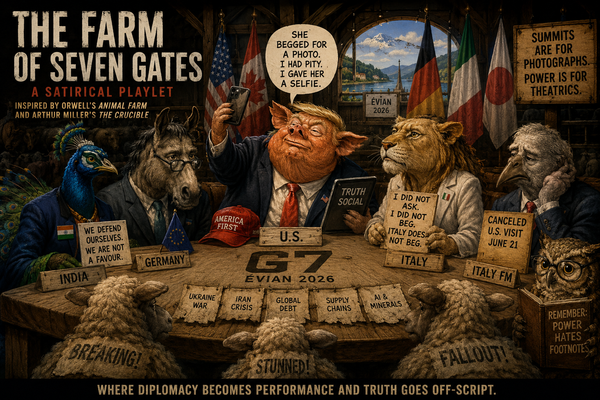
There are moments in world politics when the surface event is less important than the anxiety beneath it. The G7 summit at Évian-les-Bains, on the placid shores of Lake Geneva, is one such moment. The setting may have been picturesque, even deliberately so: a French spa town, Alpine water, polished diplomacy, choreographed arrivals, and the language of cooperation. But beneath that scenery lay a harder recognition. The richest democracies in the world were not merely discussing trade, Ukraine, Iran, artificial intelligence or development finance. They were confronting a more unsettling question: what happens when the material foundations of modern power have quietly shifted into the hands of a strategic rival?
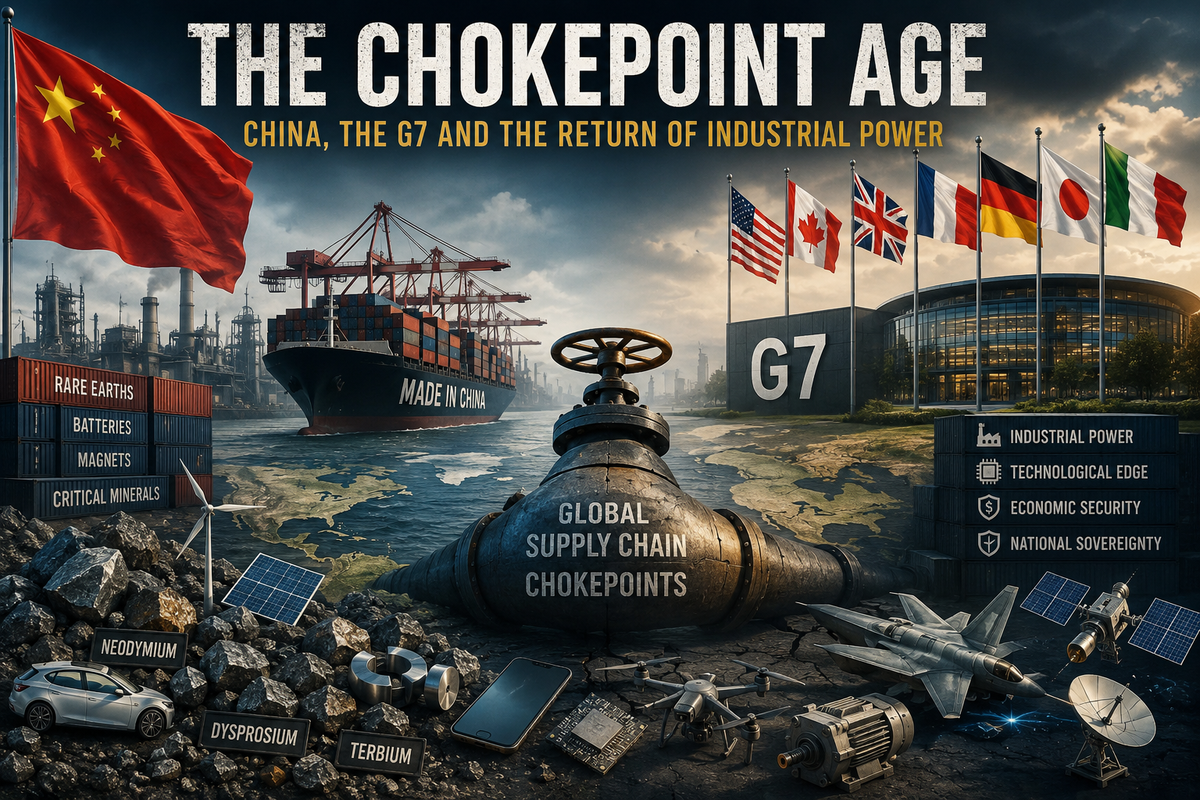
China was not the only subject at Évian. But it was the absent presence around which much of the summit’s economic anxiety revolved. The issue was not simply China’s exports, nor even its industrial overcapacity. It was China’s command over the hidden architecture of the modern world: rare earths, critical minerals, refining capacity, permanent magnets, batteries, solar components, and the dense industrial ecosystems without which the green transition, digital economy and modern defence production cannot move at scale.
For three decades, the West spoke the language of globalisation as if it were a neutral economic process. Production would go where it was cheapest. Capital would go where returns were highest. Supply chains would stretch across continents because efficiency demanded it. The assumptions were elegant, mathematical and comforting. Interdependence, it was believed, would soften rivalry. Trade would discipline geopolitics. Markets would disperse power.
China understood something different. It understood that interdependence is not always mutual. When dependence is symmetrical, it produces restraint. When dependence is asymmetrical, it produces leverage.
That is the central lesson of Évian.
The G7 is not discovering that China is powerful. That has been obvious for years. It is discovering that China’s power does not lie only in aircraft carriers, missiles, GDP figures, export surpluses or diplomatic assertiveness. It lies in the intermediate layers of industrial civilisation — in the processing plants, metallurgical skill, refining infrastructure, magnet factories, port logistics, state-backed credit, patient subsidies, skilled technicians and supplier networks that convert raw material into usable power.
This is why rare earths matter beyond their name. The phrase itself is misleading. Many rare earth elements are not geologically rare in the ordinary sense. What is rare is the capacity to mine, separate, refine and manufacture them at scale under commercially viable, environmentally managed and strategically secure conditions. Neodymium, dysprosium, terbium and related materials do not command public imagination the way oil once did. They do not flow through pipelines or burn in engines. They are buried inside things: wind turbines, electric vehicles, smartphones, drones, radars, satellites, missiles, guidance systems, industrial motors and advanced electronics.
They are quiet materials. But quiet materials often sustain loud power.
The 20th century taught states to think in terms of oil chokepoints: the Strait of Hormuz, the Suez Canal, the Turkish Straits, the Malacca Strait. The 21st century is adding another geography of vulnerability: mineral chokepoints, semiconductor chokepoints, battery chokepoints, data chokepoints, undersea cable chokepoints, cloud chokepoints and platform chokepoints. The new cartography of power is not only territorial. It is industrial, technological and logistical.
This is the world the G7 is struggling to name.
For the West, the embarrassment is acute because much of this vulnerability was not imposed from outside. It was chosen. It was chosen in boardrooms, trade agreements, procurement systems, environmental arbitrage, financial markets and political cycles that rewarded immediate efficiency over long-term resilience. The United States retained finance, software, universities, military platforms and the dollar system. Europe retained regulation, high-end engineering, luxury manufacturing and normative ambition. China absorbed the difficult middle: factories, scale, processing, dirty metallurgy, component ecosystems, infrastructure build-out and disciplined industrial upgrading.
The West did not simply outsource production. It outsourced memory. It forgot how industrial systems are built, maintained and defended.
This forgetting was masked for a time by the immense convenience of cheap imports. Western consumers enjoyed lower prices. Western corporations enjoyed higher margins. Western politicians enjoyed the illusion that inflation had been tamed by clever monetary policy, when in fact part of the work was being done by Chinese labour, Chinese infrastructure and Chinese industrial discipline. Globalisation became a narcotic. It softened the pain of deindustrialisation while concealing the strategic cost.
That cost is now visible.
When a major power controls a large share of the refining and processing capacity for materials essential to electric vehicles, clean energy, electronics and precision weapons, it possesses something more subtle than an export advantage. It possesses a veto potential. It may not need to impose a formal embargo. Delay, licensing restrictions, administrative scrutiny, price manipulation, selective exports, informal pressure and regulatory uncertainty can be enough to create fear across supply chains. In strategic competition, the credible possibility of disruption can be as useful as disruption itself.
China knows this. Japan learned it in 2010 during the rare-earth crisis triggered by the Senkaku/Diaoyu fishing-boat dispute. Whether one describes that episode as a formal embargo or a politically induced disruption, its lesson was unmistakable: a modern industrial state can be shaken by a bottleneck that most citizens had never heard of. Japanese firms adjusted, diversified and stockpiled. But the wider West did not internalise the lesson with sufficient urgency.
Instead, it produced reports.
This is one of the recurring pathologies of late Western statecraft. Recognition substitutes for action. Communiqués substitute for capacity. Strategy documents substitute for factories. The language becomes sharper while the underlying dependency continues. “De-risking” becomes the preferred word because “decoupling” sounds too extreme. “Resilience” becomes fashionable because “industrial policy” still embarrasses free-market orthodoxy. “Friend-shoring” sounds reassuring until one asks whether the friends actually possess the refining, processing, engineering and capital base required to replace China at scale.
The brutal truth is that diversification is necessary but slow. Mines take years. Refineries take longer. Environmental permissions are politically difficult. Processing is technically complex. Local communities resist. Investors hesitate without price guarantees. Firms will not build expensive capacity if China can undercut prices and bankrupt them. Governments speak of supply-chain sovereignty but often lack the institutional patience to finance it.
China’s advantage, therefore, is not merely that it controls minerals. It controls time.
It has spent decades building capacity that cannot be replicated by slogans. Its industrial state has been willing to subsidise, absorb losses, discipline capital, shape demand, integrate infrastructure and think in generational horizons. Western democracies, by contrast, are often trapped in electoral cycles, quarterly earnings, regulatory fragmentation and ideological discomfort with strategic planning. The difference is not simply authoritarianism versus democracy. It is patience versus impatience.
This is why the Évian summit matters. Not because it will solve the problem. It will not. No summit can rebuild industrial depth. But it may mark the point at which the G7’s language shifts from complaint to recognition. The old language was about trade deficits. The new language is about coercive interdependence. The old anxiety was that China was selling too much. The new anxiety is that China may be able to prevent others from building what they need.
That is a very different problem.
It also demands a different response. Tariffs alone cannot solve it. Tariffs can punish imports; they cannot create metallurgical expertise. Sanctions cannot refine rare earths. Speeches cannot build magnet factories. Export controls cannot compensate for absent domestic capacity. A true response would require industrial policy at a depth the West has largely forgotten: public finance, guaranteed offtake, stockpiles, procurement reform, technical education, recycling ecosystems, allied investment, environmental realism and long-term political commitment.
This is where the G7 faces its own contradiction. It wants the security of industrial sovereignty without the cost of industrial rebuilding. It wants resilient supply chains without higher prices. It wants strategic autonomy without political sacrifice. It wants clean energy without dirty processing. It wants defence readiness without dependence on adversarial supply chains. It wants the benefits of a wartime industrial posture without admitting that the economic order has already entered a wartime logic.
That contradiction cannot hold forever.
For Europe, the problem is existential. Europe has excellent engineers, strong firms and immense regulatory power, but it has allowed parts of its industrial base to hollow out under the combined pressure of cheap Chinese imports, expensive energy, weak investment and bureaucratic slowness. Germany’s automobile sector, once the emblem of European industrial supremacy, now faces the dual shock of Chinese electric-vehicle competition and Chinese supply-chain leverage. France, under Macron, appears to understand the symbolic and strategic importance of critical minerals. But Europe as a whole remains slow, divided and often more comfortable regulating the future than manufacturing it.
For the United States, the problem is different but equally severe. America still has unmatched financial power, technological innovation, military reach and university depth. Yet it has allowed essential segments of the defence-industrial and clean-tech supply chain to depend on foreign processing. The country that can project power across oceans may still find itself constrained by obscure inputs buried deep inside its weapons systems. This is not weakness in the old sense. It is fragility inside strength.
For Japan, the issue is memory. Having faced Chinese mineral pressure earlier than most, Tokyo has pursued diversification with greater seriousness. It understands that supply-chain security is not an abstract matter. It is national security by another name. South Korea faces a similar dilemma: technologically advanced, globally embedded, but vulnerable because its industrial champions operate inside networks where China remains deeply consequential.
And then there is India.
India’s presence in this wider conversation is important, but it should not be misunderstood. India cannot afford to become merely a rhetorical member of an anti-China chorus. Nor should it imagine that geopolitical alignment alone will produce industrial capability. The lesson for India is more demanding. If the world is entering a chokepoint age, India must decide whether it wants to be only a market, only a diplomatic swing state, only a supplier of talent — or a serious industrial node in the new architecture of power.
This requires a shift in strategic imagination. India has critical-mineral ambitions, a large market, scientific talent, a growing electronics push, defence modernisation needs and a geopolitical incentive to reduce dependence on China. But ambition is not capacity. India must build processing, refining, recycling, component manufacturing, rare-earth magnet production, battery ecosystems, semiconductor-adjacent capabilities and technical depth. It must coordinate ministries, public-sector units, private capital, universities, defence procurement and state governments. It must reduce bureaucratic friction. It must treat industrial policy not as a slogan but as a national discipline.
The opportunity is real. The G7 and its partners are looking for alternatives to China. Supply chains are being reconsidered. Capital is searching for politically trusted destinations. The democratic world needs scale outside China. India has scale. But scale by itself is not strategy. Unless India builds reliability, infrastructure, contract enforcement, power availability, logistics, skill pipelines and policy predictability, it will remain a possibility rather than a pillar.
This is where India must be coldly realistic. The world will not relocate supply chains to India out of sentiment. It will do so only if India can deliver. Strategic autonomy in the 21st century will not be achieved by declarations in foreign-policy speeches. It will be built in industrial parks, laboratories, ports, refineries, training institutes, standards bodies and procurement systems. Sovereignty now has a material grammar.
China understands this grammar.
That is why the simplistic phrase “China owns the modern world” is both exaggerated and revealing. China does not own the modern world. But it has acquired influence over some of the indispensable mechanisms through which the modern world functions. That is more subtle, and in some ways more powerful. Ownership can be challenged legally. Military power can be deterred. But embedded industrial dependence is harder to escape because it lives inside cost structures, production timelines, corporate habits and technical systems.
The G7’s anxiety is therefore not simply about China’s rise. It is about the West’s own loss of industrial seriousness. China did not merely exploit globalisation. It studied it, entered it, used it, bent it and climbed through it. The West, intoxicated by services, finance and consumption, mistook the disappearance of factories from its own landscapes as evidence of progress. It now discovers that the factory was not an obsolete relic of the industrial age. It was a repository of power.
Marx, in a very different context, understood that production was not merely economic activity but a social relation. Gramsci understood that power works through institutions, habits and consent. Mahan understood that maritime power rests on commerce, bases and logistics. Clausewitz understood that war is not an isolated act but an extension of political purpose. Taken together, these older insights illuminate the present: modern power is never only military, never only economic, never only ideological. It is organised capacity.
China’s achievement has been to organise capacity at civilisational scale.
The democratic world’s challenge is to recover capacity without becoming what it fears. That is the difficult balance. Democracies cannot and should not copy China’s political model. But they can learn from its seriousness about production, infrastructure, technology and long-range planning. They can rediscover that markets require states, that resilience has costs, that national security begins before the battlefield, and that sovereignty cannot be outsourced indefinitely.
The Évian G7, therefore, should be read not as a summit about rare earths alone, but as a symptom of a larger historical transition. The age of naïve globalisation is over. The age of weaponised interdependence has begun. In this new age, the central question is not who speaks most loudly about freedom, democracy or rules. It is who can build, refine, manufacture, finance, protect and sustain the systems on which those words depend.
The West still has immense advantages. It has capital, innovation, alliances, universities, legal systems, entrepreneurial culture and military power. But these advantages must now be reconnected to production. A civilisation that cannot manufacture its future will eventually import its dependencies. And dependencies, once accumulated, become strategy in the hands of others.
That is the warning from Évian.
The summit may produce a communiqué. It may announce partnerships, funds, frameworks and working groups. Some of these may be useful. But the true test will come after the leaders leave the lakeside and return to their capitals. Will they accept higher costs for resilience? Will they finance unglamorous processing plants? Will they protect infant strategic industries from predatory pricing? Will they coordinate across allies rather than merely compete for subsidies? Will they build stockpiles, recycling chains and technical schools? Will they sustain policy beyond one election cycle?
Or will they do what they have often done: recognise the danger, name the danger, deplore the danger, and then continue living inside it?
China will be watching. So will the rest of the world.
For countries like India, the lesson is not to cheer the West’s discomfort or China’s mastery. The lesson is to understand the age we are entering. The next world order will not be determined only by ideology, demography or military alliances. It will be shaped by chokepoints — by who controls the materials, standards, platforms, cables, chips, ports, refineries and manufacturing systems through which power circulates.
The 20th century belonged to those who mastered oil, steel, sea lanes and mass production. The 21st will belong to those who master critical minerals, semiconductors, batteries, data, artificial intelligence, advanced manufacturing and resilient logistics. Power is becoming less theatrical and more embedded. It will not always announce itself with flags and fleets. Sometimes it will appear as a licensing delay, a missing component, a price shock, a stalled assembly line, a grounded aircraft, an unfinished battery plant.
That is why a discussion about rare earths in a French spa town is not a minor economic story. It is a window into the new structure of world power.
Évian tells us that the age of comfortable dependence is ending. What comes next will be harder, costlier and more strategic. The nations that understand this will build. The nations that do not will issue statements.
And in the chokepoint age, statements will not be enough.
For India, the implications of this transition are profound. The crisis that the G7 is now beginning to articulate is not a Western problem alone. It is a global warning. Every serious state must now ask itself a basic question: where, exactly, does its sovereignty reside? Is it in territory alone? Is it in armies alone? Is it in constitutional language, diplomatic posture, cultural confidence, or GDP rankings? Or does sovereignty now also reside in the less visible but more decisive realm of industrial capability?
This question matters because India’s strategic discourse often remains trapped between two registers. One is civilisational rhetoric: the language of destiny, resurgence, ancient wisdom, demographic scale and global respect. The other is geopolitical balancing: America, Russia, China, the Gulf, Europe, the Quad, BRICS, SCO, G20, the Global South. Both registers have their place. But neither is sufficient.
Civilisational confidence without industrial depth becomes theatre. Geopolitical balancing without technological capability becomes dependence disguised as autonomy.
India has long spoken of strategic autonomy. During the Cold War, that phrase meant freedom from bloc politics. It meant the ability to maintain relations with both superpowers, to resist external diktat, and to preserve decision-making space in a divided world. That version of autonomy was essentially diplomatic. It operated in the realm of alignment, voting patterns, arms purchases, non-alignment and political posture.
The 21st century demands a harsher definition. Strategic autonomy now means the capacity to withstand coercion in supply chains, energy systems, finance, food security, technology stacks, digital infrastructure, defence production and critical minerals. It means not merely the freedom to speak independently, but the ability to act independently when pressure is applied.
That is much harder.
India knows this from experience. The history of post-independence India is partly a history of vulnerability to external technology denial. Nuclear sanctions, dual-use restrictions, pressure over missile systems, dependence on imported defence platforms, energy insecurity and periodic food anxieties all taught India that formal sovereignty does not automatically produce functional sovereignty. A country may possess a flag, a constitution, an army and a seat at international forums, and yet remain constrained by external dependencies in moments of crisis.
The rare-earth question must be understood in this tradition.
India cannot afford to view critical minerals as a fashionable policy subject imported from Western think tanks. Nor can it afford to reduce the matter to anti-China sentiment. China’s dominance in rare earths and critical minerals is not an accident of geology. It is the result of industrial policy, state patience, technological accumulation, environmental sacrifice, infrastructure, export discipline and strategic clarity. If India wishes to reduce dependence, it must first respect the scale of the achievement it seeks to rival.
The temptation will be to issue declarations. India has an abundance of declarations. It will be said that India will become a global manufacturing hub, a semiconductor hub, a green energy hub, an electronics hub, a defence production hub, a battery hub, an AI hub, a space hub, and now perhaps a critical-minerals hub. Some of these ambitions are credible. Others remain aspirational. But the danger lies in treating the word “hub” as a substitute for hard capacity.
A hub is not created by announcement. It is created by throughput, reliability, standards, scale, finance, skills, supplier networks, logistics, energy, infrastructure and trust.
This is where India’s challenge becomes concrete. To become a serious node in the critical-minerals order, India must move beyond mining licences and diplomatic memoranda. It must build the midstream. That is where the real power lies. Mining is important, but refining, separation, processing, alloying, magnet-making, battery chemistry, component manufacturing and recycling are where strategic dependence is either broken or reproduced.
If India mines but does not process, it remains dependent. If India imports processed materials and merely assembles finished goods, it remains dependent. If India announces manufacturing schemes without developing precision engineering and supplier ecosystems, it remains dependent. If India seeks to replace China only at the final assembly stage, it will be joining the lower rungs of someone else’s value chain.
The task, therefore, is not substitution. It is capability creation.
This requires institutional seriousness. India must map its vulnerabilities across sectors: defence, telecommunications, electric mobility, renewable energy, electronics, medical technology, space systems and industrial automation. It must identify which components are genuinely critical, which are merely commercially convenient, and which could become coercive chokepoints in a crisis. It must create a national critical-materials and industrial-resilience architecture that is not episodic but permanent.
Such an architecture should bring together ministries that often work in silos: mines, commerce, defence, external affairs, heavy industries, electronics, power, environment, finance, skill development and education. It should include the armed forces, DRDO, ISRO, public-sector enterprises, private industry, start-ups, universities and state governments. Critical minerals cannot be treated as a mining issue alone. They are a whole-of-state issue.
This is precisely what China understood early. Industrial power is not produced by isolated ministries. It is produced by state coordination over time.
India must also think in terms of alliances, but not as dependency transfer. The United States, Japan, Australia, France, South Korea, the European Union and several African and Latin American countries will all be central to the emerging critical-minerals order. India should participate in these networks aggressively. It should seek joint ventures, processing technology, investment, exploration rights, recycling partnerships, academic collaboration and offtake agreements. But the purpose must be clear: not merely to replace Chinese imports with Western imports, but to build Indian capacity.
Otherwise, India will only shift the address of dependence.
Africa will be central to this story. So will Latin America. The next mineral race will not be fought only in boardrooms in Washington, Brussels, Tokyo or Beijing. It will be fought in the politics of Congo, Zambia, Namibia, Tanzania, Kenya, Chile, Argentina, Bolivia, Brazil and Indonesia. Here, India has an opportunity if it acts with sensitivity. It cannot approach these regions with the extractive arrogance historically associated with Western corporations or the debt-heavy infrastructure model often associated with China. India’s offer must be different: partnership, training, value addition, local employment, technology transfer and political respect. Africa has been a traditional friend of India. We have great relationships with Africa, and these can be leveraged to advantage now with patience and respect.
This would align with India’s Global South language. But once again, language must be matched by instruments. India needs development finance capacity, diplomatic bandwidth, mineral diplomacy, technical institutes, overseas project management and private firms capable of operating globally. The Global South cannot be invoked merely in speeches. It must be engaged through institutions.
There is also a domestic democratic dimension. Critical-mineral extraction and processing can be environmentally damaging. India cannot build industrial sovereignty by sacrificing communities without consent, transparency or safeguards. The mining belts of India already carry histories of displacement, ecological damage and social grievance. If the new strategic economy reproduces old injustices, it will generate internal resistance and moral contradiction.
A democratic industrial policy must therefore be both strategic and accountable. It must recognise that speed is necessary, but so is legitimacy. Communities must see benefit. Environmental standards must be credible. Compensation must be fair. Local employment must be real. Skill development must be tied to actual jobs. Otherwise, the state will face the familiar trap: projects delayed not by foreign enemies, but by domestic distrust.
This is where the comparison with China becomes instructive but limited. China can impose industrial projects through state power in ways India cannot and should not imitate. India’s path must be slower in some respects because it is democratic. But democracy need not mean drift. It can mean consent-based speed, if institutions are competent. The problem in India is not democracy. The problem is often administrative fragmentation, regulatory unpredictability, weak execution and the absence of long-term policy credibility.
India’s advantage, if properly used, is that it can combine scale with legitimacy. It has a vast domestic market, a young workforce, a large engineering base, strategic geography, geopolitical relevance and a growing appetite for manufacturing. But these advantages will not automatically translate into power. They require discipline.
The first discipline is intellectual: India must stop confusing aspiration with achievement.
The second is institutional: India must build mechanisms that survive ministers, governments and news cycles.
The third is industrial: India must move from assembly to ecosystems.
The fourth is educational: India must restore dignity to technical training, vocational skill, metallurgy, materials science, mining engineering, chemical processing and industrial maintenance.
The fifth is financial: India must create patient capital for sectors where returns are strategic before they are immediately commercial.
The sixth is diplomatic: India must secure mineral partnerships abroad without appearing extractive or opportunistic.
The seventh is ethical: India must ensure that the pursuit of sovereignty does not become another name for dispossession.
If India can do this, the chokepoint age may become an opportunity. If it cannot, it will become another era in which India speaks in the language of great power while importing the sinews of great power from elsewhere.
The G7’s anxiety should therefore be read in New Delhi not as a distant Western drama but as a mirror. The West is discovering that it hollowed out too much. India must not repeat the error in a different form. It must not imagine that services, software, consumption and digital platforms alone can sustain national power. These are vital sectors, but they do not eliminate the need for hard industrial capability.
A nation cannot code its way out of every dependency. It cannot app-build its way into strategic autonomy. It cannot replace metallurgy with slogans, refining with rhetoric, or manufacturing with market size.
There is a deeper philosophical point here. Modernity has often encouraged societies to despise the material foundations of their own comfort. Factories became ugly, mines became embarrassing, logistics became invisible, and industrial labour became socially downgraded. The polished surface of the digital age concealed the extractive and industrial worlds beneath it. But geopolitics has a way of restoring visibility to what comfort hides.
The battery in an electric car is not merely a clean object. It is lithium, nickel, cobalt, graphite, manganese, rare earths, chemistry, labour, water, land, transport and politics. A missile is not merely a symbol of military power. It is electronics, propellants, sensors, magnets, alloys, chips and supply chains. A smartphone is not merely a lifestyle device. It is a compact map of global extraction, assembly and dependency.
The chokepoint age forces us to see the world materially again.
This is why Évian matters. It signals a belated Western return to material reality. For too long, the commanding heights of the global economy were imagined as financial flows, intellectual property, software platforms and consumer brands. These still matter enormously. But the return of industrial geopolitics reminds us that power also resides in refineries, ports, machine tools, grid capacity, mines, smelters, precision components and the skilled hands that know how to operate them.
The countries that understand this will shape the coming order. Those that do not will become dependent consumers of someone else’s industrial strategy.
India stands at precisely this crossroads. Its rhetoric of rise is powerful. Its possibilities are real. Its diplomatic space is wider than at any point since independence. But the next stage of Indian power will not be secured by rhetoric, demography or summitry alone. It will be secured by the slow, stubborn creation of capacity.
That is the lesson China has taught the world, whether the world likes it or not.
And that is the lesson the G7 is now learning beside Lake Geneva.
Colonel Maqbool Shah is a retired Indian Army officer. He is the Founding Editor of Frontline Strategy Digest. He can be reached at maqboolshahin@gmail.com