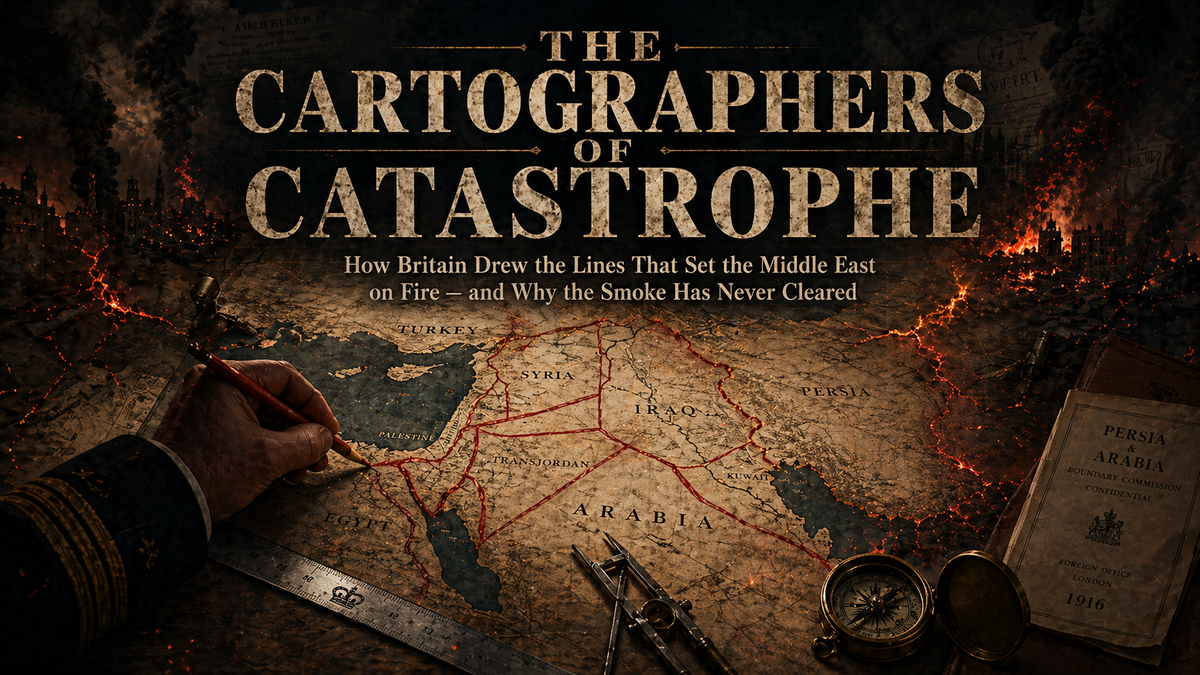
THE CARTOGRAPHERS OF CATASTROPHE: How Britain Drew the Lines That Set the Middle East on Fire — and Why the Smoke Has Never Cleared
FRONTLINE STRATEGY: Strategic Analysis for a Fractured World
Special Series • The Long View • April 2026
A Three-Part Series | Part I of III
PART I: THE GREAT GAME AND THE STOLEN OIL
Britain, Persia, and the Architecture of Exploitation — 1800 to 1953
――― THE LONG VIEW ―――
There is a map in the British National Archives in Kew, London, drawn in 1907, on which the fate of a civilisation was decided. It shows the territory of Persia — ancient Persia, the empire of Cyrus and Darius, of Hafiz and Rumi, of the fire temples of Zoroaster and the astronomical observatories of the Sassanids — divided by two coloured pencil lines into three zones. A northern zone marked in blue for Russia. A southern zone marked in red for Britain. A grey zone in the middle, nominally neutral, which both powers reserved the right to enter whenever their interests required. No Persian official was consulted in the drawing of these lines. No Persian signature appears on the document. The Convention was negotiated in St. Petersburg by the British Ambassador Sir Arthur Nicolson and the Russian Foreign Minister Alexander Izvolsky, and initialled on the 31st of August 1907. Persia learned of its own partition from the newspapers.
This essay is about the chain of events that runs from that map in Kew to the rubble in Tehran in 2026. It is not a simple chain. History rarely is. But it is an unbroken one, and it is long past time that it was told with the clarity and the moral directness it deserves.
I. The Great Game: Persia as a Chessboard
THE NINETEENTH CENTURY AND THE LOGIC OF THE BUFFER STATE
To understand why Britain treated Persia the way it did, one must first understand the anxiety that drove British imperial policy throughout the nineteenth century. That anxiety had a single name: India. The subcontinent was, in the language of the time, the jewel in the crown — the source of enormous wealth, the engine of British commercial power, the territory whose defence consumed a disproportionate share of British strategic imagination. Everything that Britain did in Central Asia, the Middle East, and the Persian Gulf between 1800 and 1945 was, at some level, about protecting the road to India.
Russia was the threat. The slow, relentless southward expansion of the Russian Empire through the Caucasus and Central Asia during the nineteenth century was watched from London with a mixture of strategic anxiety and imperial jealousy. Russian armies reached the borders of Afghanistan in 1885. Russian influence penetrated the northern provinces of Persia — Azerbaijan, Gilan, Mazandaran, Khorasan — through trade concessions, loans, and the Cossack Brigade, a Persian military force trained and officered by Russians. The British response was to extend their own influence southward from India, establishing treaty relationships with the Gulf sheikdoms, maintaining a naval presence in the Persian Gulf, and seeking to turn Persia into a buffer zone that would prevent Russian power from reaching the warm-water ports of the Indian Ocean.
The problem with buffer zones is that they require the co-operation of the territory being buffered. Persia in the nineteenth century was governed by the Qajar dynasty — a ruling house of Turkic origin whose administrative capacity had been steadily eroded by financial mismanagement, court corruption, and the steady loss of territory to Russia in the north. The Qajars had ceded the Caucasian territories — present-day Georgia, Armenia, and Azerbaijan — to Russia in the treaties of Gulistan (1813) and Turkmenchay (1828), following military defeats that demonstrated the catastrophic gap between Qajar military capacity and that of the modern European powers. By the mid-nineteenth century, the Qajar court was financially dependent on loans from both Russia and Britain, each of which extracted concessions — trade, infrastructure, resource extraction — in exchange for the cash that kept the dynasty solvent.
The concession system was the mechanism of colonial extraction dressed as commerce. A financially desperate government grants a foreign company exclusive rights to develop a resource or operate an infrastructure — a railway, a telegraph line, a river navigation system — in exchange for an upfront payment. The foreign company extracts the value. The host country receives a fraction, usually under terms it negotiated without the technical expertise to understand what it was agreeing to. The political class is corrupted by the flow of cash. The population sees none of the benefit. And the foreign power has established a structural presence inside the country that gives it both economic leverage and, if necessary, the justification for military intervention to “protect its interests.”
This pattern — established in Persia through the tobacco concession of 1890, the Reuter concession of 1872, and a series of loan agreements — would reach its ultimate expression in 1901 with the D’Arcy oil concession. But before we reach the oil, we must register the human cost of the preceding century: the Qajar Persia that entered the twentieth century was a state whose sovereignty had been systematically hollowed out over a hundred years of competing imperial pressure. Its finances were in external creditors’ hands. Its military was trained and commanded by foreign officers. Its major infrastructure concessions were owned by foreign companies. It was, in the language of our own time, a failed state — but it had been made to fail. The failure was not a function of Persian incapacity. It was the product of deliberate external pressure applied over generations.
II. The D’Arcy Concession and the Birth of the Oil Order
HOW TWENTY THOUSAND POUNDS PURCHASED A NATION’S INHERITANCE
In May 1901, William Knox D’Arcy — an Australian-born speculator who had made his fortune in the Mount Morgan gold mine in Queensland — was received at the court of Mozaffar ad-Din Shah in Tehran. D’Arcy was not acting alone. Behind him was a network of British commercial and political interests that understood, from geological surveys conducted in the preceding decade, that the Persian subsoil contained oil in quantities that could transform the global energy order. D’Arcy had been briefed by the geologist H.T. Burls, acting on intelligence gathered by the British Indian government. He arrived in Tehran knowing approximately what was under the ground. The Shah did not.
The concession D’Arcy extracted was, by any subsequent measurement, one of the most one-sided resource agreements in the history of colonial extraction. In exchange for the exclusive right to explore for, extract, refine, and export oil across five-sixths of Iranian territory — an area of approximately 1.2 million square kilometres — for a period of sixty years, D’Arcy paid the Shah £20,000 in cash, £20,000 in shares of the company to be formed, and a promised 16 percent of annual net profits. The Shah, whose treasury was essentially insolvent, accepted.
Oil was struck at Masjed Soleyman in the Khuzestan province on the 26th of May 1908 — seven years after the concession was signed, and six years after D’Arcy had nearly abandoned the enterprise for lack of funds, only to be bailed out by the Burmah Oil Company acting on behalf of the Admiralty’s strategic interest in securing a British oil supply. The Anglo-Persian Oil Company was formally incorporated in April 1909. By 1913, Winston Churchill, as First Lord of the Admiralty, had concluded that the Royal Navy’s conversion from coal to oil — essential for the speed and efficiency advantages of the new dreadnought fleet — required a guaranteed British supply. In June 1914, two months before the outbreak of the First World War, the British government purchased a 51 percent controlling stake in the Anglo-Persian Oil Company for £2.2 million. The Iranian oil fields were now, in effect, a strategic asset of the British state.
The Iranians received, on the terms of the 1901 agreement, 16 percent of net profits — net profits as calculated by the Anglo-Persian Oil Company’s own accountants, using accounting methodologies that the Iranian government had no technical capacity to audit or challenge. When the Iranian government eventually gained access to the company’s books in the late 1940s, it discovered systematic underreporting of profits, inflated operating costs, and the creative use of subsidiary company pricing to shift profits out of the Iranian royalty calculation. The true return to Iran over four decades of oil extraction was a fraction of what even the already-unfavourable contractual terms specified.
Between 1913 and 1951 — the year of nationalisation — the Anglo-Persian Oil Company (renamed the Anglo-Iranian Oil Company in 1935) extracted oil from Iranian soil worth, in contemporary estimates, several hundred billion dollars. Iran received approximately £112 million in total royalties over the same period. The company’s refinery at Abadan, built on Iranian soil with Iranian labour, was the largest oil refinery in the world. Iranian workers at Abadan lived in a racially segregated company town where they were barred from certain facilities reserved for British employees, paid a fraction of British wages for equivalent work, and subject to dismissal for union organising. The conditions were those of colonial labour extraction: a resource colony in all but name.
III. The Occupation of a Neutral Country
THE FAMINE THAT HISTORY FORGOT: 1914–1921
When the First World War began in August 1914, Persia declared neutrality. The declaration was ignored.
Britain and Russia both required Persian territory for their war aims — Britain to protect the oil fields of Khuzestan and the route to India, Russia to maintain its sphere of influence in the north and prevent the Ottoman Empire from using Persian territory as a corridor. Both powers deployed forces into Persian territory without requesting or receiving permission. The Ottomans, fighting on the opposing side, also operated across Persian territory in the west. German agents attempted to stir up tribal insurrections in the south. Persian sovereignty was not merely violated. It ceased to function. The central government in Tehran, never strong, lost effective control of most of the country.
The consequences for the Persian population were catastrophic. The occupying armies requisitioned food supplies, disrupted agricultural production, and commandeered transport infrastructure. The Qajar government’s capacity to distribute food was destroyed. A famine developed across the central and northern provinces between 1917 and 1919. The scholar Mohammad Gholi Majd, in his 2003 study The Great Famine and Genocide in Persia, 1917–1919, drawing on British diplomatic archives, American consular reports, and Iranian sources, estimated that between 1.5 and 2 million Persians died in the famine — in a country whose total population at the time was approximately 8 to 10 million. If these figures are even approximately correct — and they are consistent with the population data of the period — this was a demographic catastrophe comparable, in proportional terms, to the Irish Famine of the 1840s.
The British government’s internal documents on the famine, now available in the National Archives, acknowledge the scale of the mortality while carefully deflecting responsibility. Lord Curzon, who would become Foreign Secretary in 1919 and whose contempt for Persian sovereignty was one of the defining features of British policy in the period, wrote in 1919 that the famine had been “due to a combination of drought, locust, and the breakdown of the distribution system.” He did not mention the occupation. He did not mention the requisitioning of grain. He did not mention that the breakdown of the distribution system was the direct consequence of the military occupation that Britain had imposed on a country that had asked only to be left alone.
The post-war settlement in Persia was shaped entirely by British interests. In 1919, Lord Curzon — now Foreign Secretary, and a man who regarded Persia essentially as a British protectorate by right of geographic proximity and imperial investment — negotiated the Anglo-Persian Agreement of 1919 with the compliant Qajar Prime Minister Vossough od-Dowleh, who had been paid £130,000 in bribes by the British government to sign it. The agreement would have placed British officers in command of the Persian army, British advisors in control of the treasury, and British-supervised loans at the centre of the fiscal structure. It was, in substance, the formal conversion of Persia into a British protectorate.
The Iranian Majlis — the parliament established by the Constitutional Revolution of 1906 — refused to ratify it. The popular reaction was one of fury. Curzon was furious in return. When the agreement collapsed, Britain moved to its next instrument: the military coup.
IV. The Making of a Dynasty
HOW BRITAIN INSTALLED THE PAHLAVIS — AND WHY IT MATTERED
On the 21st of February 1921, a column of approximately 2,500 Cossack Brigade cavalry entered Tehran under the command of Colonel Reza Khan, an officer of formidable physical presence and considerable military ability who had risen through the Persian Cossack Brigade — the force trained and until recently officered by Russians. The coup was swift, bloodless, and successful. The Qajar government capitulated. Reza Khan became Minister of War and de facto ruler of Persia.
The role of British General Edmund Ironside — commanding British forces in northern Persia at the time of the coup — has been the subject of historical debate for a century. Ironside’s own diaries, published posthumously, record his assessment that a “strong man” was needed to stabilise Persia and that Reza Khan was that man. They record conversations with Reza Khan in the weeks before the coup. They record Ironside’s decision to remove the Russian-born officers commanding the Cossack Brigade — officers whose presence would have complicated a coup — in the days immediately before the column marched on Tehran. Whether this constitutes direct British organisation of the coup, or merely the removal of an obstacle by a sympathetic observer, historians continue to debate. What is not debated is that the British government was informed, was not displeased, and did nothing to prevent it.
Reza Khan consolidated power with remarkable speed. By 1923 he was Prime Minister. In 1925, the Majlis — suitably managed — deposed the last Qajar Shah and declared Reza Khan the new Shah of Iran, founding the Pahlavi dynasty. The dynasty that would rule Iran until 1979, that would be deposed and reinstalled by British and American intelligence in 1941 and 1953 respectively, and whose overthrow would produce the Islamic Revolution whose consequences are still being felt in 2026, was installed — at minimum with British acquiescence and most probably with British facilitation — in a military coup.
Reza Shah proceeded to modernise Iran by force: building roads, railways, and schools; secularising the legal system; banning the veil; changing the country’s name from Persia to Iran in 1935. His methods were authoritarian. His secret police, though less sophisticated than his son’s SAVAK would become, was brutal. His relationship with Britain was complicated: he resented British commercial dominance of Iranian oil while depending on British support for his political position. When he renegotiated the oil concession in 1932 and achieved marginally better terms — still far short of what any equitable arrangement would have provided — he regarded it as a victory. The British regarded the revised terms as a manageable accommodation of Iranian nationalism that preserved the essential structure of extraction.
When the Second World War began and Reza Shah’s sympathies for Germany became apparent — he had admired German industrial efficiency and resented both Britain and Russia — Britain and the Soviet Union acted with the same disregard for Iranian sovereignty that had characterised British policy since 1907. In August 1941, without a declaration of war and without serious Iranian military resistance, British and Soviet forces invaded Iran simultaneously from the south and north. Within weeks, Reza Shah was forced to abdicate. He was sent to South Africa, where he died in 1944. His son, Mohammad Reza, twenty-two years old and pliant, was placed on the Peacock Throne. The dynasty Britain had installed in 1921 was preserved — in a more controllable form.
V. Mossadegh and the Crime at the Centre
OPERATION BOOT: THE DESTRUCTION OF IRANIAN DEMOCRACY, 1951–1953
Mohammad Mossadegh was not a revolutionary. He was, by temperament and formation, a constitutional democrat of the European liberal tradition — trained in law at the Ecole des Sciences Politiques in Paris and the University of Neuchâtel in Switzerland, a product of the Iranian Constitutional Revolution of 1906, a politician who had spent decades arguing for the rule of law, parliamentary accountability, and the sovereignty of the Iranian state against both domestic authoritarianism and foreign interference. He was sixty-nine years old when he became Prime Minister in April 1951. He wept in parliament. He sometimes conducted business from his bed, in pyjamas, for reasons of genuine ill health. He was, in the estimation of most historians who have studied him closely, a man of personal integrity so complete as to be almost anomalous in the politics of his time.
Mossadegh’s great cause was the nationalisation of the Anglo-Iranian Oil Company. The intellectual and moral case was unanswerable: Iranian oil, extracted from Iranian soil by Iranian labour, was generating enormous profits for a British company and the British government while the Iranian state received a royalty calculated by the company’s own accountants on terms the company had negotiated with a government that had no capacity to resist. In 1948, the Anglo-Iranian Oil Company paid £28 million in taxes to the British government. It paid £9 million in royalties to Iran. The British government received more from Iranian oil than the Iranian government did.
Mossadegh put the nationalisation bill to the Majlis in March 1951. It passed unanimously. The Shah, who had little enthusiasm for confrontation with Britain, signed it into law. The Anglo-Iranian Oil Company was nationalised. The Iranian National Oil Company was established to operate the fields and the refinery at Abadan.
Britain’s response was immediate, comprehensive, and ruthless. The Royal Navy was deployed to the Persian Gulf to prevent Iranian oil from reaching international markets. British technicians were withdrawn from Abadan, taking with them the operational knowledge required to run the refinery. The British government lobbied every oil-importing nation not to purchase Iranian oil. Iranian assets in British banks were frozen. A legal action was brought before the International Court of Justice — which ruled, ultimately, that the dispute was outside its jurisdiction. The economic strangulation was effective: Iranian oil exports, which had been approximately 30 million tons per year, fell to almost nothing. The Iranian economy contracted severely. Inflation rose. Political instability followed economic distress.
The Truman administration in Washington initially refused to support the British position. Secretary of State Dean Acheson regarded the British stance as colonial overreach — “a group of unconscionable reactionaries,” in his private characterisation — and proposed a compromise settlement that would have given Iran a genuine share of oil revenues. The British rejected every American mediation attempt that did not restore British operational control of the oil company. The British priority was not a fair settlement. It was the restoration of the principle that Iranian oil was a British asset.
Acheson’s warning was prescient and was ignored. In January 1953, Dwight Eisenhower replaced Truman as President. His incoming Secretary of State was John Foster Dulles, whose law firm Sullivan and Cromwell had acted for the Anglo-Iranian Oil Company. His incoming CIA Director was Allen Dulles, John Foster’s brother. The British, who had been unable to sell the Truman administration on a covert operation against Mossadegh, now found a more receptive audience. The reframing of Mossadegh as a communist threat — a framing the British had been preparing for two years, despite the absence of any credible evidence for it — was accepted by the Eisenhower administration without serious interrogation.
Operation Ajax — the American codename — and Operation Boot — the British codename that captured the intended action more honestly — was a joint CIA-MI6 operation planned and executed between March and August 1953. The operational details are now thoroughly documented, partly from CIA and British Foreign Office archives declassified since 2013, and partly from the memoir of Kermit Roosevelt Jr., the CIA officer who ran the operation from inside Iran.
The mechanism was the purchase of Iranian politics. MI6 and the CIA paid Iranian newspaper editors, religious figures, military officers, parliamentarians, and street gang leaders to manufacture a political crisis. Paid mobs attacked Mossadegh supporters and created the appearance of popular opposition. Paid military officers planned a coup. The Shah, terrified and vacillating, was pressured by both the CIA’s Kermit Roosevelt and by his own sister, Princess Ashraf — who had been visited in Europe by an MI6 officer bearing gifts — to sign the decree dismissing Mossadegh. On the 19th of August 1953, tanks moved on Tehran. Mossadegh was arrested. The coup succeeded. The Shah, who had fled to Rome when an earlier attempt miscarried, returned to his throne.
The consequences of the 1953 coup are not difficult to trace. The Shah, restored to his throne by foreign intelligence services, understood that his hold on power depended on those same services rather than on the consent of his people. SAVAK, the secret police established in 1957 with CIA and Mossad assistance, became the instrument of a repression that targeted precisely the liberal, nationalist, and leftist forces that had supported Mossadegh — the democratic centre of Iranian politics that might, in other circumstances, have been the foundation of a functioning parliamentary democracy. With the democratic centre destroyed or exiled, the only organised opposition remaining in Iran by the 1970s was the network of mosques and seminaries that Reza Shah had been unable to suppress and that SAVAK found difficult to penetrate. The space that Mossadegh’s democracy had occupied was left empty, and Khomeini filled it.
The line from the 1953 coup to the 1979 revolution is not metaphorical. It is causal. Every Iranian leader who has negotiated with the United States since 1953 has done so in the knowledge that the last Iranian leader who trusted American good faith was placed under house arrest for the remainder of his life. Every Iranian population that has been asked to trust Western intentions has done so in the shadow of August 19, 1953. The Islamic Republic’s foundational anti-Americanism is not ideology in the abstract. It is institutional memory of a specific, documented crime.
VI. The Unbroken Thread
FROM KEW TO ABADAN TO TEHRAN — AND TO 2026
Let us now draw the thread from its beginning to its present end.
The 1907 Convention established the principle that Persia was a space to be managed for external interests. The D’Arcy concession of 1901 and the Anglo-Iranian Oil Company established the mechanism of that management: resource extraction under legal cover, enforced by the implicit threat of superior military power. The occupation of 1914–1921 demonstrated that even formal neutrality would not protect Persia from the consequences of great power competition conducted on its territory. The 1919 Anglo-Persian Agreement attempted to formalise the protectorate that British policy had been creating informally for two decades. When the Majlis refused it, Britain found an alternative in the Pahlavi dynasty. When the Pahlavi dynasty produced a Shah who was insufficiently controllable, Britain deposed him. When the dynasty produced a Mossadegh who insisted on sovereignty over Iranian oil, Britain and America destroyed him. What grew in the ruins of Mossadegh’s democracy was Khomeini’s revolution, and what grew in the ruins of Khomeini’s revolution — forty years of theocratic mismanagement, revolutionary adventurism, and the construction of the Axis of Resistance as a deterrent against the external powers that had repeatedly demonstrated their willingness to overthrow Iranian governments they disliked — was the condition that produced Operation Epic Fury.
The American and Israeli pilots who took off on the 28th of February 2026 were flying into a history they did not know and had not been required to learn. The Iranians who scrambled to their missile batteries that morning carried that history in their institutional and cultural memory with a specificity and a detail that no amount of American military power has ever managed to erase. That asymmetry of historical memory — the perpetrators who forget and the victims who cannot — is the deepest reason why every military campaign against Iran has produced the opposite of its intended effect.
Part II of this series will examine the Sykes-Picot Agreement of 1916, the Balfour Declaration of 1917, and the carving of the Arab world into the straight-lined states whose instability has generated conflict without interruption since their creation. The cartographers of catastrophe had more than one map.
Wherever you are reading this, I wish you the wisdom to read history before it reads you.
THE CARTOGRAPHERS OF CATASTROPHE — SERIES OUTLINE
Part I (This Edition): The Great Game and the Stolen Oil — Britain, Persia, and the Architecture of Exploitation, 1800–1953
Part II (Forthcoming): The Cartographers’ Other Map — Sykes-Picot, the Balfour Declaration, and the Arab World Britain Built to Fail, 1916–1948
Part III (Forthcoming): The Long Consequence — From 1953 to Operation Epic Fury: The Unbroken Causal Chain
FRONTLINE STRATEGY
Col Maqbool Shah SM (Retd) | Strategic Research Analyst | Substack & LinkedIn
Views are the author’s own. All analysis based on open-source reporting, declassified archives, and strategic assessment.