THE ANARCHY ARRIVES
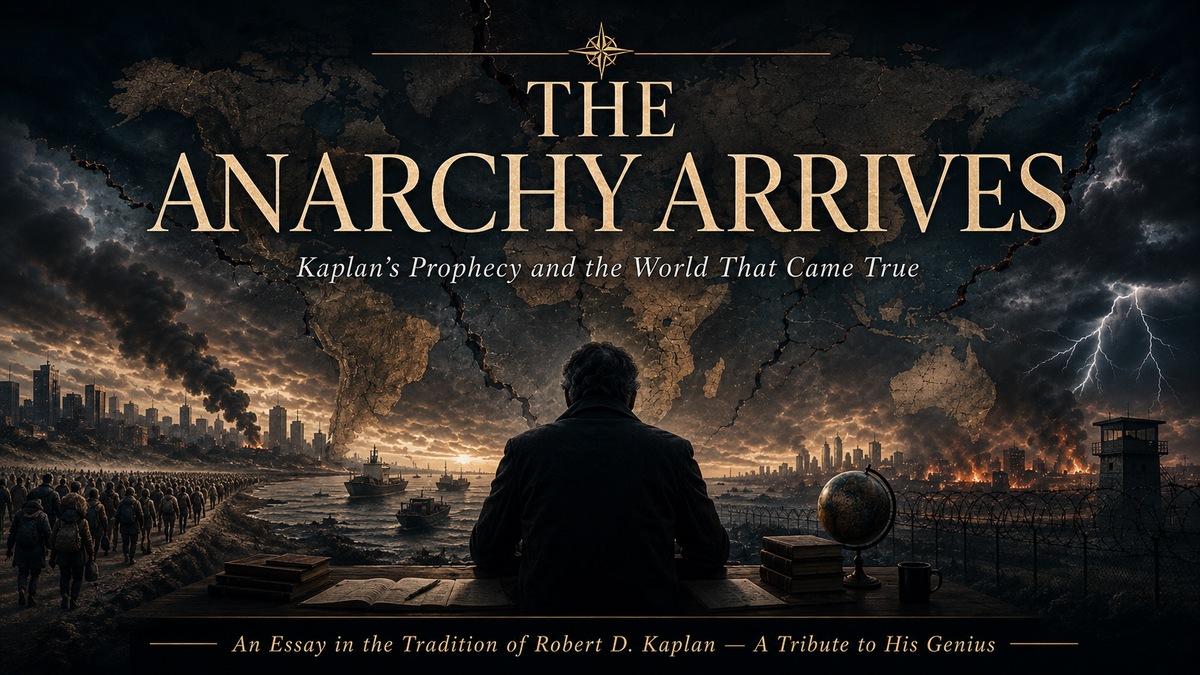
Kaplan’s Prophecy and the World That Came True
A Tribute to the Genius of Robert D. Kaplan
FRONTLINE STRATEGY DIGEST | Strategic Analysis · 22 May 2026
EDITOR’S NOTE: Robert D. Kaplan published The Coming Anarchy in 2000. Twenty-six years on, this essay — written by our Founding Editor — employs Kaplan’s own analytical architecture to document an anarchy that has demonstrably arrived. It is both a tribute to Kaplan’s prescience and a strategic assessment of the world as it stands in 2026.
— PROVENANCE: HOW THIS BOOK FOUND ITS READER
There is a particular pleasure in tracing the lineage of an idea — the chain of minds through which a book travels before it reaches the reader who was always its intended destination.
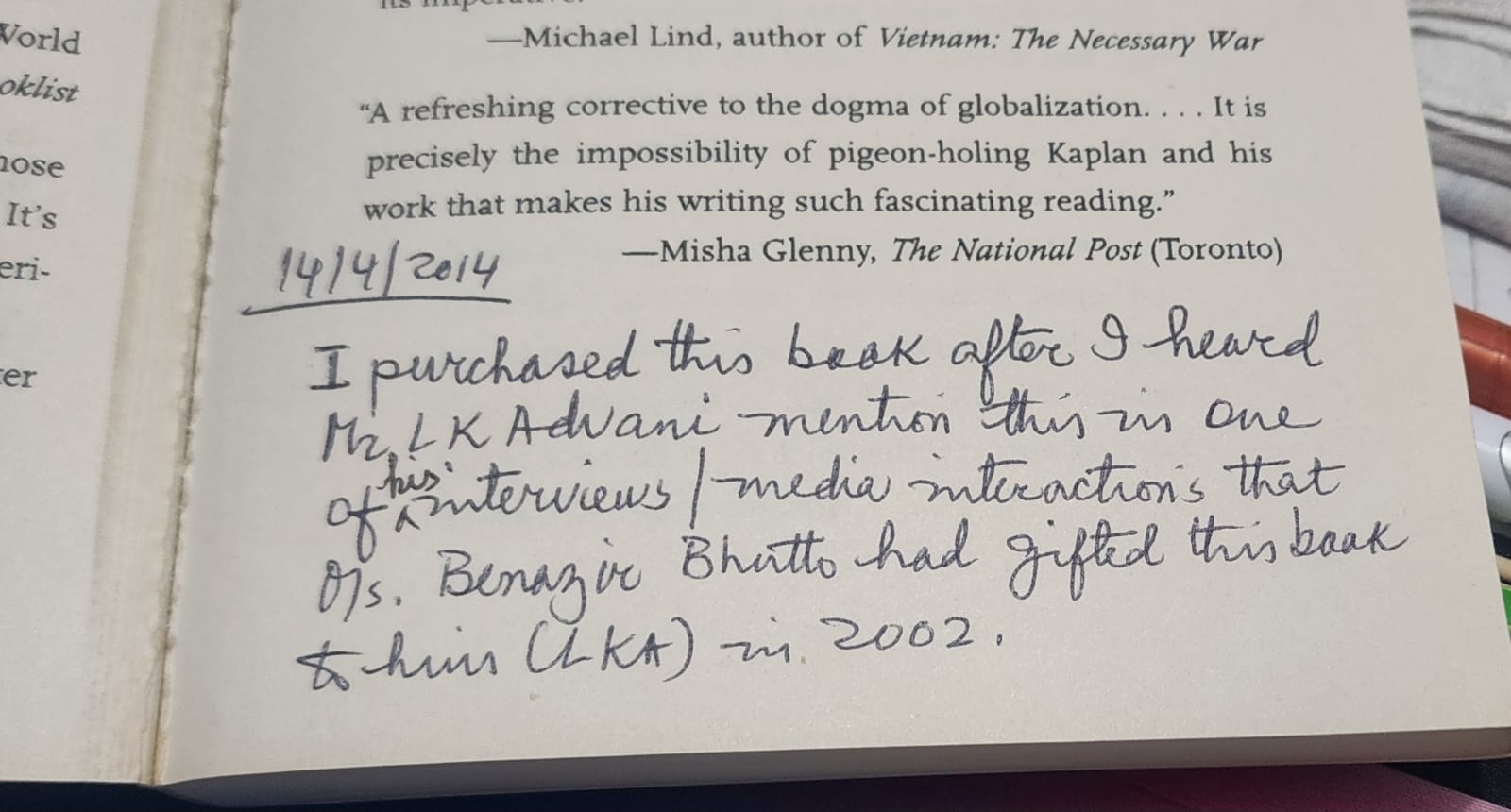
On the fourteenth of April, 2014, the author walked into a bookshop in New Delhi and purchased Robert D. Kaplan’s The Coming Anarchy. The impulse had a precise genealogy. He had recently watched an interview with Lal Krishna Advani — one of independent India’s most formidable political minds — in which Advani mentioned, almost in passing, that in 2002 Benazir Bhutto had gifted him this book and urged him to read it.
That detail demands a moment’s reflection. Here was one of the subcontinent’s great stateswomen pressing into the hands of one of its great statesmen a book written by an American journalist about the collapse of civilisational order — across a divide of nationality, party, religion, and the perpetual antagonism of two nuclear-armed neighbours. Whatever Bhutto saw in Kaplan’s pages, she thought it important enough to share across that chasm. That recommendation, travelling twelve years through history before it reached the present author, was itself a small demonstration of the borderless power of serious thought.
The author was not entirely unprepared for Kaplan. He had encountered him earlier in a searching, unsettling interview Kaplan conducted with Narendra Modi, then Chief Minister of Gujarat, published in The Atlantic in 2009. What Kaplan saw in that conversation has been proved right, in almost every particular, by the subsequent fifteen years of Indian political history.
When he finally read The Coming Anarchy in its entirety, he understood what Benazir Bhutto had understood. This was not a book about West Africa or the failures of post-colonial states. This was a book about all of us — about the operating system beneath the decorative surface of civilisation, about what happens when that system begins to fail.
Twenty-six years have passed since Kaplan’s prognosis. This essay is, in equal measure, a tribute to his genius and an obligation owed to the writer’s conscience: the duty to articulate what the observer sees, to name the disorder that surrounds us with the clarity that disorder itself resists.
I THE PROPHET WITHOUT HONOUR
There is a particular cruelty reserved for prophets whose warnings are heeded only after the flood. Robert D. Kaplan published The Coming Anarchy at the turn of a millennium when the world was still intoxicated by what Francis Fukuyama had called the ‘end of history.’ Liberal democracy had triumphed. The Berlin Wall was rubble. Globalisation was the new theology. Into this festival of self-congratulation, Kaplan inserted a cold blade.
He had travelled to West Africa — to the Ivory Coast and Sierra Leone, to the slums of Abidjan and the killing fields of Freetown — and what he saw there he recognised not as the exception but as the template. The diseased, the displaced, the stateless, the criminal: these were not remnants of an unfinished past but harbingers of an arriving future.
Twenty-six years on, the flood has arrived. We do not need to travel to West Africa to find the anarchy. We need only read the morning dispatches.
II THE SCARCITY ENGINE
Kaplan borrowed from Malthus and from the environmental historians who had traced the origins of the Rwandan genocide not to ancient tribal hatreds alone but to land hunger — too many people pressing against too little arable soil. He argued that resource scarcity was the hidden grammar beneath the visible sentences of political conflict.
The grammar has not changed; the sentences have multiplied.
India’s suspension of the Indus Waters Treaty in 2025 — a Cold War monument to technocratic diplomacy that had survived two full-scale wars and decades of hostility — signalled that even the most durable instruments of civilisational management buckle when political temperature rises past a threshold. The treaty had held for sixty-five years. It took one terrorist attack and a military escalation to render it a casualty. Water was not the declared casus belli; it became the silent one.
The Nile Basin trembles between Ethiopia, Sudan, and Egypt over the Grand Ethiopian Renaissance Dam, a hydroelectric project that one nation calls development and another calls existential threat. The Tigris and Euphrates, rivers that cradled the first human civilisations, now run at fractions of their historical volume. Mesopotamia — the land between the rivers — is losing its rivers.
Climate change has done what no ideological movement could: it has made scarcity universal, though not equally distributed.
The poor nations of the tropical littoral — Bangladesh, the Sahel, the Pacific atolls, coastal West Africa — face the arithmetic of submersion and desertification while the prosperous nations of the temperate north negotiate carbon credits at annual conclaves that produce, reliably, more hot air than resolution. Kaplan understood that when the environment breaks down, political institutions follow. He was describing a sequence, not a simultaneity. We have now reached the later stages of that sequence.
III THE HOLLOWING STATE
The nation-state, Kaplan argued, was a European export of the seventeenth century being applied to societies whose organic political units were the tribe, the clan, the ethnic confederation, the river basin. In much of the post-colonial world, the state was a legal fiction maintained by international convention and foreign aid, not by the consent of the governed or the capacity to deliver security.
The hollowing was already advanced when Kaplan wrote. It is now, in many regions, complete. In the Sahel, the French withdrew their forces from Mali, Burkina Faso, and Niger following military coups that were themselves symptoms of state failure. The governments that replaced the governments are not governments in any meaningful sense — they are armed factions with presidential letterheads. The void has been filled by Wagner Group mercenaries, jihadist confederacies, and criminal trafficking networks. The map still shows borders. The borders show nothing.
In Myanmar, the military junta that staged a coup in 2021 cannot control its own territory. The country has effectively fractured into the ethnic homelands that the colonial map always pretended were a unified nation. The state hollows; the sub-state fills.
Even in the industrial world, the hollowing is underway, dressed in more presentable clothes. The United States watched its Capitol stormed in 2021 by citizens who had ceased to recognise the legitimacy of electoral outcomes. Its federal institutions are being systematically dismantled by an executive that has decided the administrative state is an obstacle rather than an instrument. The hollowing of the American state is not the drama of warlords and checkpoints; it is the quieter drama of institutional delegitimisation, of citizens withdrawing their consent from the social compact.
Kaplan had read Ibn Khaldun carefully. The great medieval Arab historian argued that dynasties rise on the energy of asabiyyah — group solidarity, social cohesion — and decline as that cohesion frays. What Ibn Khaldun observed in the dynastic cycles of North Africa, we are watching in slow motion in Washington, Brussels, and New Delhi.
IV THE MAP AS LIE
Kaplan’s most prophetic insight was cartographic. The lines drawn by European empires — the Sykes-Picot lines across the Arab world, the Berlin Conference lines across Africa, the Radcliffe Line across the subcontinent — bore no relationship to the actual political geographies of ethnicity, language, ecology, and kinship. The violence of the twenty-first century has been, in large part, a war of reality against the map.
Iraq was always three countries wearing one suit — Shia south, Sunni centre, Kurdish north. The American invasion of 2003 simply removed the zip holding the suit closed. Syria fragmented under the pressure of civil war into zones of Iranian, Turkish, Russian, Kurdish, and jihadist control. The Abraham Accords rearranged the diplomatic furniture while the underlying ethnic and sectarian architecture remained exactly as Kaplan had described it: volatile, unresolved, awaiting the next earthquake.
The Russia-Ukraine war is, among other things, a war about the arbitrariness of the map. Soviet administrative lines that became international borders in 1991 cut through populations that had lived in more complex, overlapping historical arrangements for centuries. Putin’s war was a criminal enterprise, but it was also an expression of the Kaplanesque reality that maps drawn by bureaucrats do not survive contact with history.
Closer to home — very close to home — the Line of Control in Kashmir is both a map and a wound. The Indus Waters Treaty was the engineering that tried to compensate for the cartographic violence of 1947. When the treaty collapsed under the weight of the Pahalgam attack and the Indian military response in 2025, it was the map asserting, again, its inability to contain what lies beneath it.
V THE STRETCH LIMO AND THE SWARM
Kaplan’s most visceral image was the stretch limousine moving through an unnamed Third World city. Inside: air-conditioned, a different civilisation. Outside: the dispossessed, the diseased, the furious — pressing their faces against glass they could not break.
The limousine has grown longer. The swarm outside it has grown larger. The glass between them has grown thinner. The billionaire class has built, with considerable architectural ingenuity, the physical infrastructure of the Kaplan limousine: private jets, private security, private islands, and the purchase of entire governments through campaign finance systems that launder corruption into legality.
When elites retreat into the limousine and the state ceases to serve the people outside it, the people outside reach for the most available instrument of rage: the demagogue who promises to break the glass.
The migration crisis is reshaping European politics. Tens of millions of people in motion — from Syria, Afghanistan, sub-Saharan Africa, Central America — not for ideological reasons but for the oldest human reason: survival. Kaplan understood that this movement was not a policy problem soluble by border enforcement. It was the physical consequence of state failure, resource depletion, and the arithmetic of despair. You cannot wall out geography.
The political convulsions of the last decade — Brexit, the Trump phenomenon, the rise of authoritarian populism across Hungary, Poland, Italy, Brazil, Turkey — are, in Kaplan’s framework, not aberrations but predictable responses.
VI THE CRIMINAL STATE
Kaplan foresaw a world in which the distinction between governance and organised crime would blur beyond recognition. In the most stressed societies, the criminal network would become the state — providing security, employment, arbitration, and a form of social order that the official government could no longer supply.
The narco-state is now a recognised geopolitical category. Mexico’s cartels operate with military-grade equipment, sophisticated intelligence networks, and a capacity for violence that exceeds that of the Mexican army in several provinces. The Sinaloa Cartel is not a criminal organisation operating in spite of the state; it is the state in significant portions of Mexican territory. Haiti has no functioning government — it has gangs, who control the capital, the ports, the roads, and the daily lives of Haitians with an efficiency that the official republic never achieved.
In Russia, the distinction between the intelligence apparatus, the oligarchy, and organised crime collapsed entirely under Putin. What invaded Ukraine in February 2022 was not simply a nation-state; it was a criminal enterprise with nuclear weapons and a permanent seat on the Security Council.
Israel’s conduct in Gaza since October 2023 presents a different variant of the same pathology. Here, a state with sophisticated democratic institutions, a functioning judiciary, and a historical claim to the world’s sympathy prosecuted a military campaign that international courts, UN rapporteurs, and independent legal scholars have characterised as collective punishment on a scale that strains the architecture of international humanitarian law. The criminal state does not always wear the face of a failed one. Sometimes it wears the face of a democracy conducting a war with industrial efficiency against a captive civilian population.
This is perhaps the most unsettling refinement of Kaplan’s thesis that our era has produced: the criminal state does not merely coexist with the international order. It sits at its table. It votes in the General Assembly. It chairs committees. The anarchy is not outside the system. The anarchy has learned to wear a suit.
VII THE RETREAT OF IDEALISM
Kaplan was not a democrat in the idealistic sense. He admired Lee Kuan Yew’s disciplined compact with his people. He understood that democracy requires a certain density of institutional infrastructure — an independent judiciary, a free press, an educated citizenry, a middle class with sufficient material security to think beyond immediate survival. In its absence, elections become auctions, constitutions become decorative, and the ballot box becomes a mechanism for legitimising whoever is most willing to exploit fear.
The democratic recession of the twenty-first century has confirmed his scepticism. Freedom House has recorded democratic backsliding across every region of the world for eighteen consecutive years. Hungary dismantled its independent judiciary while remaining a member of the European Union. India — the world’s largest democracy and, by any measure, one of the twentieth century’s most remarkable constitutional achievements — has navigated a decade of political consolidation that has tested several of its institutional guardrails. Questions about press freedom, electoral finance transparency, and the pace of judicial intervention on matters of civil liberties have been raised by domestic commentators and international observers alike. These are not terminal diagnoses; they are stress indicators on a democracy whose resilience has been tested before and whose constitutional inheritance remains formidable. But they are precisely the indicators that Kaplan’s framework would predict.
This is not democracy failing. This is democracy succeeding — at producing outcomes that its theorists never anticipated, because they failed to account for the conditions that Kaplan identified: scarcity, institutional decay, elite withdrawal, and the criminalisation of the political marketplace.
VIII THE EDGE OF THE PRECIPICE
We stand, in 2026, on the edge that Kaplan described. But the precipice is not the one we imagined. We expected, perhaps, a dramatic collapse — a single catastrophic war, a pandemic that ended civilisation, a financial crisis that extinguished the lights. Instead, what Kaplan’s anarchy looks like in practice is more mundane and therefore more insidious: the gradual normalisation of disorder, the incremental acceptance of what would once have been considered intolerable.
We have normalised a global power invading a neighbour in violation of every principle of international law, met by sanctions and speeches but not enforcement. We have normalised the election of a leader credibly accused of subverting democratic outcomes, accommodated by the very institutions designed to prevent such outcomes. We have normalised climate negotiations that produce commitments no major emitter intends to honour, whose consequences will be paid not by the negotiators but by the children of Bangladesh and the Sahel.
We have normalised, too, the spectacle of a superpower and its ally conducting sustained strikes against a sovereign nation’s nuclear infrastructure — Operation Epic Fury in 2025 — outside any UN mandate, justified by the familiar grammar of existential threat, and met by the international community with the same forensic impotence that greeted the invasion of Ukraine. The precedent is not lost on the next power calculating whether international law is a constraint or a convenience.
The normalisation of disorder is itself the anarchy. It does not announce itself with trumpets. It arrives as the gradual lowering of expectations, the slow acceptance that this is simply how things are, the withdrawal of moral imagination from the public sphere.
IX IBN KHALDUN’S CONSOLATION
And yet. Kaplan, for all his darkness, was not a nihilist. He was a realist — which means he believed that understanding the world as it is remains the necessary precondition for acting upon it with any prospect of effect. He drew from Ibn Khaldun not only the diagnosis of dynastic decline but also the implied prescription: that new asabiyyah — new forms of social solidarity, new nodes of cohesion — arise from the ruins of the old.
The anarchy is real. But so are the counter-movements. Every collapsing state produces, somewhere in its rubble, the cell of a new social contract. Every retreat of democratic idealism produces, in the universities and the mosques and the trade unions and the women’s movements and the courts, individuals who refuse the normalisation of disorder and insist, against the evidence of their daily lives, that the compact is worth preserving.
Kaplan was right about the diagnosis. The question — the only question that matters — is whether we are capable of the prescription: the patient, unglamorous, institution-building work that creates the conditions under which human beings can live with dignity, security, and the freedom to imagine a future different from the present.
The stretch limousine is accelerating. The swarm outside it is growing. The glass between them is cracking.
What happens next is not in Kaplan’s book.
It is in ours.
ABOUT THE AUTHOR
Colonel Maqbool Shah, SM (Veteran), Indian Army, is Founding Editor of Frontline Strategy and Frontline Strategy Digest (frontlinestrategydigest.com). He served for 33 years in the Indian Army, including tenures in the Military Operations Directorate, on the Line of Control and in Baghdad and Kuwait. He writes at the intersection of military strategy, political philosophy, and the classical literary tradition, with bylines in The Diplomat, Foreign Policy, Asia Times, and Greater Kashmir.