Operation Epic Fury: The Wages of Escalation
US strikes have degraded but not eliminated Iran's nuclear infrastructure. The strategic paradox of escalation now demands clear analysis.
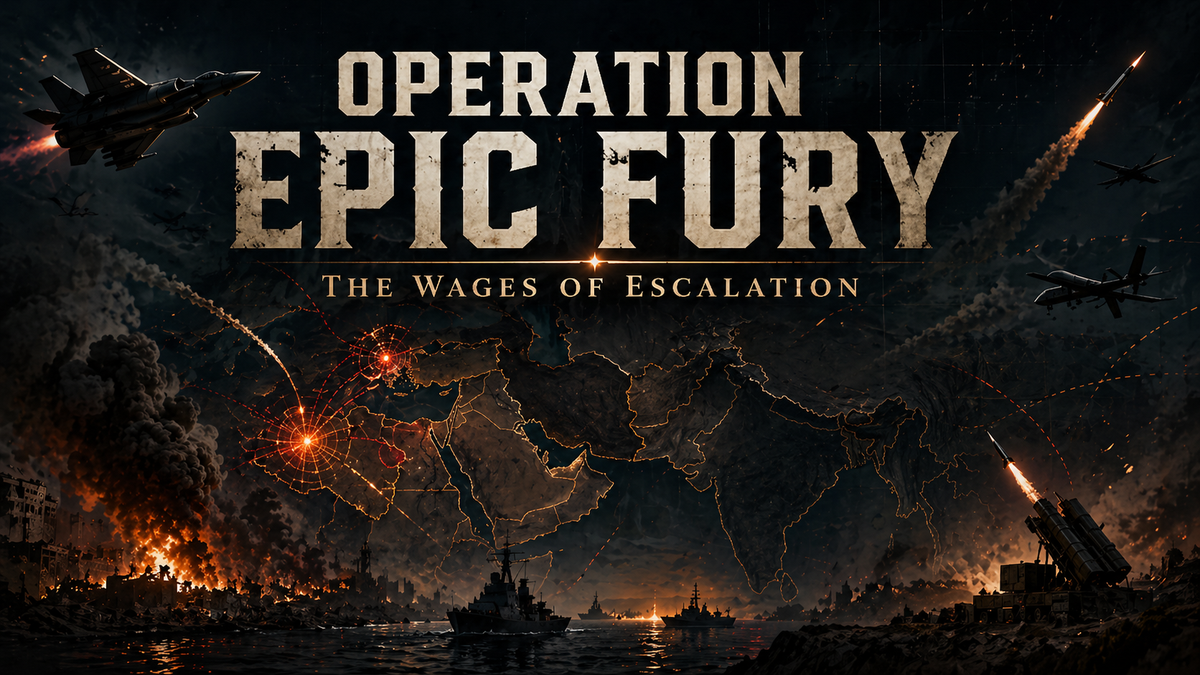
OPERATION Epic Fury, the series of coordinated US Air Force and Israeli Air Force strikes against Iran's nuclear and ballistic missile infrastructure that began on 18 March 2026, has now entered its fourth week. The immediate tactical results are not in dispute. The Fordow enrichment facility — buried under 80 metres of mountain rock near Qom and long considered the hardest target in the Iranian nuclear complex — was struck by a combination of B-2 Spirit deliveries using the GBU-57 Massive Ordnance Penetrator and Israeli F-35I sorties employing a classified penetrating munition. Satellite imagery analysed by the Middlebury Institute and independently corroborated by the Institute for Science and International Security suggests that at least two of Fordow's four enrichment halls have sustained structural collapse.
Natanz, the above-ground enrichment facility that has been struck before — by the Stuxnet worm in 2010, by Israeli sabotage in 2021, and by strikes in 2024 — has again been hit, this time with sufficient force to destroy the above-ground infrastructure entirely. The underground sections at Natanz are assessed as partially functional.
The Imam Ali missile base near Kermanshah, which houses Iran's Shahab-3 and Emad missile stocks and serves as the primary logistics node for the Islamic Revolutionary Guard Corps Aerospace Force's western command, was struck in the second wave. The base is assessed as non-operational.
What Survived
The more consequential intelligence, however, concerns what was not destroyed. Iran's dispersal programme — the systematic relocation of centrifuge components, enriched uranium stocks, and key nuclear scientists to undisclosed sites over the past eighteen months — appears to have been more extensive than US and Israeli intelligence estimated. The Director of National Intelligence's assessment, leaked in fragmentary form to the Washington Post on 28 March, suggests that Iran had pre-positioned enough 60%-enriched uranium hexafluoride at dispersed locations to reconstitute a meaningful enrichment capability within twelve to eighteen months, even in the event of total destruction of declared facilities.
This is not a small finding. It means that the military campaign, even if executed with near-perfect precision against declared targets, cannot by itself foreclose the Iranian nuclear option. It can set back the programme. It cannot end it. The strategic paradox embedded in this reality is one that the architects of the campaign have not publicly addressed: if the strikes demonstrably fall short of elimination, and if Iran's survival instinct and nationalist legitimacy is thereby strengthened, the campaign may have accelerated the very outcome it sought to prevent.
Iran's Asymmetric Response
Tehran has, with some discipline, avoided the direct missile salvos against US bases in Qatar and the UAE that many analysts anticipated. The calculation appears to be that a direct conventional exchange with the United States risks regime-ending escalation, whereas asymmetric pressure — costly enough to impose pain, calibrated enough to avoid crossing the threshold — preserves Iran's strategic position while bleeding American credibility.
In practice, this has meant a renewed Houthi offensive in the Red Sea: since 22 March, Houthi forces have launched fourteen anti-ship missile and drone attacks, sinking one Liberian-flagged container vessel and damaging two others. Insurance rates for Red Sea transits have surged by 340% since the campaign began. The Bab-el-Mandeb chokepoint is, for practical purposes, closed to unescorted commercial shipping.
In Lebanon, Hezbollah has resumed low-intensity operations against northern Israeli communities: daily rocket and anti-tank missile fire at levels just below the threshold Israel has defined as requiring a major ground response. The calculation is precise. Hezbollah is imposing costs, demonstrating solidarity with Tehran, and testing Israel's tolerance for attrition — all without triggering the escalation that would invite its own destruction.
In the cyber domain, Saudi Aramco's Abqaiq processing facility — the single installation through which approximately 7% of global oil supply flows — suffered a partial network intrusion on 1 April attributed by US Cyber Command to IRGC-affiliated actors. The intrusion did not reach operational technology systems. It did not need to. The message was the intrusion itself.
The Strategic Prognosis
Three scenarios now present themselves with unequal probability. In the first — the optimists' scenario — the combination of military damage and economic pressure from reimposed sanctions produces a negotiated pause: Iran agrees to cap enrichment below weapons-grade, the US suspends further strikes, and a framework for a more durable agreement is established. This scenario requires both sides to want an exit ramp simultaneously, a condition that does not presently obtain.
In the second scenario, the current equilibrium of calibrated asymmetric pressure holds through mid-2026, by which point the US presidential cycle and Israeli domestic politics create a window for a diplomatic opening. This scenario requires Iran to continue exercising restraint in its asymmetric responses — a discipline that Hezbollah and the Houthis, both of whom have independent interests and operational momentum, may not indefinitely sustain.
In the third — and in this analyst's assessment, the most probable — scenario, escalation continues in staircase fashion: each Iranian asymmetric action produces a proportionate US or Israeli response, each response produces a further Iranian adjustment, and the compound effect over six to nine months is a regional conflict of significant destructive scope that no party entered intending to fight. This is how most modern conflicts have actually developed. The principals plan for scenarios one and two. History delivers scenario three.
Colonel Maqbool Shah, SM (Veteran), is a former senior Indian Army officer having served command and staff tenures including as Director of Military Operations, Indian Army. He also served as United Nations Liaison Officer across 42 nations in Iraq and Kuwait after the First Gulf War. He has bylines in The Diplomat, Asia Times, Greater Kashmir. He is the Founding Editor of Frontline Strategy Digest.