Nazim Hikmet and Faiz Ahmad Faiz: Prison, Revolution and the Tenderness of Hope
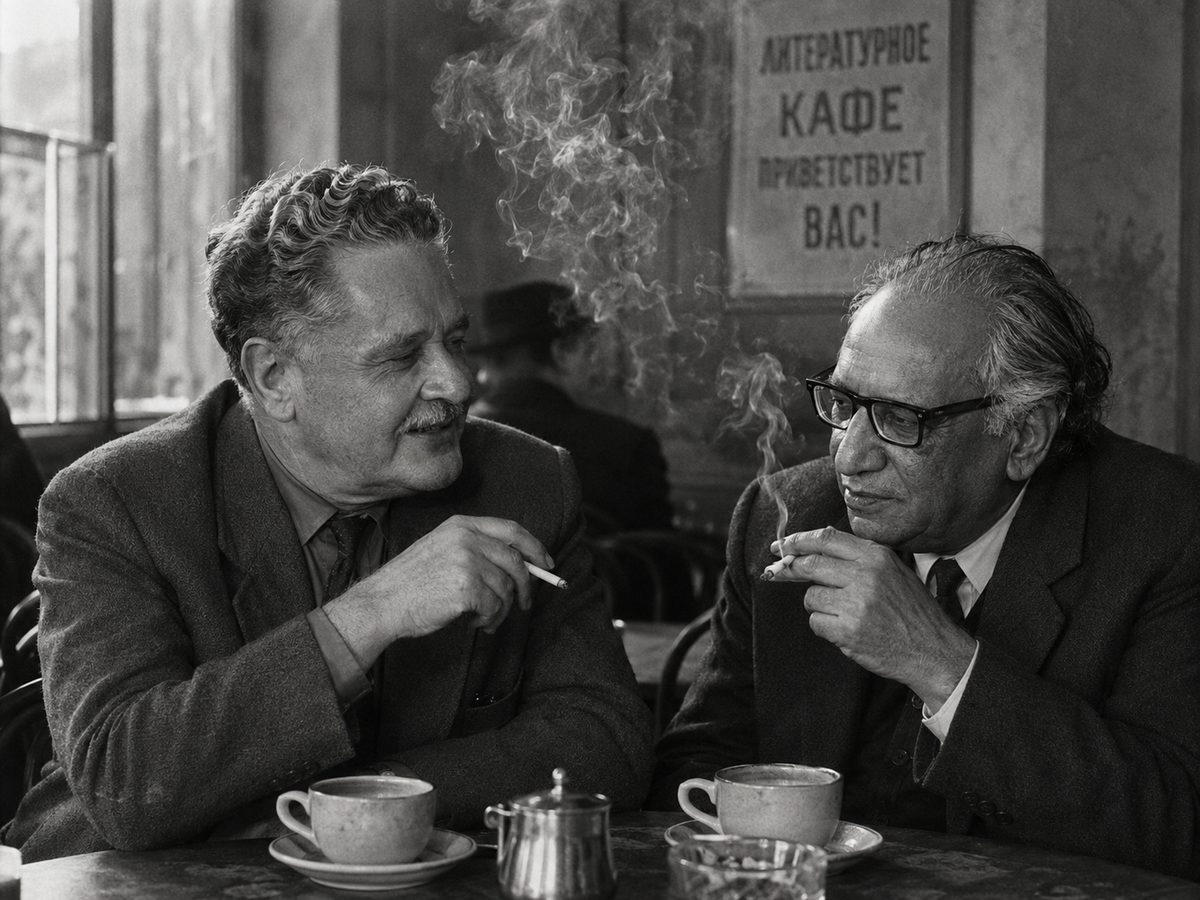
The Lyric as Red Flag and Rose
“Walo ha bagwano, navbahaaruk shaan paida kar;
Pholan gul, gath karan bulbul, tithi samaan paida kar.”
Come, O gardener, create the splendour of a new spring;
Let flowers bloom and nightingales gather — create such a world.
— Mahjoor, adapted from “Walo Ha Bagwano”
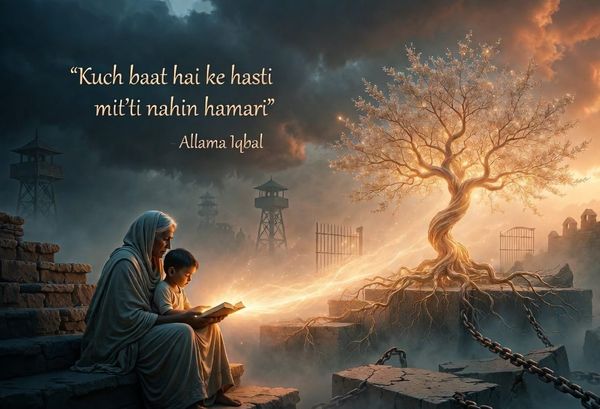
Kashmir’s Mahjoor could not have known that this invocation to the gardener would one day speak so naturally to the revolutionary lyric of Turkey and Punjab. Yet his image is exact. The poet is not merely a singer of spring; he is the one who calls upon the gardener to create the conditions in which spring may return. Flowers do not bloom by sentiment alone. Nightingales do not gather in a devastated garden. Someone must clear the thorns, heal the soil, open the cages, and make life possible again.
That is also the world of Nazim Hikmet and Faiz Ahmad Faiz. Their poetry does not imagine revolution as mere destruction. It imagines revolution as restoration: the return of bread, dignity, beauty, song, friendship and human fellowship to a world disfigured by prisons and power. The garden, the rose, the dawn, the beloved, the worker, the prisoner, the exile — these are not separate worlds in Hikmet and Faiz. They are parts of one moral landscape.
There is also a personal route by which Nazim Hikmet entered my own literary world. I first encountered him not directly, but through Faiz. In The Rebel’s Silhouette, Agha Shahid Ali’s selection and translation of Faiz Ahmad Faiz’s essential verse, I came across Faiz’s “To Vera” — his rendering of Hikmet’s brief and piercing poem addressed to Vera, Hikmet’s Russian wife. The poem struck me with unusual force. It was intimate, almost childlike in its simplicity, yet immense in its surrender. Through Faiz, I had suddenly glimpsed Hikmet.
That small doorway opened into a much larger world. I began searching for Hikmet, reading whatever I could find and procuring whatever work of his was available to me. What I discovered was not merely a political poet, but a profound literary thinker — a poet of prison, exile, revolution, tenderness and world-embracing humanism. In him one could sense the modernist daring of Vladimir Mayakovsky, the revolutionary seriousness of Lenin’s century, and yet something wholly his own: a voice at once public and intimate, ideological and deeply human, militant and tender.
This essay, therefore, is not an abstract comparison between two famous progressive poets. It grows from a literary encounter that began with Faiz and led me to Hikmet. It is also a tribute to the strange fraternity of poets across languages: Hikmet writing to Vera, Faiz carrying Hikmet into Urdu, Agha Shahid Ali carrying Faiz into English, and a reader in Kashmir discovering, through that chain, a Turkish poet whose voice seemed to belong to all wounded and hopeful peoples.
Some revolutionary poets write like manifestos. Others write like wounds. Nazim Hikmet and Faiz Ahmad Faiz belong to that rare order of poets who made revolution sing without making poetry submit to slogan. They were not identical figures. Hikmet came from the collapsing Ottoman world and became the great modern communist voice of Turkish poetry. Faiz came from colonial Punjab and became the most beloved progressive poet of Urdu in the twentieth century. One wrote in Turkish, the other in Urdu. One passed through Moscow, Turkish prisons and exile in Eastern Europe; the other through Lahore, journalism, the Progressive Writers’ Movement, Rawalpindi conspiracy imprisonment, London, Moscow and Beirut. Yet they meet in a shared moral climate: anti-fascism, socialism, prison, exile, love, public hope and an almost miraculous tenderness toward human beings.
They were poets of revolution, but not merely revolutionary poets. That distinction matters. A revolutionary poet may turn verse into political instrument. Hikmet and Faiz did something more difficult. They made political longing inseparable from lyric beauty. Like Mahjoor’s gardener, they imagined revolution not as the destruction of beauty but as its restoration — the return of flowers, birds, bread, dignity, song and human fellowship to a world wounded by history.
Two Lives in the Furnace of the Twentieth Century
Nazim Hikmet was born in 1902 in Salonika, then part of the Ottoman Empire, into a world already approaching dissolution. The old imperial order was breaking; Turkish nationalism, war, revolution and ideological modernity were gathering force. His youth brought him into contact with the currents of modernism, socialism and Soviet revolutionary culture. He studied in Moscow, absorbed the energy of Mayakovsky and the Russian avant-garde, and returned to Turkish poetry with a new music: free verse, cinematic movement, public speech, and an unprecedented fusion of political urgency with lyric warmth.
He paid heavily for that vocation. His communist commitments and writings brought persecution, trial and imprisonment. He spent long years in Turkish prisons, where he continued to write some of his most enduring work. Later he left Turkey and lived in exile, dying in Moscow in 1963. His work, long banned in Turkey, eventually returned to his people and to the world with the force of delayed justice.
Faiz Ahmad Faiz was born in 1911 in Sialkot, in undivided Punjab, into another world under transition: colonial rule, anti-imperial ferment, the rise of modern Urdu literary movements, and the moral convulsions that would lead to Partition. Trained in English, Arabic and Persian literary worlds, he entered the Progressive Writers’ Movement and brought to Urdu poetry a sensibility at once classical and modern, romantic and political, deeply South Asian yet internationally attuned.
Faiz was not a poet of rage alone. He was also a journalist, editor, soldier, cultural worker, peace advocate and political prisoner. His involvement in progressive politics and his alleged role in the Rawalpindi conspiracy case led to imprisonment in 1951. Prison sharpened rather than silenced his poetry. Out of confinement came some of his most beautiful poems, later gathered in collections that made captivity itself part of Urdu’s modern lyric inheritance. He too experienced exile, especially in Beirut, where Palestine and the Arab world deepened his international imagination.
Both poets therefore belong to the great twentieth-century fraternity of imprisoned and exiled writers. But what makes them singular is not the mere fact of persecution. Many writers were persecuted; fewer transformed persecution into a poetics of human enlargement. Hikmet and Faiz refused to become poets of bitterness. They did not deny suffering, but they would not let suffering monopolise the future.
Revolution Without Hatred
The central miracle of both poets is that they wrote revolutionary poetry without reducing the human being to a political category. They were committed to the oppressed, the worker, the peasant, the prisoner, the colonised, the exile, the martyr, the lover, the grieving mother, the comrade, the unnamed poor. Yet they did not turn these figures into ideological symbols alone. They gave them breath, hands, songs, faces, hunger, waiting, fatigue and tenderness.
Hikmet’s socialism is expansive. It contains factory whistles, ships, prisoners, children, peasants, landscapes, machines, lovers and dreamers. He is modern without becoming mechanical. He can write of class struggle, but also of sunlight on water, a woman’s face, a tree, a city, an ordinary meal. His revolution is not only seizure of power; it is restoration of life to those from whom life has been stolen.
Faiz’s revolution is even more subtle because it passes through the inherited language of the ghazal. He does not abandon the beloved; he transforms the beloved. The beloved may still be a human figure, but she may also become the homeland, the people, freedom, justice, or the deferred dawn. In Faiz, the vocabulary of ishq becomes the grammar of politics. The old Urdu lyric world of longing, separation, cruelty, fidelity and waiting becomes a language through which colonialism, class oppression, dictatorship and exile can be felt as wounds of love.
This is why Faiz is so widely loved. He did not write politics as doctrinal explanation. He made injustice emotionally intelligible. The reader does not merely agree with Faiz; the reader feels implicated in his sorrow and hope. His revolution is not cold. It has fragrance, dusk, blood, chains, song, memory and beloved faces.
Neither poet wrote hatred as a permanent political emotion. Anger exists in them, of course; it had to. But hatred is not their final element. They understood that the oppressed do not struggle merely to reverse cruelty. They struggle to recover the possibility of love, bread, dignity, song, sunlight and human fellowship. The revolutionary horizon, for both, is not revenge. It is a world in which ordinary tenderness need not be ashamed of itself.
Prison as School of Vision
Prison is one of the great locations of twentieth-century literature. It is where power tries to reduce the writer to silence, and where the writer discovers that silence itself can be made resonant. For Hikmet and Faiz, prison was not merely biographical accident. It became a central imaginative condition.
Hikmet’s prison years produced work of extraordinary scale and intimacy. The prison cell becomes a point from which the whole country can be imagined. Confinement enlarges vision. Deprived of free movement, the poet moves through memory, solidarity and imagination. He sees workers, villagers, landscapes, battles, women, comrades, rivers, railways and cities. The prison wall becomes a cruel physical fact, but poetry refuses its metaphysical authority.
This refusal is crucial. A state can imprison a body, censor a book, delay publication, separate a poet from his people. But it cannot finally prevent the poem from imagining a community beyond the wall. Hikmet’s poetry makes this point again and again: hope is not produced by favourable circumstances. It is produced by fidelity.
Faiz’s prison poetry is quieter, more perfumed, more classically inflected, but no less defiant. In prison he writes of night, dawn, memory, separation, the beloved, the comrade and the promised morning. Yet the prison is not romanticised. Its darkness is real. Its loneliness is real. Its indignity is real. The greatness lies in the transformation of captivity into a new register of lyric resistance.
Faiz’s prison is also a place where the personal and political merge. The beloved may be absent; so is freedom. The dawn may be delayed; so is justice. The prisoner waits for a footstep, a letter, a sign, a change in the air. The whole political future is condensed into the emotional structure of waiting. This is why his prison poems enter public memory so deeply: they make political hope feel like the return of someone loved.
For both poets, then, prison becomes a school of vision. It teaches the poet to distinguish between confinement and defeat. The jailer controls the gate; the poet controls the horizon.
The Beloved and the People
The most beautiful convergence between Hikmet and Faiz lies in the relation between love and revolution. Neither poet treats love as a private escape from politics. But neither treats politics as an excuse to abolish love. Instead, both discover that the beloved and the people are linked by a deep metaphorical kinship.
In Hikmet, love is often immediate, bodily, generous, open to the world. He writes as one who wants to embrace life in its fullness: the woman he loves, the country he longs for, the comrades he remembers, the workers who build, the children who will inherit the future. His lyric “I” is not narrow. It expands outward. To love one person deeply is to affirm the world in which that person must live freely.
Faiz’s treatment of the beloved is more historically layered. Classical Urdu poetry had already made the beloved powerful, distant, cruel, radiant, unattainable. Faiz inherits that figure and politicises it without destroying its ambiguity. The beloved becomes a bridge between erotic longing and collective emancipation. When Faiz turns from the beloved’s beauty to the wounds of the world, he is not rejecting love. He is enlarging it.
This enlargement is one of his greatest achievements. He teaches Urdu poetry to move from mehfil to mazdoor, from the private chamber to the public square, from the lover’s complaint to the people’s unfinished struggle. Yet he does so without vulgar rupture. The old music remains. The ghazal’s delicacy survives inside the poem of resistance.
Hikmet’s method is different. He is less bound by the classical lyric conventions of an inherited courtly form. His free verse moves with cinematic breadth, direct speech and social panorama. He can sound like a lover, a comrade, a witness, a storyteller, a prisoner, a citizen of the world. Faiz moves through refinement; Hikmet moves through amplitude. Faiz distils; Hikmet expands. Faiz is perfume and flame; Hikmet is wind and marching light.
Yet both understand that revolution without tenderness becomes another prison. Their poetry insists that the ultimate test of politics is whether it makes human tenderness more possible.
“To Vera”: The Secret Bridge
The small poem that first brought Hikmet to me through Faiz remains important to this comparison. “To Vera” is not a manifesto. It is not a poem of slogans, barricades or historical thunder. It is brief, intimate and disarming. The beloved speaks; the lover yields. The command is simple; the surrender is complete. In that miniature structure lies something essential to both Hikmet and Faiz.
Revolutionary poetry is often misunderstood as poetry of hardness. But Hikmet and Faiz reveal that the opposite may be true. The revolutionary poet must be capable of unusual softness, because he is fighting not only for systems but for the human capacity to love, trust, wait, forgive, remember and begin again. The heart that cannot be tender cannot imagine liberation except as another arrangement of force.
Faiz’s rendering of Hikmet’s poem is therefore more than an act of translation. It is an act of recognition. One poet recognises in another the same fusion of surrender and resistance, private love and public faith. Agha Shahid Ali’s later English rendering completes another crossing: Turkish to Urdu, Urdu to English, personal address to world lyric. This is the route through which Hikmet entered my reading life. It also symbolises the deeper route by which revolutionary poetry travels — not as doctrine alone, but as intimacy passed across languages.
The bridge from Hikmet to Faiz is thus not only ideological. It is emotional, aesthetic and spiritual. They share socialism, prison and exile, yes. But they also share the deeper knowledge that no revolution worthy of the name can survive without the grammar of love.
Language: Free Verse and the Ghazal’s Transformation
Hikmet changed Turkish poetry by helping free it from older metrical constraints and by bringing to it a modern energy influenced by Russian futurism, revolutionary speech, cinema and folk cadence. His free verse is not formless. It has rhythm, breath, movement and dramatic pacing. It can move from intimacy to epic scale in a few lines. It can sound like a conversation, a chant, a letter, a song, a proclamation or a cinematic sequence.
This formal liberation suited his politics. A new world required a new line. The old metres could not fully contain factory sirens, modern prisons, mass politics, internationalism, railway rhythms and revolutionary temporality. Hikmet’s line stretches, breaks, accelerates, pauses, leaps. It carries the velocity of the twentieth century.
Faiz’s revolution in language is quieter but perhaps even more subtle. He did not abandon the ghazal tradition. He entered it, absorbed it, and changed its centre of gravity. The ghazal had long been capable of metaphysical and mystical meanings, but Faiz made its inherited symbols speak to colonialism, class, prison, dictatorship and collective hope. The beloved’s lane could become the street of struggle. The morning breeze could become political possibility. The wound could become history. The rose could become revolution.
This is why Faiz’s poetry travels so effortlessly into song. Its political meanings are borne by an older music. His cadences feel familiar even when his implications are radical. The listener may first hear beauty, then discover danger. That is Faiz’s art: he lets revolution arrive in the form of remembrance.
Hikmet modernises through formal rupture. Faiz radicalises through formal continuity. Hikmet breaks the line open; Faiz turns the old line toward the future. Both strategies are revolutionary, but in different ways.
Mayakovsky, Lenin and the Modern Revolutionary Imagination
In reading Hikmet after first encountering him through Faiz, one begins to sense the large intellectual weather behind his poetry. Hikmet is not simply a Turkish poet who happened to be communist. He belongs to the greater revolutionary modernity of the twentieth century — the world of Moscow, workers’ movements, avant-garde experiment, anti-imperial hope and ideological struggle.
The shadow of Vladimir Mayakovsky is important here. Mayakovsky had shown that revolutionary poetry need not whisper in inherited forms. It could stride, shout, fracture, leap, address crowds, remake rhythm and treat the modern city as a new poetic machine. Hikmet absorbed something of that daring, though he remained warmer, more humanly spacious, less metallic in emotional texture. If Mayakovsky often sounds like a trumpet blown against the future, Hikmet frequently sounds like a human voice travelling through prison walls toward those he loves.
Lenin’s century also shapes Hikmet, not in the narrow sense of political doctrine alone, but in the sense of historical seriousness. The poet writes as though history can be changed, as though ordinary people matter, as though the future is not a metaphysical abstraction but a human construction. That belief gives his poetry its forward motion. Even when he writes from prison, one feels that the world outside the cell remains unfinished, therefore still available to hope.
Faiz stands in a related but distinct tradition. His revolutionary imagination does not come through Russian modernism in the same formal sense. It comes through anti-colonial struggle, the Progressive Writers’ Movement, Indo-Persian lyric inheritance, Marxist humanism, and the agonies of South Asian history. If Hikmet carries the energy of revolutionary modernism, Faiz carries the sorrowing continuity of a classical civilisation turning toward justice.
Together, they show two ways in which socialism entered poetry: as formal explosion in Hikmet, as lyrical transfiguration in Faiz.
Internationalism and the Geography of Hope
Both poets were internationalists, but their internationalism was not abstract. It was born from the concrete solidarities of the twentieth century: anti-fascism, socialism, anti-colonialism, workers’ movements, peace campaigns, prison networks, literary congresses and the shared moral imagination of oppressed peoples.
Hikmet’s world crosses borders. Turkey, Russia, Spain, Asia, Europe, workers, revolutionaries, prisoners, exiles — all inhabit his poetic map. He belongs to Turkey, but also to the international communist imagination. His poetry dreams beyond the nation without ceasing to love the homeland. This is important: internationalism does not make him rootless. It makes his love of country more demanding. He loves Turkey not as state power, but as people, landscape, language, memory and possibility.
Faiz similarly belongs to several geographies. He is Punjabi, Urdu, Pakistani, South Asian, Muslim by cultural inheritance, Marxist by political conviction, and internationalist by temperament. His poetry travels from Lahore to Moscow, from prison to Beirut, from the Progressive Writers’ Movement to Palestinian solidarity, from Indo-Persian lyric tradition to global anti-imperialism. He was perhaps one of the few Urdu poets whose sensibility could make Palestine feel organically present within the emotional universe of South Asia.
This is another reason to read Hikmet and Faiz together. Both understood that the twentieth century had made suffering international. Fascism, colonialism, capitalism, militarism, dictatorship and exile did not respect borders. Therefore poetry too had to cross borders. But their internationalism was never bureaucratic. It was human, musical, intimate.
Their true country was not merely socialism as doctrine. It was the human future.
Hope After Betrayal
No serious reading of Hikmet and Faiz should turn them into uncomplicated saints of revolution. They lived in a century in which revolutionary dreams were also compromised by authoritarian states, party orthodoxies, censorship, purges, ideological blindness and historical tragedy. The communist imagination that gave hope to millions also produced its own silences and cruelties. Any honest essay on revolutionary poets must acknowledge this shadow.
Yet the value of Hikmet and Faiz does not depend on treating twentieth-century socialism as innocent. Their value lies in something deeper: they preserved the ethical longing that made the dream necessary in the first place. They remind us that the demand for bread, dignity, equality and freedom cannot be invalidated by the failures of regimes that claimed to speak in its name.
Hikmet’s faith in humanity sometimes appears almost extravagant. But it is not childish. It survived prison, censorship, exile and political defeat. Faiz’s hope is even more tempered. His dawn is often delayed, stained, compromised, or deferred. He knows that liberation does not arrive in pure light. Yet he continues to write toward it. His optimism is wounded, therefore credible.
This is perhaps their most urgent lesson. Hope is not the belief that history will automatically improve. Hope is the refusal to let injustice define the limits of the imaginable. Hikmet’s hope is expansive, bodily, future-facing. Faiz’s hope is melancholic, musical, waiting for dawn. Together they give us two forms of revolutionary endurance: the march and the vigil.
The Kashmiri Resonance
To begin this essay with Mahjoor is not ornamental. Kashmir too knows what it means to wait for spring. It knows the difference between landscape and freedom, between beauty and justice, between song and wound. Mahjoor’s gardener is therefore not a pastoral figure alone. He is a figure of historical responsibility.
In the Kashmiri imagination, spring is never merely seasonal. It carries memory, renewal, return, possibility. It is the opposite of barrenness, fear and silence. When Mahjoor calls upon the gardener to create the splendour of a new spring, he is asking for more than flowers. He is asking for a moral climate in which life can become liveable again.
That is why the line belongs naturally beside Hikmet and Faiz. Hikmet’s prisoner dreams beyond the wall. Faiz’s captive waits for dawn. Mahjoor’s gardener prepares the garden for spring. All three images belong to the same moral universe: the human refusal to accept winter as destiny.
For a Kashmiri reader, this triangulation matters. It places Kashmir not at the margin of world literature, but inside its great conversations. Mahjoor, Hikmet and Faiz are not the same kind of poets, but they share a faith in renewal. Their poetry says that history may wound the garden, but the gardener must still be summoned.
Why They Matter Now
We live in a time when revolutionary language has either hardened into slogan or been emptied into branding. Words such as justice, freedom, resistance and people are used everywhere, but often without inner cost. Hikmet and Faiz return moral seriousness to these words. They remind us that poetry can be political without becoming crude, and beautiful without becoming evasive.
Their relevance is especially acute in societies marked by inequality, authoritarianism, war, censorship, religious polarisation and the loneliness of public life. They show that art need not choose between lyric depth and political responsibility. A poem may sing of the beloved and still belong to the worker. It may speak of the rose and still recognise the prison. It may be gentle and still dangerous.
For South Asian readers, Faiz remains familiar, but pairing him with Hikmet restores his international scale. It reminds us that Faiz was not only an Urdu poet of romance and protest; he was part of a world tradition of left humanist poetry. For readers of Hikmet, comparison with Faiz reveals how revolutionary poetry can inhabit classical lyric inheritance rather than only modernist rupture. Each poet enlarges the other.
This pairing also matters because both poets resisted the brutal simplifications of power. States prefer obedient language. Markets prefer consumable emotion. Sectarian politics prefers identity without tenderness. Militarised nationalism prefers love of country without love of people. Hikmet and Faiz oppose all these reductions. Their poetry says: to love the people is to want them free; to love the country is to refuse its prisons; to love the future is to protect the human capacity for song.
Conclusion: The Red Rose of the Future
Nazim Hikmet and Faiz Ahmad Faiz stand together as two of the twentieth century’s great poets of revolutionary tenderness. Hikmet gives us breadth, energy, free verse, internationalism and the open horizon. Faiz gives us refinement, melancholy, ghazal inheritance, prison music and the deferred dawn. Hikmet’s poetry often feels like a window thrown open; Faiz’s like a lamp kept burning through the night.
Both knew that poetry alone cannot overthrow tyranny. But both also knew that no struggle for human freedom can survive without imagination, memory, love and song. The oppressed do not live by bread alone, though they must have bread. They also live by the dream that bread will one day be shared without humiliation, that love will not be policed, that prison walls will not define truth, that exile will not erase belonging, and that history’s night will not last forever.
Mahjoor’s gardener, Hikmet’s prisoner and Faiz’s lover all belong, finally, to the same human fraternity. Each calls for a world not yet fully born. Each refuses to mistake winter for fate. Each believes that song may not be enough, but without song the struggle loses its soul.
Their revolution was not merely red. It was also fragrant, musical, wounded and human. It carried the rose as well as the flag.
In a century of prisons, they wrote freedom. In a century of exile, they wrote belonging. In a century of slogans, they wrote songs. And because their songs were made of suffering as well as hope, they continue to travel — across Turkey and South Asia, across Kashmir and Punjab, across languages, across defeated revolutions and unfinished struggles — toward that difficult dawn where justice and tenderness may yet recognise each other.
Hikmet gives that dawn its unfinished promise:
“Our most beautiful days
we haven’t seen yet.”
Faiz gives it its moral command:
“Bol, ke sach zinda hai ab tak” —
Speak, for truth is still alive.