Iran’s Strategy of Survival
Absorption, Retaliation and Strategic Endurance in the US-Israel-Iran War - A Campaign Study for Frontline Strategy Digest | 25 May 2026
“War is not merely a political act, but also a real political instrument.”
— Carl von Clausewitz, On War
Editor’s Note
The test of a campaign is not the violence it unleashes, but the political result it compels.
This study treats the US-Israel-Iran war not as a passing crisis, but as a campaign: a sequence of connected political, military, maritime, economic and diplomatic actions through which Iran sought to survive superior force, retaliate without losing control, widen the costs of aggression, and convert endurance into bargaining power.
Its central proposition is this:
Iran did not fight for battlefield victory in the Western manoeuvre-war sense. It fought to prevent strategic defeat. In asymmetric war, the prevention of defeat can itself become a strategic result.
The war’s final record is still incomplete. No open-source analyst can yet know the full Iranian command record, true attrition of missile launchers, internal debates in Tehran, classified US-Israeli target lists, or exact air routes flown. But enough public material now exists to conduct a first-order military study. Recent reporting indicates that the emerging ceasefire framework has revolved heavily around the Strait of Hormuz, sanctions relief, Iranian oil movement, port blockades, and future talks over nuclear limitations — strong evidence that Iran’s maritime and economic leverage became central to war termination.
This study is a continuing effort to capture this modern heavyweight campaign from a military-studies standpoint. It is also intended to form the basis of a larger Frontline Strategy Digest book project once the conflict reaches a more definitive political and military conclusion.
Methodological Note
This study is based on open-source reporting, published military analysis, official statements, regional media accounts, aviation and maritime risk reporting, and campaign-pattern inference. It does not claim access to classified targeting data, actual air routes, internal Iranian command records, or verified attrition figures. Where evidence remains incomplete, the study uses cautious formulations such as “appears”, “likely”, “suggests”, and “indicative”.
Executive Summary
This campaign study examines the US-Israel-Iran war as a contest between superior coercive power and strategic endurance. Its central finding is that Iran did not seek victory in the conventional manoeuvre-war sense. It sought to prevent strategic defeat. In asymmetric war, that distinction is decisive. Iran’s aim was to absorb the opening blow, preserve regime and command continuity, retain enough retaliatory capacity, widen the costs of escalation, and enter diplomacy without appearing to surrender.
Iran entered the war after years of sanctions, intelligence penetration, regional proxy attrition, Israeli covert action and accumulated military pressure. Its older deterrence model rested on four pillars: missiles and drones, forward defence through regional partners, strategic depth within Iranian territory, and maritime leverage through the Strait of Hormuz. The war exposed the limits of these pillars, especially the weakening of the forward-defence network, but it also demonstrated the continuing value of Iran’s homeland missile-drone complex, underground infrastructure, decentralised command structures and geographic leverage. The battlefield shifted from forward deterrence to homeland endurance.
The study identifies Iran’s campaign logic as a six-stage sequence: Absorb → Survive → Retaliate → Widen → Endure → Negotiate. First, Iran had to absorb US-Israeli strikes without paralysis. Second, it had to preserve political command, internal control and minimum military functionality. Third, it had to retaliate sufficiently to show that deterrence had not been destroyed. Fourth, it widened the theatre into the Gulf, energy markets, shipping lanes, regional bases, proxy theatres and diplomacy. Fifth, it endured punishment while preserving options. Finally, it sought to convert survivability into bargaining leverage.
The campaign’s decisive feature was not any single weapon or commander. It was the convergence of several factors: regime continuity, missile survivability, underground dispersal, strategic depth, Hormuz leverage, GCC anxiety, China-Russia diplomatic shelter, Iranian diplomacy and the adversary’s own escalation limits. Iran’s missile and drone forces did not need to defeat Israel’s or America’s military systems outright. They had to remain sufficiently dangerous to impose cost, uncertainty and political pressure. Even intercepted missiles could generate strategic effect by forcing warnings, sheltering, interception expenditure, base hardening, insurance adjustment and public anxiety.
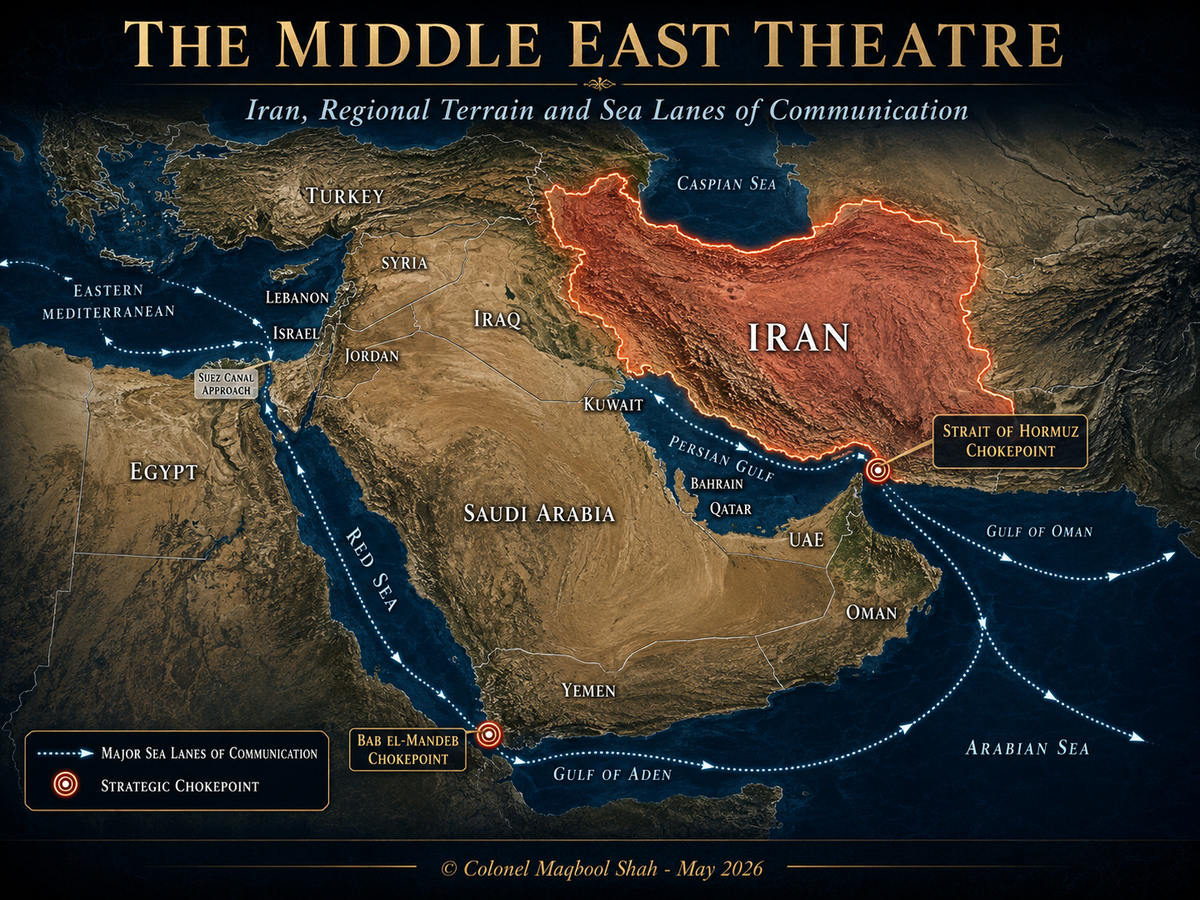
The Strait of Hormuz became Iran’s most important equaliser. Iran could not defeat the US Navy in blue-water terms, but it did not need to. By threatening maritime traffic, energy flows, insurance markets and Gulf stability, Tehran turned geography into bargaining power. Hormuz transformed the war from a punitive campaign against Iran into a global economic and diplomatic problem. That is why maritime access, oil sales, sanctions relief, port blockades and ceasefire arrangements became central to the war-termination framework.
The GCC states were not passive spectators. They occupied a position of armed caution: dependent on the US security umbrella, anxious about Iranian retaliation, vulnerable to missile and drone strikes, and deeply concerned about energy infrastructure, ports, desalination plants and financial hubs. Their strategic dilemma was simple: they wanted Iran contained, but not the Gulf set on fire. This anxiety helped create pressure for de-escalation and mediation.
The China-Russia factor also mattered. Neither Beijing nor Moscow fought for Iran, and neither provided a formal security guarantee. Yet both supplied a form of strategic shelter. Their shared aversion to unchecked American coercive power, their economic and diplomatic links with Tehran, and their willingness to operate outside Western sanction frameworks helped reduce Iran’s isolation. This demonstrates a modern lesson in alliance formation: a state under pressure does not always require a formal alliance; it needs enough external depth to prevent complete strategic suffocation.
Iran’s decentralised command arrangements and underground missile infrastructure were central to its survival. Missile cities, dispersed launchers, hidden storage, mobile systems and regional command structures were not improvised during the war; they were the result of decades of adaptation under sanctions. Their purpose was clear: if Iran could not prevent the first strike, it had to ensure that the first strike would not be decisive. This architecture forced the attacker to confront a dispersed, concealed and redundant target system rather than a small number of exposed military nodes.
The war also revealed Iranian weaknesses. Its air defences were vulnerable to superior ISR, electronic warfare and suppression operations. Its economy remained fragile. Its proxy network had degraded compared with earlier years. Its missile inventories and production infrastructure were not inexhaustible. Its domestic legitimacy remained vulnerable to prolonged hardship. Iran’s strategy therefore should not be romanticised. It succeeded only within a limited but vital frame: it prevented the adversary from translating battlefield superiority into political submission.
The core military lesson is that tactical success does not automatically produce strategic decision. The US-Israeli campaign may have degraded Iranian assets, damaged infrastructure and demonstrated overwhelming reach. But if Iran remained coherent, retained retaliatory capacity, preserved Hormuz leverage and entered negotiations without formal surrender, then superior military power did not produce clean political victory.
The study’s final judgement is therefore measured: Iran did not defeat the United States and Israel. It prevented them from achieving decisive political submission. In the grammar of asymmetric war, that is not classical victory — but it is far from defeat.
I. The Character of the War
The US-Israel-Iran war was not a conventional war between equivalent military systems. It was a coercive air-maritime campaign by technologically superior powers against a regional state possessing missiles, drones, proxy networks, geography, ideological depth and the political habit of endurance.
The United States and Israel possessed overwhelming advantages in airpower, intelligence, precision strike, cyber penetration, satellite surveillance, naval reach and integrated battle management. Iran possessed a different arsenal: ballistic missiles, cruise missiles, drones, dispersed launch systems, underground facilities, armed partners, internal mobilisation structures and the Strait of Hormuz.
This asymmetry shaped everything.
For Washington and Tel Aviv, the campaign’s logic was compellence: punish Iran, degrade its nuclear and military capacity, impose pain, and force concession. For Tehran, the logic was denial: deny regime collapse, deny decisive disarmament, deny political humiliation, deny safe escalation to the adversary, and deny the impression that Iran could be struck without consequence.
The war therefore became a contest between coercive punishment and strategic endurance.
Iran could not defeat the United States in the classical sense. It could not destroy Israel’s military capacity. It could not seize territory and impose terms. Its operational problem was different: to remain dangerous after punishment.
The moment Iran survived the opening blow and demonstrated retained retaliatory capacity, the war entered a more complex phase.
That was Iran’s first strategic achievement.
Role in campaign: Ultimate political authority and guardian of regime survival.
Strategic function: Maintain regime continuity, approve escalation thresholds, preserve the legitimacy of resistance and authorise negotiation.
Campaign significance: Iran’s leadership structure, whether embodied in a single Supreme Leader or a wartime collective security consensus, was itself a centre of gravity. The adversary needed paralysis; Tehran needed continuity.
Likely priority: Prevent regime fracture, avoid unconditional capitulation, maintain deterrence credibility and keep diplomatic exits open without appearing defeated.
Note: Reporting on Iran’s leadership during the 2026 war has been fluid and contested. Some reports describe leadership transition and the growing influence of hardline security elites after strikes on senior Iranian figures; therefore, the campaign study should avoid over-claiming exact internal command dynamics unless later confirmed by official or archival sources.
II. Strategic Background: Iran Before the Opening Blow
Iran’s strategic culture draws from two long memories: the imperial memory of statecraft and depth, and the Shia memory of endurance, sacrifice and refusal under superior force.
Iran entered the war after years of accumulated pressure: sanctions, Israeli covert action, cyber intrusion, regional proxy attrition, internal dissent, intelligence penetration and the long shadow of nuclear confrontation.
The older Iranian model of deterrence rested on four pillars:
- Missiles and drones as long-range punishment tools.
- Forward defence through partners and proxies across Lebanon, Syria, Iraq, Yemen and Gaza.
- Strategic depth and dispersal inside Iran’s own territory.
- Maritime leverage in the Gulf, especially through the Strait of Hormuz.
The war exposed both the fragility and value of these pillars.
The proxy pillar had weakened compared with its earlier high point. Hezbollah had been under severe pressure; Syria was no longer the same strategic rear; Iraq’s militias remained useful but politically constrained; the Houthis retained disruptive capacity but could not alone decide the war. Iran’s homeland missile and drone complex therefore became more central.
The battlefield shifted from forward deterrence to homeland endurance.
Before the war, Iran hoped to deter attack by threatening retaliation through its wider regional network. Once the war began, Iran had to prove that even under direct assault, it could still impose costs. The campaign was therefore not merely military. It was psychological: Tehran had to show that the Islamic Republic had not been strategically paralysed.
In the Shia political imagination, Karbala is not merely a tragedy; it is a grammar of endurance against superior force.
III. Iran’s Campaign Logic
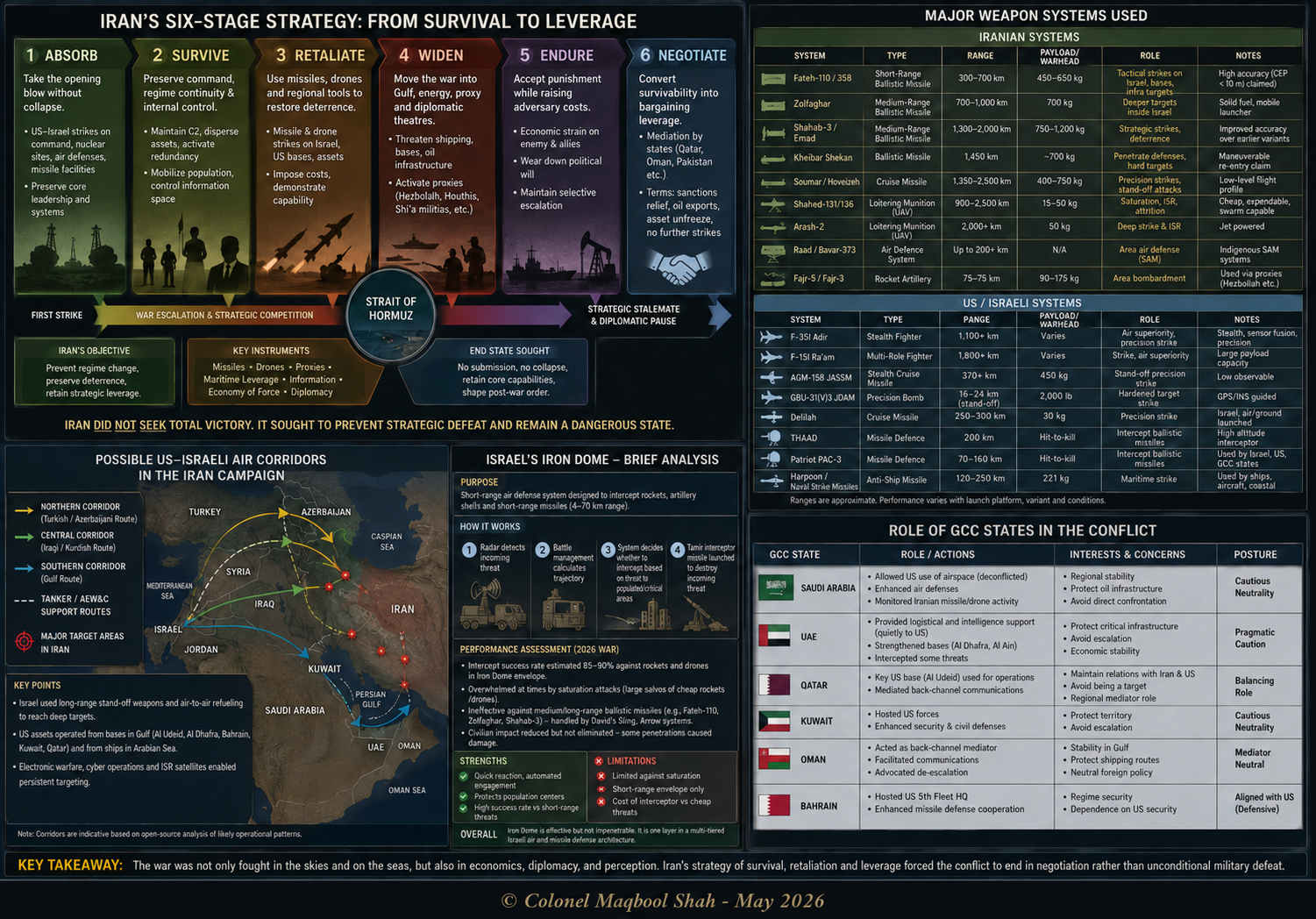
Iran’s strategy can be reduced to a six-stage model:
Absorb → Survive → Retaliate → Widen → Endure → Negotiate
Each stage had a distinct operational purpose.
|
Stage |
Purpose |
|
Absorb |
Take the first blow without
collapse. |
|
Survive |
Preserve political
command, internal control and minimum military functionality. |
|
Retaliate |
Prove that
deterrence had not been destroyed. |
|
Widen |
Expand costs beyond
Iranian territory. |
|
Endure |
Outlast the
adversary’s political appetite. |
|
Negotiate |
Convert
survivability into bargaining leverage. |
This was not elegant manoeuvre warfare. It was layered, reactive, coercive and attritional. But it was strategically coherent.
Iran’s campaign drew on the Islamic Republic’s institutional memory: the Iran-Iraq War, isolation, sanctions, martyrdom, mobilisation, dispersal, deception, redundancy and long endurance against stronger enemies. It also reflected Iran’s political structure: overlapping centres of power, IRGC autonomy, civilian-state management, ideological control and security-first governance.
The campaign’s grammar was not “victory through decisive battle”. It was “survival through cumulative cost imposition”.
IV. Phase One: Absorbing the Opening Blow
The opening phase of the war appears to have been designed to shock Iran into paralysis. US-Israeli strikes reportedly targeted air defences, missile infrastructure, nuclear-associated facilities, command nodes, military bases, storage facilities and parts of Iran’s coercive apparatus. Subsequent reporting and analysis indicate that the campaign placed particular pressure on Iranian missile and drone systems, while Iran later used the ceasefire period to reconstitute damaged capabilities.
Iran’s first strategic problem was not retaliation. It was non-collapse.
The opening phase created four immediate problems:
|
Problem |
Iranian Requirement |
|
Command continuity |
Preserve political and military decision-making under strike pressure. |
|
Air-defence survival |
Retain enough radar, SAM, decoy and dispersal capability to complicate
enemy air operations. |
|
Missile-force survivability |
Keep mobile launchers, underground storage and command links functional. |
|
Domestic control |
Prevent panic, elite fracture, ethnic unrest or regime
delegitimisation. |
This is central to the campaign study. Under decapitation pressure, the first act of strategy is continuity. If the regime continues to issue orders, communicate resolve and retaliate, the attacker’s tactical success does not automatically become political victory.
Iran absorbed punishment and remained a belligerent.
That altered the war.
V. Phase Two: Retaliation Without Collapse
Once Iran absorbed the opening blow, it had to respond. Failure to retaliate would have meant strategic humiliation. Excessive retaliation, however, risked inviting even greater destruction. Iran’s central operational dilemma was therefore how to punish without committing suicide.
Iran’s retaliation served several purposes:
- Demonstrative: show that Iran’s missile and drone forces remained alive.
- Punitive: impose physical and psychological costs on Israel, US assets and regional infrastructure.
- Deterrent: warn against unlimited escalation.
- Political: reassure domestic and regional audiences that Iran had not been humbled.
- Operational: stretch adversary air and missile defence systems.
The key question is whether Iran sought mass retaliation or sustained retaliation.
A single massive salvo can create spectacle but exhaust inventory. Sustained salvos, even if smaller, keep adversaries under pressure, complicate civil defence, force repeated interception, consume expensive interceptors and maintain uncertainty. The reported pattern of missile and drone pressure suggests Iran sought a mixture: dramatic salvos for political messaging, followed by managed fire pressure to preserve options.
A ballistic missile that is intercepted may still impose cost. It forces detection, tracking, warning, sheltering, interception, base hardening, insurance adjustment and political anxiety. Iran’s objective was therefore not merely the number of successful impacts. It was the cumulative creation of danger.
This is deterrence by punishment under technological disadvantage.
Major Weapon Systems Used by Both Sides
These figures are indicative OSINT ranges, not classified performance data. Exact variants, launch platforms, payloads, guidance packages and wartime success rates remain disputed.
A. Iranian Systems
|
System |
Type |
Approx. Range |
Payload / Warhead |
Campaign Role |
Assessment |
|
Fateh-110 / Fateh-313 |
Short-range ballistic missile |
300–700 km |
~450–650 kg |
Tactical strikes on bases and infrastructure |
Solid-fuel, mobile, useful for regional targets |
|
Zolfaghar |
Medium-range
ballistic missile |
700–1,000 km |
~500–700 kg |
Deeper regional
strikes |
Mobile, survivable,
politically visible |
|
Shahab-3 / Emad |
Medium-range ballistic missile |
1,300–2,000 km |
~750–1,200 kg |
Strategic strike against Israel / Gulf targets |
Older lineage but still significant |
|
Kheibar Shekan |
Ballistic missile |
~1,450 km |
~500–700 kg |
Penetration of
defended targets |
More modern,
manoeuvrable re-entry claims |
|
Soumar / Hoveyzeh |
Land-attack cruise missile |
1,350–2,500 km |
~400–750 kg |
Low-level precision strike |
Harder to detect than ballistic missiles |
|
Shahed-131/ 136 |
Loitering munition /
drone |
900–2,500 km |
~15–50 kg |
Saturation,
harassment, ISR-shaping |
Cheap, expendable,
useful in swarms |
|
Arash-2 |
Long-range loitering munition |
2,000 km+ claimed |
~50 kg |
Deep strike / psychological pressure |
Strategic signalling value |
|
Bavar-373 / Raad /
Khordad family |
Air-defence systems |
Varies; up to 200
km+ claimed |
N/A |
Area air defence |
Important but
vulnerable to SEAD/DEAD |
|
Fast-attack craft, mines, coastal missiles |
Maritime denial tools |
Gulf / Hormuz theatre |
Varies |
Strait of Hormuz coercion |
Iran’s geographic equaliser |
Iran’s strength was not any one system. It was the combination of missiles, drones, dispersal, maritime denial, proxy pressure and political endurance. Its weakness remained vulnerability to ISR penetration, air superiority, cyber-attack and precision strikes against fixed infrastructure.
Iranian Missile and Drone Names: Approximate Meanings for Non-Persian Audiences
|
Name |
Approximate Meaning / Reference |
Analytical Note |
|
Fateh |
“Conqueror” or
“Victor” |
A name of triumph
and battlefield success. |
|
Zolfaghar / Zulfiqar |
The legendary sword
associated with Imam Ali |
Evokes Shia martial
symbolism and sacred legitimacy. |
|
Shahab |
“Meteor” or
“shooting star” |
Suggests speed,
descent and sudden strike. |
|
Emad |
“Pillar”, “support”
or “mainstay” |
Implies strength and
structural reliability. |
|
Kheibar Shekan |
“Khaybar Breaker” |
Refers to the Battle
of Khaybar; carries religious-historical resonance. |
|
Soumar |
Usually associated
with an Iranian place name |
Often linked to
geography and national memory. |
|
Hoveyzeh |
Iranian place name |
Carries Iran-Iraq
War and territorial memory. |
|
Shahed |
“Witness” or
“martyr” |
Central term in
revolutionary and Shia political vocabulary. |
|
Arash |
Legendary Iranian
archer |
Evokes Persian myth,
range and sacrifice. |
|
Bavar |
“Belief” or
“confidence” |
Suggests
self-reliance and indigenous capability. |
|
Raad |
“Thunder” |
Common military name
indicating shock and force. |
|
Khordad |
Name of a month in
the Iranian calendar |
Used in several
Iranian systems; culturally domestic rather than purely martial. |
Analytical Note
Iranian system names are not accidental. They draw from three symbolic reservoirs:
- Islamic-Shia memory — Zolfaghar, Shahed, Kheibar.
- Persian civilisational memory — Arash.
- Revolutionary self-reliance — Bavar, Fateh, Raad.
This naming practice helps Iran convert weapons into political symbols. Missiles are not presented merely as technical systems. They are framed as instruments of memory, resistance, martyrdom and national will.
B. US-Israeli Systems
|
System |
Type |
Approx. Role / Range |
Campaign Role |
Assessment |
|
F-35I Adir |
Stealth fighter |
Deep-strike aircraft |
Air superiority, SEAD, precision strike |
Central to Israeli deep-strike architecture |
|
F-15I Ra’am |
Strike fighter |
Long-range, heavy payload |
Deep strike and heavy ordnance delivery |
Strike workhorse |
|
F-16I Sufa |
Multirole fighter |
Medium-long range with refuelling |
Strike, escort, suppression |
Flexible but less survivable than F-35 |
|
US strategic bombers |
Long-range strike platform |
Intercontinental with refuelling |
Hardened and strategic targets |
Useful where bunker penetration is required |
|
Tomahawk cruise missile |
Land-attack cruise missile |
1,600 km+ class |
Stand-off strike |
Naval strike against fixed targets |
|
JDAM / bunker-buster family |
Precision-guided bomb |
Aircraft-delivered |
Hardened facilities |
Dependent on access and ISR |
|
Aegis / SM family |
Naval air and missile defence |
Layered naval defence |
Protection of ships and regional assets |
Supports US regional posture |
|
Arrow-2 / Arrow-3 |
Ballistic missile defence |
Endo/exo-atmospheric intercept |
Defence against Iranian ballistic missiles |
More relevant than Iron Dome against MRBMs |
|
David’s Sling |
Medium-range missile defence |
Medium-range intercept |
Defence against cruise missiles / tactical ballistic threats |
Crucial middle layer |
|
Iron Dome |
Short-range air defence |
Rockets, artillery, drones |
Defence against short-range threats |
Less central against Iranian MRBMs |
Israel’s defensive architecture is multi-layered: Iron Dome for short-range threats, David’s Sling for medium-range threats, Arrow-2 and Arrow-3 for ballistic missiles, with US regional systems providing additional depth. Reporting during the war stressed that Iron Dome probably played only a limited role against longer-range Iranian ballistic missiles; Arrow and David’s Sling were more relevant.
VI. Phase Three: Widening the Theatre
Iran’s strongest move was not purely kinetic. It was geographic and economic.
A war confined to Iranian territory favoured the United States and Israel. A war widened into the Gulf, energy markets, shipping insurance, regional bases, proxy theatres and global inflation became more difficult to manage.
Iran therefore attempted to transform the war from a punitive campaign against Iran into a regional crisis whose costs could be felt by many actors.
The widening phase had five dimensions:
1. The Gulf as pressure theatre
Iran could threaten shipping, oil flows, ports, tankers, naval movement and insurance markets. It did not need to sink fleets to impose costs. Even uncertainty around Hormuz raised pressure.
2. Regional bases as vulnerable nodes
US bases in the Gulf are essential to American power projection, but they are also fixed or semi-fixed targets within Iranian missile range. Iran’s ability to threaten them complicated Washington’s operational calculus.
3. Partners and proxies as distributed escalation tools
Iran’s aligned actors offered options below the threshold of direct state-to-state escalation. These networks allowed pressure in multiple theatres, though their usefulness varied by geography and local political conditions.
4. Energy markets as strategic terrain
Oil prices, shipping delays, insurance premiums and supply uncertainty became instruments of war. Iran understood that Western, Gulf and Asian economies are sensitive to Gulf disruption.
5. Mediation as battlefield extension
Pakistan, Qatar, Oman and other intermediaries became part of the war-termination mechanism. Once mediation became central, Iran had succeeded in turning military endurance into diplomatic relevance. Reporting on the May 2026 framework highlights Pakistan’s mediation role, the Strait of Hormuz, Iranian oil sales, sanctions relief and port access as core elements of the emerging arrangement.
Iran’s insight was clear: when facing a superior military coalition, do not fight only where the coalition is strongest. Move the contest into areas where the coalition has vulnerabilities — economics, alliance cohesion, public fatigue, shipping disruption and fear of regional conflagration.
Liddell Hart’s central lesson was that strategy should avoid strength and strike at weakness. Iran’s widening of the war into energy, shipping, regional anxiety and diplomacy followed that indirect logic: it did not try to defeat the US-Israeli coalition where it was strongest; it tried to make the wider theatre politically and economically costly.
Position: President of Iran.
Role in campaign: Civilian face of the state; manager of public legitimacy, domestic endurance and diplomatic signalling.
Strategic instinct: Pragmatic but constrained by wartime nationalism, security institutions and hardline power centres.
Campaign significance: His function was less operational and more political: to keep the state appearing coherent, rational and capable of negotiation without surrender.
Likely priority: Prevent war from becoming regime collapse; preserve diplomatic space; manage economic hardship; avoid appearing weak before hardliners.
VII. Indicative Air-Corridor Sketch: US-Israeli Air Operations
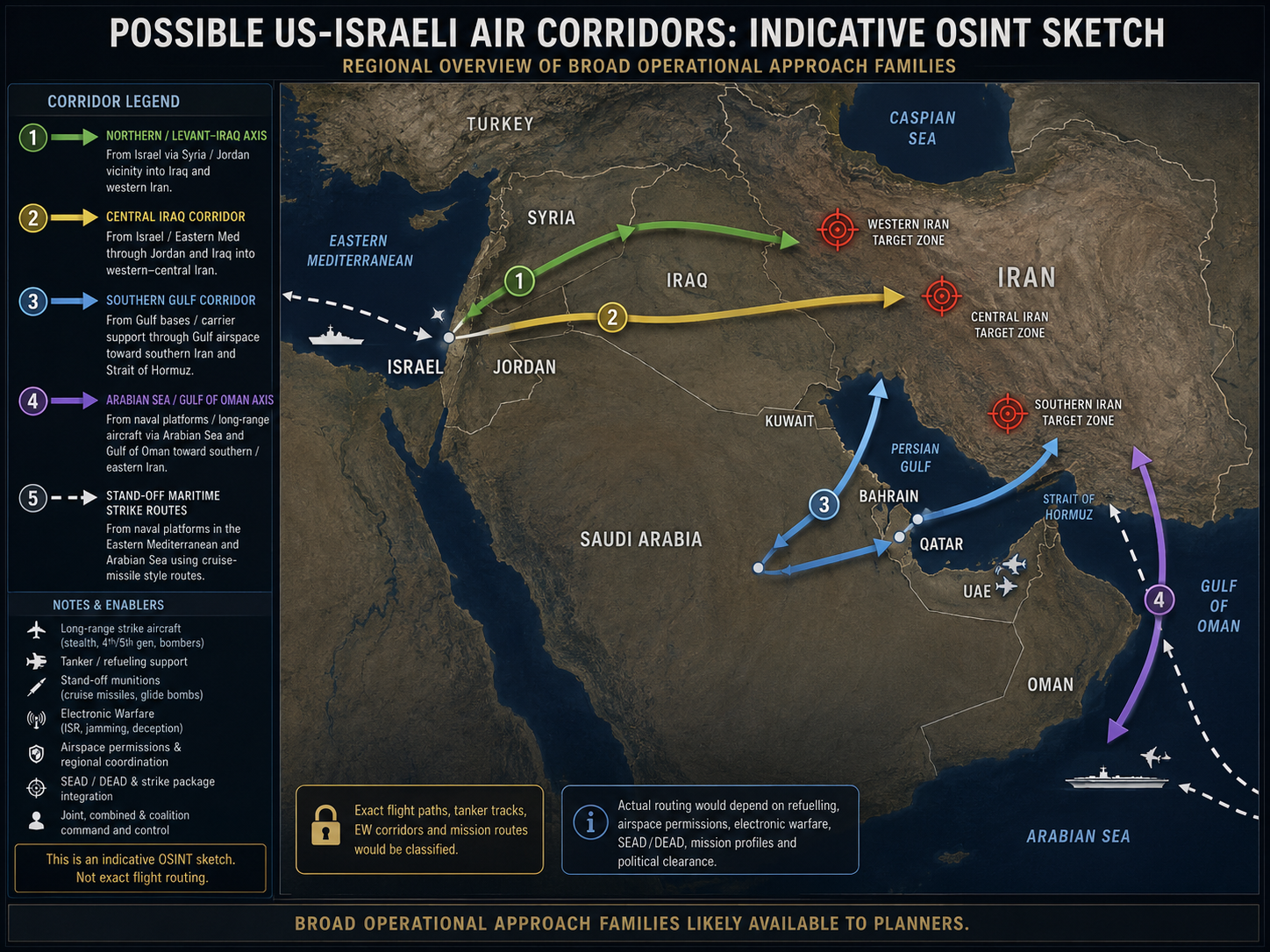
This part must be handled with professional caution. Exact flight paths, refuelling tracks, tanker orbits, electronic-warfare corridors and mission routes are classified. The sketch below does not claim exact routing. It identifies broad approach families likely available to US-Israeli planners, reconstructed from publicly available reporting and operational geography.
Possible US-Israeli Air-Corridor Families
|
Corridor |
Broad Route |
Likely Users |
Operational Logic |
Constraints |
|
Northern /
Levant-Iraq Axis |
Israel →
Syria/Jordan vicinity → Iraq → Western Iran |
Israeli aircraft,
stand-off weapons |
Shorter path into
western Iran; historically plausible strike geometry |
Political
sensitivities; airspace detection; deconfliction |
|
Central Iraq
Corridor |
Eastern Mediterranean
/ Israel → Jordan/Iraq → Iran |
Israeli and
US-linked assets |
Direct approach to
western and central Iran |
Requires
suppression, deception and airspace management |
|
Southern Gulf
Corridor |
Gulf bases /
carriers → Gulf airspace → Southern Iran |
US aircraft, naval
aviation, cruise missiles |
Access to Bandar
Abbas, Bushehr, Kharg, Asaluyeh and Hormuz-related targets |
Vulnerable to
Iranian missiles and maritime escalation |
|
Arabian Sea / Gulf
of Oman Axis |
Naval platforms /
long-range aircraft → Gulf of Oman → Southern/Eastern Iran |
US naval and
long-range assets |
Useful for cruise
missiles and seaward deep strikes |
Longer distances;
Iranian coastal sensors and missiles |
|
Stand-off maritime
corridor |
Eastern
Mediterranean / Red Sea / Arabian Sea naval platforms |
US and allied naval
forces |
Cruise-missile
strikes without overflight dependence |
Targeting depends on
ISR and battle damage assessment |
VIII. Israel’s Iron Dome: Tactical Shield, Not Strategic Panacea
Iron Dome is often misunderstood in public debate. It is a superb short-range defence system, but it is not Israel’s primary shield against Iranian medium-range ballistic missiles.
What Iron Dome does well
Iron Dome is designed primarily to intercept:
- Short-range rockets.
- Artillery rockets.
- Mortars.
- Some drones.
- Projectiles threatening populated or high-value areas.
Its strength lies in automation. Radar detects launch, battle-management software calculates the likely impact point, and the system fires interceptors only if the projectile threatens a protected area.
This makes it highly effective against rocket attacks from Gaza, Lebanon or other nearby fronts.
What Iron Dome does not do well
Iron Dome is not optimised for:
- Long-range ballistic missiles.
- High-speed medium-range ballistic missiles.
- Manoeuvring re-entry vehicles.
- Heavy mixed salvos combining ballistic missiles, cruise missiles and drones.
For Iranian ballistic-missile attacks, Israel’s more relevant systems are Arrow-2, Arrow-3 and David’s Sling, supported by US regional assets. Breaking Defense reported that Iron Dome likely did not play a significant role against Iranian missile attacks because it is mainly intended for short-range missiles and one-way attack drones; outer layers such as Arrow-3, Arrow-2 and David’s Sling were more relevant.
Operational Lesson
Iron Dome is a tactical shield. Against Iran, Israel required a strategic missile-defence architecture:
|
Layer |
Main System |
Threat Set |
|
Outer layer |
Arrow-3 |
Exo-atmospheric ballistic missile intercept |
|
Middle layer |
Arrow-2 / David’s Sling |
Ballistic and medium-range missile threats |
|
Inner layer |
Iron Dome |
Rockets, short-range missiles, drones |
|
External layer |
US Aegis, Patriot, THAAD and sensors |
Regional reinforcement |
The lesson is clear:
Iron Dome protects Israeli population centres from short-range fire. It does not, by itself, solve the Iranian missile problem.
IX. Phase Four: Strategic Economy of Force
One of the most important questions is not only what Iran did, but what it avoided doing.
Iran did not appear to expend all its military assets immediately. It did not activate every partner at maximum intensity. It did not abandon diplomacy. It did not fully convert the war into an uncontrolled regional inferno. Even when escalation widened, it retained a degree of selectivity.
That selectivity had two explanations.
First, constraint. Iranian missile stocks, launcher availability, air-defence capacity and command systems are finite. A technologically superior adversary can destroy production lines, storage sites, radars, depots and launchers. Iran therefore had to conserve.
Second, strategy. Iran needed enough escalation to impose costs, but not so much that it unified all Gulf and Western actors behind maximal war aims. If Iran struck indiscriminately, it risked turning reluctant neighbours into active enemies. If it remained passive, it invited further punishment.
Its answer was calibrated danger: enough to frighten, not always enough to consolidate a grand coalition against it.
This is the paradox of Iranian strategy: ideological defiance combined with operational caution.
Iran tried to keep something in hand for every phase: missiles for retaliation, drones for persistence, proxies for ambiguity, Hormuz for coercion, diplomacy for exit, and ideological mobilisation for endurance.
Position: Senior IRGC figure; reported by multiple outlets as a key figure in Iran’s wartime security establishment.
Role in campaign: Symbol of hardline security control, missile-drone posture, coercive escalation and regime defence.
Strategic instinct: Hardline, security-first, escalation-capable, but operating within the regime-survival imperative.
Campaign significance: The IRGC was both sword and shield: the institution through which Iran retaliated and the structure most tied to regime continuity.
Likely priority: Restore deterrence, preserve missile and drone forces, prevent the image of defeat, maintain proxy credibility and shape the post-war bargaining environment.
Recent reporting describes Vahidi as a critical voice in Iran’s wartime establishment, though public reporting differs on his exact formal title and degree of command authority.
X. The Architecture of Survival: Decentralised Command and Missile Cities
Iran’s strategic endurance did not begin on the first day of the war. It was built over decades.
Two features deserve particular attention: decentralised command and dispersed underground missile infrastructure.
Iran appears to have understood a basic truth of modern airpower: any fixed, centralised and exposed military system will be found, struck and degraded. The answer was not to match the United States and Israel platform for platform. The answer was to make Iran’s coercive capacity difficult to eliminate in one blow.
1. Decentralised provincial command
There have been reports and analyses suggesting that Iran’s security architecture gives significant autonomy to provincial or regional IRGC structures. One recent analysis described Iran’s IRGC organisation as horizontally structured, with independent command chains across provinces and weapons stockpiles dispersed across the country.
Some claims about Iran’s wartime command architecture refer to a division into independent districts or operational zones. Since the precise number requires firmer confirmation, the safer formulation is that Iran appears to rely on decentralised provincial or regional command structures designed to preserve operational continuity under decapitation pressure.
This is not merely military organisation. It is a survival doctrine.
2. Missile cities and underground dispersal
Iran’s so-called “missile cities” are among the most important features of its deterrent posture. These underground complexes, tunnels, depots and launch facilities are designed to hide, protect, move and preserve missile systems under conditions of attack.
The IISS has described Iran’s missile and UAV capabilities as central to its doctrine of denying adversaries their military objectives, and open-source assessments have repeatedly noted Iran’s emphasis on precision, range, survivability and dispersal.
The logic is simple:
- Put missiles underground.
- Disperse launchers.
- Hide entrances and storage points.
- Use mobile systems.
- Preserve enough capability after the first strike.
- Make the adversary uncertain about how much has survived.
Iran’s missile cities do not make it immune. In fact, US-Israeli strikes reportedly targeted launchers, bunker entrances and missile-support infrastructure. But underground dispersal changes the attacker’s problem. Instead of destroying a few visible bases, the attacker must map and neutralise a vast hidden network.
That imposes time, intelligence and munition costs.
The achievement is striking because Iran built much of this architecture under severe Western sanctions. Sanctions restricted access to advanced aircraft, sensors, engines, finance and industrial inputs. Iran responded by investing in what it could build, hide, replicate and sustain: missiles, drones, tunnels, hardened sites, maritime denial tools and local production ecosystems.
This deserves to be called strategic ingenuity.
Not because it is morally admirable, but because it is militarily consequential.
Campaign Lesson
When a weaker state cannot prevent the first strike, it must design itself to survive the first strike. Iran’s decentralised command zones and missile cities were built for precisely that purpose.
XI. Phase Five: Hormuz as Strategic Equaliser
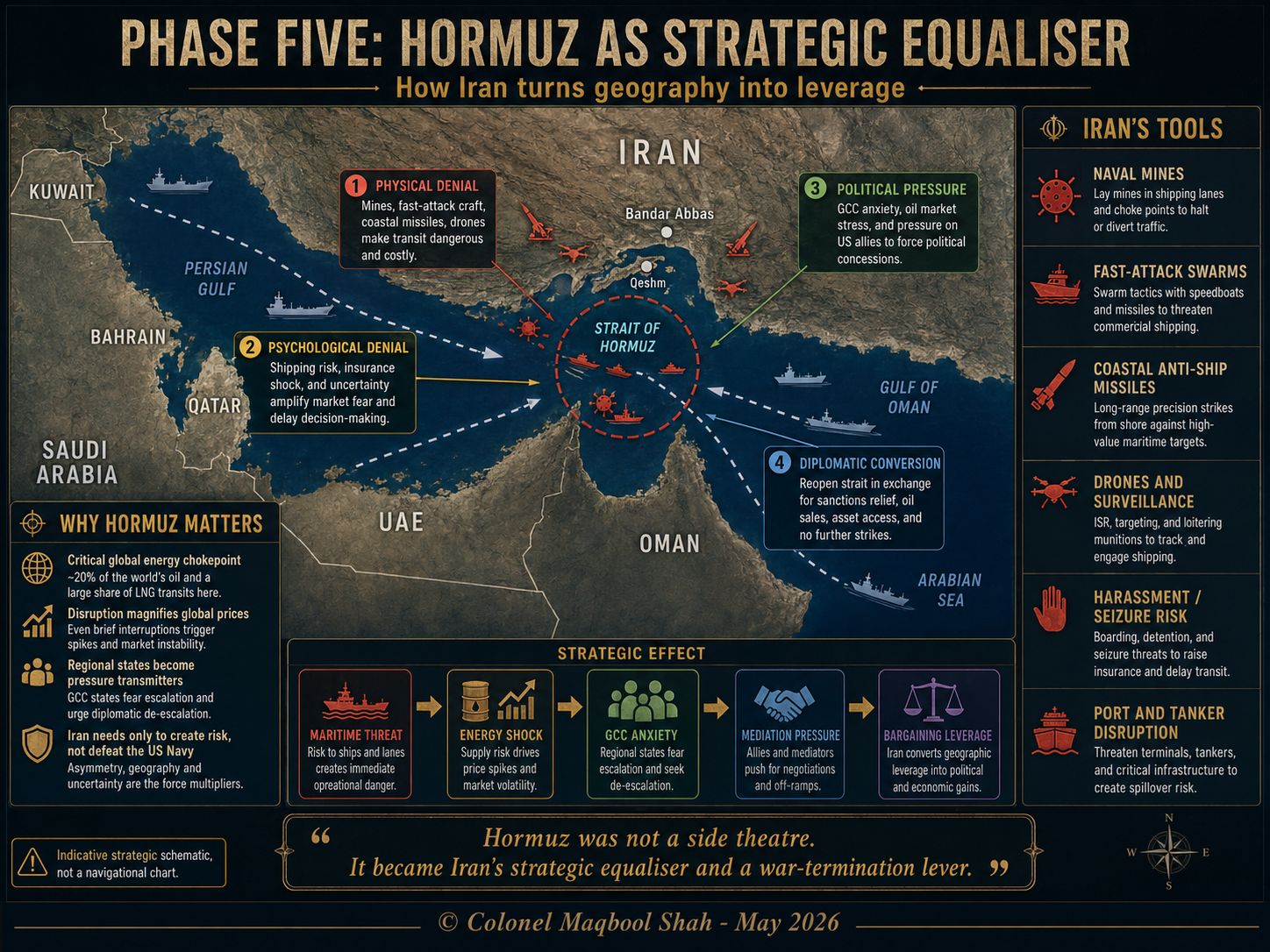
No serious study of this war can treat Hormuz as secondary. It was central.
The Strait of Hormuz is not merely geography. It is a global pressure point. Iran’s ability to threaten the strait transforms a local war into a world-economic event. Mines, coastal missiles, fast-attack craft, drones, submarines, maritime harassment, tanker seizures, insurance shock, port disruption and undersea fibre-optic vulnerability all give Iran tools disproportionate to its conventional naval strength. Hormuz matters not only because oil and gas pass through it, but because data also runs beneath it. In a digitised global economy, the seabed is no longer inert terrain; it is critical infrastructure.
Recent reports indicate that the proposed ceasefire extension includes reopening the Strait of Hormuz, clearing Iranian mines, permitting oil sales, lifting US port blockades, considering sanctions relief and unfreezing Iranian assets.
Iran’s Hormuz strategy had five layers.
1. Physical denial
Mines, missiles, naval swarms and drones could make passage risky.
2. Psychological denial
Even without complete closure, the perception of danger affects shipping decisions, insurance premiums and market behaviour.
3. Political denial
Gulf states dependent on maritime stability become pressure transmitters. They may not support Iran, but they may urge Washington to de-escalate.
4. Digital Denial: Undersea Cables and the Data Chokepoint
The Strait of Hormuz is not only an energy chokepoint. It is also a digital corridor. Submarine fibre-optic cables running through or near the Strait and its approaches carry large volumes of regional and intercontinental data traffic. These cables connect the Gulf to India, Southeast Asia, Europe and wider global networks, while also serving Gulf financial centres, energy companies, data centres, cloud services and government communications.
This matters because the modern economy moves not only through tankers but through packets of data. Energy markets, shipping, banking, aviation, insurance, military command networks and platform economies all depend on resilient digital connectivity. A crisis around Hormuz therefore threatens two circulatory systems at once: hydrocarbons above the seabed and data beneath it.
Iran’s ability to exploit this infrastructure should not be exaggerated. Undersea cable sabotage is technically difficult, politically dangerous and subject to surveillance by US and allied forces. The global internet also has redundancy. Damage to one cable does not automatically collapse global connectivity. Yet localised or regional disruption in the Gulf could still be serious, especially if repair vessels were delayed by maritime insecurity, insurance risk or military escalation.
The more important point is strategic. By raising the possibility of legal, technical or physical pressure on undersea cables, Iran added a digital layer to the Hormuz problem. It signalled that the Strait is not merely a route for oil and gas, but a corridor for information, finance, cloud infrastructure and regional command systems. The geography of coercion has therefore moved from the surface of the sea to the seabed below it.
The Guardian reported in May 2026 that Iranian state-linked discussions had raised the possibility of using Iran’s geographic position near Hormuz to levy fees or impose conditions on foreign technology companies connected to undersea internet cables, while experts cautioned that Iran’s practical ability to control or selectively disrupt such traffic is limited. Time similarly noted that the Strait is a critical corridor for undersea cables linking the Gulf with India, Southeast Asia and Europe. TeleGeography has also described Hormuz as a crucial artery not only for oil and cargo, but for data flowing through submarine cables on the seafloor.
5. Diplomatic conversion
Once Hormuz becomes negotiable, Iran gains leverage. It can trade maritime normalisation for sanctions relief, oil movement, asset unfreezing, port access or limits on further strikes.
Iran therefore used Hormuz as a strategic equaliser. It cannot defeat the US Navy in blue-water terms. But it does not need to. It only needs to make maritime order expensive, uncertain and politically dangerous.
Hormuz was therefore a triple chokepoint: energy above the water, naval movement on the water, and data beneath the water.
Mahan taught that sea power is not only about fleets; it is about command of maritime routes, commerce, chokepoints, and national power. Hormuz was therefore not a side theatre. It was Iran’s way of making maritime order itself part of the war.
XII. The Role of the GCC States
The GCC states were not spectators. They were exposed, constrained and diplomatically active. Their role should be analysed under five headings: basing, airspace, energy security, mediation and strategic anxiety.
The Gulf monarchies faced a structural contradiction:
They wanted Iran contained, but not the Gulf set on fire.
Most GCC states depend on the US security umbrella, but they also fear becoming the battlefield through which Washington and Tehran fight. Their military facilities, ports, energy installations, desalination plants, airports and financial hubs are vulnerable to Iranian missiles, drones and maritime pressure.
GCC Role Matrix
|
State |
Role
/ Exposure |
Interests |
Likely
Posture |
|
Saudi Arabia |
Regional heavyweight;
energy infrastructure at risk; involved in diplomacy |
Protect oil
infrastructure, avoid direct war, preserve US security ties, manage relations
with Iran |
Cautious neutrality
with quiet coordination |
|
UAE |
Critical logistics, ports, airfields, trade exposure |
Protect ports, aviation, finance and energy flows |
Pragmatic caution |
|
Qatar |
Hosts Al Udeid Air
Base; diplomatic channel |
Balance US alliance
with Iran proximity; preserve mediator role |
Balancing and
mediation |
|
Kuwait |
Hosts US forces; close to Iraq/Iran theatre |
Avoid missile spillover; protect territory and oil infrastructure |
Defensive caution |
|
Bahrain |
Hosts US Fifth Fleet
HQ |
Strong dependence on
US security umbrella |
Aligned with US, but
vulnerable |
|
Oman |
Traditional mediator; access to Gulf of Oman |
Preserve neutrality, shipping stability and diplomatic credibility |
Mediator-neutral |
Analyses from Gulf-focused institutions have argued that the war exposed the limits of Gulf neutrality, because GCC states had to balance US security dependence, Iranian retaliation risk and the need to preserve regional economic stability. Carnegie also noted that the Hormuz crisis validated Saudi and UAE investments in alternative pipeline routes, while stressing that such routes are only partial solutions and do not protect all Gulf states or all categories of trade.
The GCC’s role was therefore one of armed caution: strengthening defences, quietly coordinating with Washington, protecting energy flows, supporting mediation, and avoiding unnecessary public escalation.
XIII. The China-Russia Factor: Strategic Shelter Without Formal Alliance
Iran did not face the US-Israeli campaign as an isolated state in the old Cold War sense. It had no formal NATO-like alliance. Neither China nor Russia fought for Iran. Neither offered Iran an Article 5-style security guarantee. Yet both powers mattered.
Their role was less that of battlefield ally and more that of strategic shelter.
China and Russia share a structural geopolitical interest in limiting unchecked American coercive power. Both see US military dominance in the Middle East as part of a larger global pattern: sanctions, regime pressure, military basing, dollar leverage, naval control, technology denial and coalition warfare. Iran understood this structural discomfort and cultivated it.
This was not accidental. It was the result of years of politico-diplomatic investment.
Iran’s cultivation of Moscow and Beijing gave Tehran four forms of strategic benefit.
1. Diplomatic cover
China and Russia complicated Western attempts to create a unified global front against Iran. Even when they did not directly intervene, their positions made it harder to isolate Tehran completely.
2. Economic oxygen
China’s energy relationship with Iran, and Russia’s willingness to engage outside Western sanction structures, created alternative channels of survival. These channels do not eliminate pressure, but they reduce the likelihood of total strangulation.
3. Military-technological learning
Iran’s drone, missile, air-defence, electronic-warfare and sanctions-evasion ecosystems have developed in a strategic environment where Russia and China provide models, markets, technologies, methods or doctrinal inspiration. That does not mean every Iranian system is Chinese or Russian-derived. It means Iran has learned how sanctioned states survive, adapt and improvise.
4. Psychological reassurance
In wartime, a state’s perception of not being completely alone matters. Iran’s political leadership could tell itself that the emerging multipolar order offered space for resistance, bargaining and survival.
The lesson here is important:
Modern alliance formation is no longer limited to formal treaties. Strategic shelter may come through arms flows, energy markets, diplomatic vetoes, payments architecture, technology transfer, intelligence exchange, sanctions evasion, and shared hostility to a dominant power.
Iran’s success lay in understanding this world early. It converted grievance into alignment. It converted isolation into selective partnership. It converted sanctions into a discipline of adaptation.
This is one of the campaign’s most important strategic lessons: in the contemporary international system, a state under pressure does not always need a formal alliance. It needs enough external depth to prevent complete isolation.
China and Russia provided that depth.
One should not exaggerate. Moscow and Beijing acted primarily in their own interest, not out of sentiment for Tehran. But that is precisely the point. Iran’s diplomatic skill lay in making its own survival useful to their larger contest with American power.
Reuters has reported that the ceasefire diplomacy involved regional mediators and a framework in which sanctions relief, oil sales and port access were central issues, while other recent reporting has shown Pakistan and Qatar involved in efforts to keep talks alive. That context reinforces the larger point: Iran’s campaign was fought not only with missiles and drones, but through networks of states willing to prevent its diplomatic isolation.
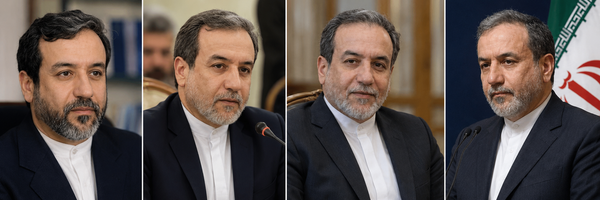
Position: Foreign Minister of Iran; senior diplomat and nuclear negotiator.
Role in campaign: Diplomatic navigator of Iran’s wartime position; interface between military endurance and political bargaining.
Strategic profile: Hardline on sovereignty and nuclear rights, but professionally trained in negotiation, fluent in the language of international diplomacy, and experienced in dealing with Western interlocutors. A calm, composed and intellectually sharp diplomat.
Career significance: Araghchi has long experience in Iran’s foreign ministry and was associated with Iran’s nuclear negotiations, including the JCPOA-era diplomatic track. Britannica describes him as a senior Iranian diplomat known for hard-line positions but extensive engagement with the West, especially on nuclear questions.
Campaign significance: In a war where Iran sought not unconditional battlefield victory but survival followed by bargaining leverage, Araghchi’s role became central. He represented the diplomatic face of strategic endurance: firm enough to satisfy Tehran’s hardliners, polished enough to engage mediators and adversaries.
Likely priority: Prevent diplomatic isolation; preserve Iran’s nuclear and missile bargaining space; secure sanctions relief and oil-export pathways; prevent renewed strikes; ensure that ceasefire does not look like surrender.
Analytical Note
Araghchi’s importance lies in his ability to translate military endurance into diplomatic language. A less skilled diplomat might have trapped Iran in slogans. A purely ideological figure might have closed the door to useful mediation. Araghchi’s value is that he could sustain defiance while preserving negotiation.
He is therefore one of the key personalities of the campaign.
If the IRGC represented Iran’s coercive fist, Araghchi represented its diplomatic hand: restrained, precise, urbane, and acutely aware that in modern war, the negotiation table is often another battlespace.
XIV. Phase Six: Ceasefire as Reconstitution
A ceasefire is not only a pause in violence. It is a continuation of war by organisational repair.
Iran’s behaviour during the ceasefire must be studied as a military phase. During this period, Iran could relocate launchers, repair infrastructure, disperse surviving assets, improve concealment, replenish drones, restore command links, assess damage, arrest suspected collaborators, rebuild air-defence coverage and prepare for renewed hostilities.
The proposed deal structure, as reported, did not simply concern the cessation of firing. It involved Hormuz, oil sales, port blockade relief, sanctions waivers, asset unfreezing and future nuclear talks. That means the ceasefire became a phase in which Iran attempted to convert survival into bargaining leverage.
Iran’s likely ceasefire objectives were:
- Rebuild missile and drone capability.
- Restore air-defence and radar coverage where possible.
- Consolidate internal political control.
- Reassure allies and partners.
- Preserve Hormuz leverage.
- Negotiate without appearing defeated.
- Prevent renewed strikes while retaining the ability to threaten them.
The ceasefire also allowed Iran to shift the image of the war. During active strikes, Iran appeared as a target under pressure. During negotiations, it appeared again as an indispensable regional actor.
That transformation — from target to negotiating party — was one of Tehran’s most important political achievements.
Position: President of the United States.
Role in campaign: Political driver of coercive pressure and later public face of ceasefire diplomacy.
Strategic instinct: High-pressure bargaining, personalised diplomacy, sanctions leverage and visible deal-making.
Campaign significance: Trump’s public claim that a deal with Iran was “largely negotiated” made war termination a major political event, although key nuclear and regional-security issues remained unresolved.
Likely priority: Reopen Hormuz, lower energy pressure, claim coercive success, avoid uncontrolled regional escalation and secure a visible diplomatic outcome.
XV. Iranian Strengths Revealed by the War
1. Strategic depth
Iran’s territory, mountains, underground sites, dispersed facilities and internal geography make complete military neutralisation difficult.
2. Institutional redundancy
The Islamic Republic’s overlapping power structures may be inefficient in peacetime, but in wartime they create redundancy. The disruption of one node does not automatically paralyse the entire state.
3. Missile and drone resilience
Even degraded systems can retain political value. A limited surviving missile force can still impose anxiety, cost and uncertainty.
4. Maritime leverage
Hormuz remains Iran’s most powerful geographic weapon.
5. Ideological endurance
The regime can convert suffering into resistance narratives, especially when attacked by external powers.
6. Escalation diversity
Iran can escalate through state missiles, drones, proxies, maritime disruption, cyber actions, diplomatic obstruction, oil leverage and domestic mobilisation.
These strengths do not make Iran invincible. They make it hard to defeat decisively.
XVI. Iranian Weaknesses Revealed by the War
A professional campaign study must avoid romanticising Iran. The war also exposed serious weaknesses.
1. Air-defence vulnerability
If US-Israeli airpower gained repeated access to Iranian airspace, Iran’s strategic infrastructure remained exposed.
2. Intelligence penetration
Successful targeting of Iranian systems suggests significant surveillance, cyber penetration, human intelligence, technical collection or internal compromise.
3. Economic fragility
Iran’s economy could not absorb indefinite disruption without domestic consequences.
4. Proxy degradation
Iran’s older forward-defence doctrine may no longer provide the same deterrent shield it once did.
5. Missile inventory constraints
Sustained missile warfare requires production, concealment, launch systems and replenishment. These are vulnerable to precision strike.
6. Diplomatic isolation
Iran can use mediators, but it lacks a formal alliance system comparable to the US network.
7. Domestic legitimacy stress
War can rally populations, but prolonged hardship can also deepen internal resentment.
Iran’s strategy worked not because Iran was strong in every domain, but because it understood where its adversaries were also vulnerable.
XVII. The US-Israeli Problem: Tactical Success, Strategic Incompleteness
The US-Israeli campaign may have achieved substantial tactical effects: damaged facilities, degraded systems, destroyed launchers, disrupted production, imposed economic pain and demonstrated reach.
But the larger question is whether it achieved strategic decision.
A campaign becomes decisive only if tactical damage produces the desired political outcome. If Iran remained intact, retained retaliatory capacity, kept Hormuz leverage, avoided surrender and entered negotiations with bargaining power, then the campaign’s strategic outcome is more ambiguous.
The war may therefore have produced a familiar pattern: Western military superiority without clean political closure.
That does not mean Iran won. It means Iran prevented the adversary from winning completely. This is the central conclusion.
Position: Prime Minister of Israel.
Role in campaign: Principal Israeli political architect of direct confrontation with Iran.
Strategic instinct: Preventive security doctrine; willingness to use force against perceived existential threats; preference for degrading adversaries before they mature into greater danger; and a long-standing inclination toward maximalist Israeli security aims.
Campaign significance: For Israel, the campaign was about delaying, degrading or destroying Iran’s nuclear, missile and regional threat networks.
Likely priority: Prevent Iranian nuclear breakout, degrade missile infrastructure, restore Israeli deterrence, preserve Israel’s freedom of action, and keep regime change pressure alive where politically feasible.
XVIII. Campaign Matrix
|
Phase |
Iranian
Problem |
Iranian
Response |
Strategic
Purpose |
Outcome |
|
Opening strikes |
Avoid paralysis |
Preserve command and
internal control |
Regime survival |
Iran remained
functional |
|
Early retaliation |
Restore deterrence |
Missile/drone salvos |
Demonstrate capability |
Adversary costs increased |
|
Theatre widening |
Escape homeland-only
war |
Gulf, proxies,
bases, energy pressure |
Regionalise costs |
Mediation pressure
rose |
|
Economy of force |
Avoid exhaustion |
Sustained but selective escalation |
Preserve options |
Iran retained leverage |
|
Hormuz phase |
Create global
pressure |
Maritime
denial/threat |
Economic coercion |
Hormuz entered
ceasefire talks |
|
Ceasefire |
Rebuild and bargain |
Reconstitution and negotiation |
Convert survival into leverage |
War shifted to diplomacy |
XIX. Lessons Learnt: Strategic, Operational and Political
The campaign yields lessons at several levels: grand strategy, operational design, deterrence, geography, diplomacy, and war termination
Lesson 1: Survival is a strategic effect
The most important lesson is that survival itself can become strategy.
Iran did not need to defeat the United States or Israel in the conventional sense. It needed to survive the opening campaign, preserve enough retaliatory capacity, and deny its adversaries a clean political outcome.
This changes how we understand success. In asymmetric war, the weaker side often wins by not losing decisively. Iran’s survival preserved bargaining power.
The first strike is decisive only if the target has not designed itself to survive it.
Lesson 2: The first strike is not the final strike
Modern airpower can devastate fixed systems. But if the target state has dispersed command, underground facilities, mobile launchers and redundant communications, the first strike may not be decisive.
Iran’s architecture suggests a long-standing recognition of this reality. Missile cities, decentralised command nodes, hidden storage and mobile launch systems were all designed to ensure that the first blow did not become the last word.
The lesson for weaker states is clear:
Do not build merely to fight. Build to survive being hit.
Lesson 3: Geography can become grand strategy
Iran’s geography is not passive terrain. It is active strategy.
The Zagros mountains, deserts, depth, Gulf coastline, islands, ports and the Strait of Hormuz give Iran options that cannot be eliminated by airstrikes alone. Hormuz especially gave Iran leverage over global energy, shipping, insurance and diplomatic urgency.
The weaker state’s geography can become its equaliser if integrated into national strategy.
Lesson 4: Missile forces are political weapons as much as military weapons
Iran’s missile salvos did not need perfect accuracy to have strategic value. Even intercepted missiles created warning cycles, sheltering, panic, interceptor expenditure, insurance shock, market fear and political pressure.
Missiles in such a campaign are not merely instruments of destruction. They are instruments of signalling, punishment, disruption and endurance.
Lesson 5: Air defence must be layered, mobile and deceptive
Iran’s vulnerability to US-Israeli airpower shows that static air defence is not enough. Radars, SAM batteries and command centres are vulnerable when exposed to superior ISR and suppression campaigns.
The lesson is that future air defence must combine:
- mobility,
- deception,
- decoys,
- emissions control,
- passive detection,
- hardened shelters,
- distributed command,
- and integration with offensive missile deterrence.
Lesson 6: Restraint can be a form of escalation control
Iran’s campaign was not one of uncontrolled rage. It was selective.
Tehran escalated enough to impose costs, but tried to avoid steps that would unify every Gulf state and Western actor into a maximalist coalition. Its restraint was partly forced by inventory and vulnerability, but partly strategic.
This is a valuable operational lesson: escalation is not only about intensity. It is about sequencing, geography, signalling and preserving options.
Lesson 7: The sea is often the decisive economic battlefield
Hormuz showed that the maritime domain can determine the political rhythm of a land-air missile war.
A state that cannot dominate the skies may still pressure sea lanes. A state that cannot defeat a navy may still raise the cost of maritime order. Insurance premiums, tanker delays, port disruptions and energy prices can generate political pressure faster than battlefield casualties.
The sea, in this campaign, became a bargaining table.
Lesson 8: Alliances need not be formal to be useful
Iran’s relationships with China and Russia show the importance of strategic shelter. Neither Beijing nor Moscow had to fight for Iran in order to matter. Their diplomatic, economic and geopolitical positions helped prevent total isolation.
The modern lesson is this:
Formal alliances are only one form of security. Strategic depth can also come from energy dependence, shared adversaries, diplomatic support, arms cooperation, financial workarounds and political sympathy born of common opposition to a dominant power.
Lesson 9: Sanctions can weaken a state, but also discipline its adaptation
Western sanctions hurt Iran deeply. But they also forced Iran into long-term self-reliance in certain domains: missiles, drones, tunnels, local production, smuggling networks, financial workarounds and austere defence innovation.
This does not mean sanctions failed. It means sanctions produced both pressure and adaptation.
The lesson is that a sanctioned state may become poor, brittle and angry — but also inventive in the domains that matter most for regime survival.
Lesson 10: War termination must be designed during the war
Iran appears to have widened the war partly to create negotiating leverage. Hormuz, oil sales, sanctions relief, port access and ceasefire terms were not afterthoughts. They were the political destination toward which military pressure moved.
The lesson is classical but often forgotten:
Strategy is not the use of force. Strategy is the use of force for a political end.
Iran’s political end was not a victory parade. It was survival with leverage.
Lesson 11: Tactical success does not guarantee political decision
The US and Israel may have damaged Iran severely. But if Iran remained coherent, retained leverage and negotiated from survivability, then tactical success did not become strategic decision.
This is the recurring dilemma of modern Western warfare: magnificent strike capacity, incomplete political closure.
Lesson 12: Decisive factors are rarely singular
No single factor explains Iran’s survival. Not missiles alone. Not Hormuz alone. Not China and Russia alone. Not geography alone. Not ideology alone.
The campaign’s decisive quality emerged from the interaction of many factors:
- strategic depth,
- missile survivability,
- decentralised command,
- maritime leverage,
- limited external shelter,
- ideological mobilisation,
- adversary escalation limits, and,
- diplomatic timing.
XX. Decisive Factors in Iran’s Strategic Endurance
|
Factor |
Why It Mattered |
Weight |
|
Regime continuity |
Prevented decapitation from becoming collapse |
Very high |
|
Missile survival |
Preserved retaliatory capacity and deterrent credibility |
Very high |
|
Hormuz leverage |
Turned a regional war into a global economic problem |
Very high |
|
Decentralised command |
Allowed operational continuity under pressure |
High |
|
Strategic depth |
Made total neutralisation difficult |
High |
|
China-Russia shelter |
Reduced diplomatic isolation |
Medium-high |
|
GCC anxiety |
Generated pressure for de-escalation |
Medium-high |
|
Proxy ecosystem |
Added distributed pressure, though unevenly |
Medium |
|
Iranian diplomacy |
Converted survival into negotiation |
High |
|
US-Israeli escalation limits |
Prevented unlimited war aims from being pursued indefinitely |
High |
The decisive factor was not one weapon, commander, corridor or strike. It was the convergence of survivability, geography, missile retention, external diplomatic shelter and war-termination leverage. Iran’s campaign was decisive not because it won the battlefield, but because it prevented the enemy from converting battlefield superiority into political submission.
XXI. Final Assessment
This assessment pertains to the period up to 24 May 2026. A final assessment of this campaign will be possible only after a complete cessation of hostilities and the conclusion of a durable, mutually acknowledged ceasefire or settlement.
Iran’s campaign was not a conventional victory. Its air defences were pressured, its infrastructure struck, its economy strained, its people exposed and its military systems degraded.
Yet Iran’s strategic aim was not to win a tank battle, seize territory or defeat the United States in open combat. Its aim was to survive aggression, retain retaliatory capacity, widen the costs of war and force the adversary into negotiation without surrender.
On that narrower but decisive scale, Iran’s strategy appears to have achieved something important: it denied its adversaries a clean victory.
The war therefore stands as a study in strategic endurance under asymmetric assault. It shows how a weaker state, unable to dominate the battlefield, can still shape the political outcome by combining survival, retaliation, geography, escalation management and negotiation.
The most concise judgement is this:
The war’s central lesson is not that Iran defeated the United States and Israel. It did not. The lesson is more subtle: Iran prevented superior military power from becoming decisive political power. It survived the first strike, retained enough retaliatory force, widened the costs of escalation, used Hormuz as a bargaining lever, and entered diplomacy without formal surrender. In the grammar of asymmetric war, that is not victory in the classical sense. But it is the prevention of defeat — and sometimes, in modern strategy, that is enough to alter the outcome of a war.
Select Sources Consulted:
· Reuters reporting on ceasefire, Hormuz and sanctions framework
· Associated Press reporting on regional mediation
· IISS assessments of Iranian missile and UAV capabilities
· Breaking Defense reporting on missile defence and Iron Dome limitations
· Carnegie Endowment analysis on Gulf states and Hormuz vulnerability
· Gulf / Middle East Council analysis on GCC neutrality and escalation risk
· Public aviation and maritime-risk reporting
· William Seymour, Decisive Factors in Twenty Great Battles of the World
Colonel Maqbool Shah, SM (Veteran), Indian Army, served 33 years in the Indian Army, including tenures in the Military Operations Directorate and command of an infantry battalion on the Line of Control. He also served with the United Nations as Liaison Officer across 42 nations in Iraq after the First Gulf War. He is Founding Editor of Frontline Strategy.