Iran’s Indirect War
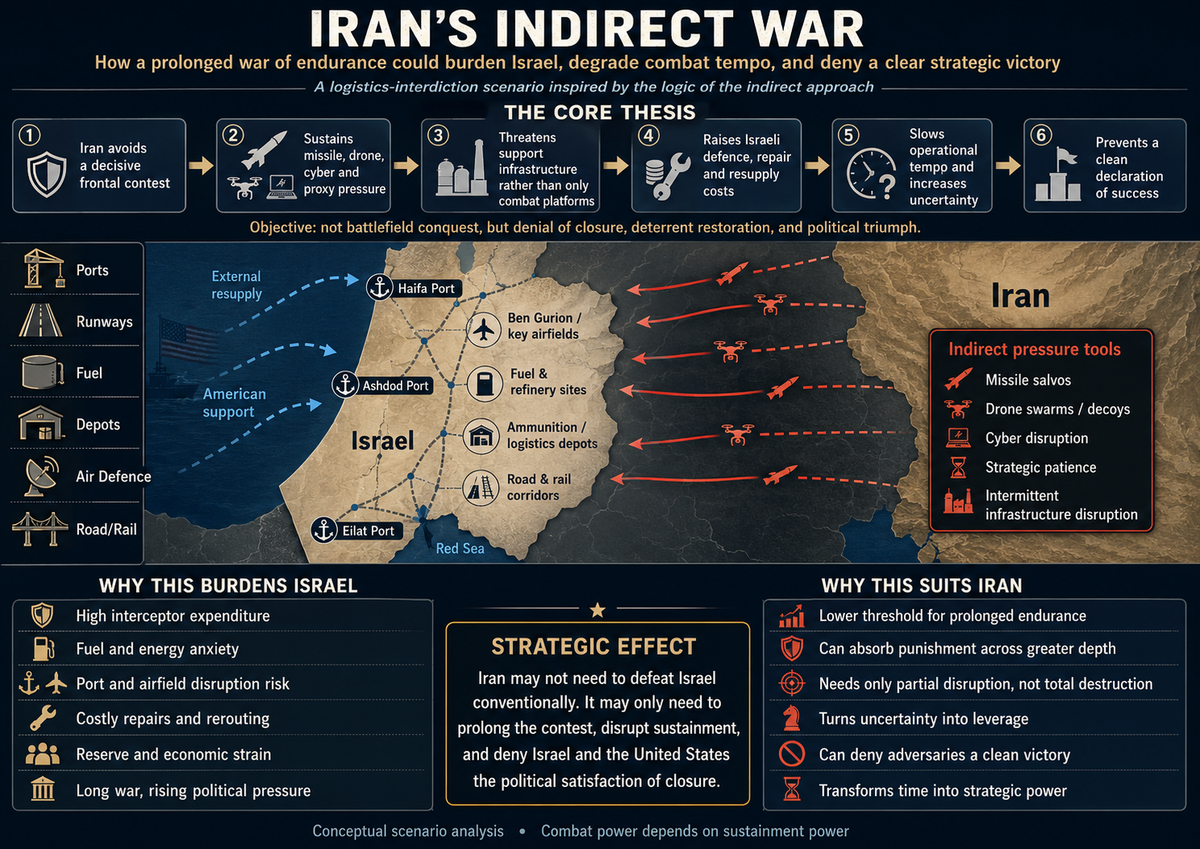
How Tehran May Deny Israel Victory Without Defeating It
Frontline Strategy Special Issue on The Theory of War | 02 June 2026
“The first creature of God, in the works of the days, was the light of the sense; the last was the light of reason.” — Francis Bacon, “Of Truth”
For nearly three months now, I have watched the US-Israel-Iran war settle into that dangerous zone where war no longer moves decisively forward, yet refuses to end. Blockades, conditional ceasefires, broken assurances, diplomatic shuttles and televised declarations of resolve have yielded little beyond exhaustion and uncertainty. Israel and the United States continue to insist that the pressure on Iran is working. Tehran, for its part, speaks the language of endurance, retaliation and strategic patience. The battlefield has not gone silent; it has merely become more difficult to read.
Frontline Strategy is a reader-supported publication. To receive new posts and support my work, consider becoming a free or paid subscriber.
It is in such moments that one is forced back to first principles.
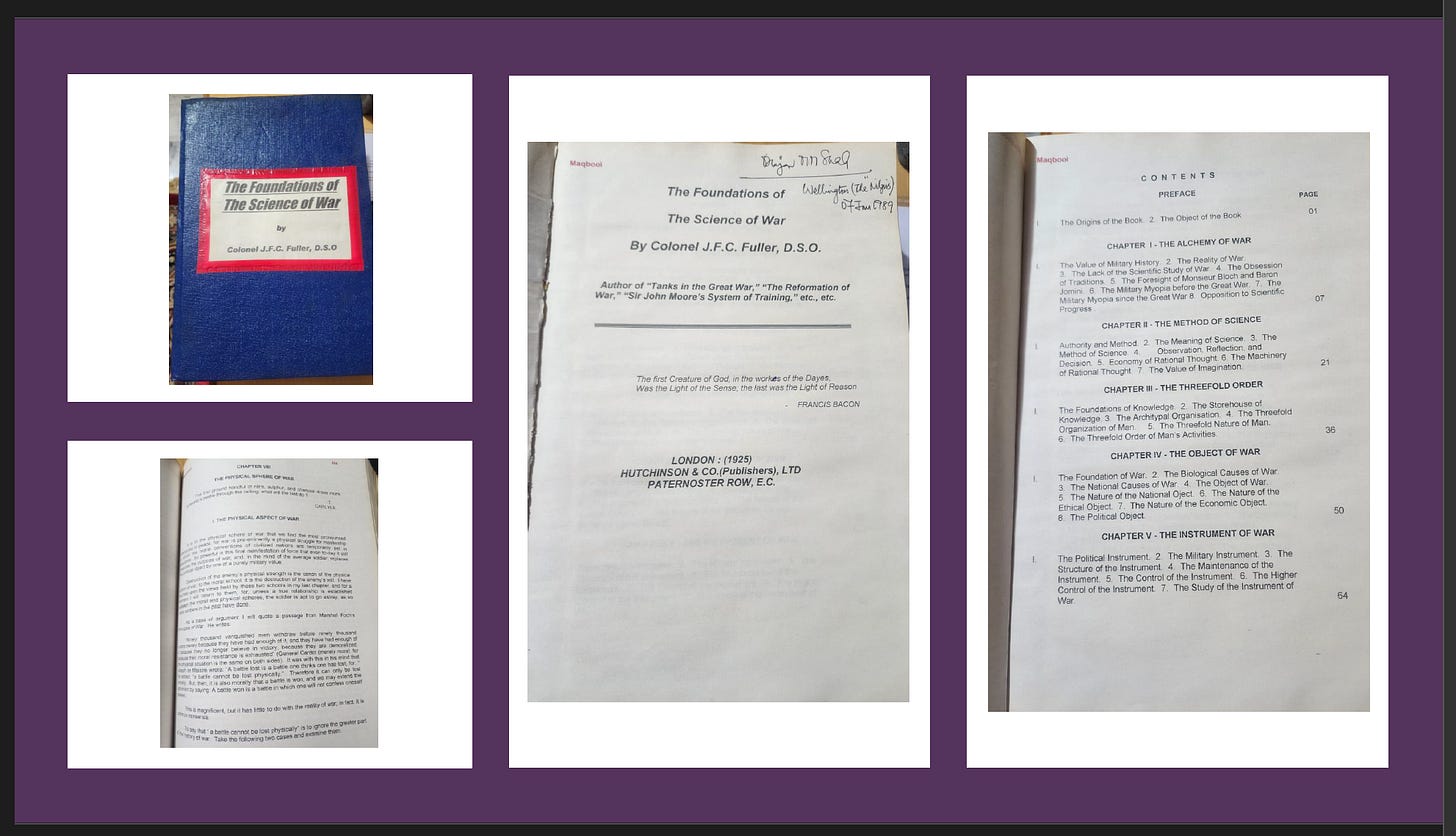
My own mind returned, almost involuntarily, to Basil Liddell Hart and his theory of the indirect approach. In the 1980s, when we were young officers at the Defence Services Staff College, Liddell Hart’s writings, along with and apart from others, Field Marshal Erwin Rommel’s Infantry Attacks, and JFC Fuller’s The Foundations of the Science of War**, were treated almost as canonical texts. They gave us many intellectual headaches, but they also taught us something enduring: wars are seldom decided only by frontal assault, bravery, firepower or spectacle. They are often decided by movement, dislocation, exhaustion, deception, surprise, logistics and the ability to strike not where the enemy is strongest, but where his strength depends upon vulnerable foundations.
A lifetime spent studying military history only reinforces this lesson. From Napoleon’s march into Russia to Rommel’s own desert campaigns, from the German failure before Moscow to the long attritional wars of the twentieth century, one truth returns again and again: armies do not fight on courage alone. They fight on fuel, food, ammunition, transport, repair, communications, ports, roads, railheads, depots, workshops and reserves. The glamour of combat belongs to the weapon system; the reality of war belongs to the supply chain.
It is from this perspective that Iran’s conduct in the present war deserves closer attention.
The question may not be whether Iran can defeat Israel in a conventional military sense. It almost certainly cannot. Nor is the question whether Iran can match American power platform for platform. It cannot, it never will. The more serious question is whether Iran is fighting a different kind of war altogether: an indirect war designed to stretch time, raise costs, degrade operational tempo, and prevent Israel and the United States from translating military superiority into political success.
Iran may not need a dramatic battlefield victory. It may need only to sustain the contest long enough to make victory unavailable to its adversaries.
This is where the logic of the indirect approach becomes relevant. Israel’s combat power is immense, but it is also highly dependent on continuous sustainment. Its air operations require fuel, munitions, spare parts, intact runways, air-defence cover and uninterrupted command systems. Its armoured formations require diesel, ammunition, recovery vehicles, transporters and road mobility. Its missile defences require interceptor stocks, radar resilience, reload cycles, technical crews and constant readiness. Its wider war effort depends on functioning ports, airfields, energy systems, logistics corridors, repair facilities, reserve mobilisation and American resupply.
Iran’s most consequential option, therefore, may not be to strike Israel’s combat platforms directly. It may be to threaten the infrastructure that allows those platforms to fight.
A port need not be permanently destroyed to become unreliable. A runway need not be obliterated to interrupt heavy airlift. A refinery need not be eliminated to create fuel anxiety. A missile-defence system need not collapse to become financially and operationally strained. A road or rail corridor need not be blocked forever to delay mobilisation and resupply. In modern war, intermittent disruption can sometimes be enough. Uncertainty itself becomes a weapon.
This is the war beneath the war. On the surface, one sees aircraft, missiles, drones, interceptors, bunker-busting munitions, satellite imagery and official claims of damage inflicted. Beneath that visible contest lies a more decisive struggle: the contest between combat power and sustainment power. Israel seeks operational decision. Iran seeks duration. Israel seeks visible degradation of Iranian capability. Iran seeks to deny Israel the political satisfaction of closure. Israel and the United States want proof that pressure works. Iran needs only to demonstrate that pressure does not compel submission.
That distinction is central to the present strategic moment.
Israel’s military system is designed for high-tempo operations, rapid mobilisation, precision strike, intelligence dominance and swift punitive response. It is a formidable structure, but it is not an autonomous structure. It depends upon fuel, munitions, spare parts, port throughput, repair capacity, secure airfields, external supply chains and a national economy capable of sustaining mobilisation. The more intense the war, the more demanding the sustainment burden becomes. The more prolonged the war, the more visible that burden becomes to society, allies and adversaries alike.
Iran’s possible strategy, therefore, may be to make Israel live inside that burden.
It can do so by combining missile salvos, drones, decoys, cyber pressure, proxy threats and strategic ambiguity. It does not have to conduct a perfect campaign. It does not have to strike every target successfully. It needs only to impose enough recurring pressure to force Israel into a condition of constant readiness, constant repair, constant resupply and constant uncertainty. A few missiles penetrating a layered defence may matter less for the immediate physical damage than for the operational questions they create: which port remains safe, which runway remains reliable, which fuel facility is exposed, which depot must be dispersed, which convoy route must be rerouted, which interceptor stockpile must be husbanded?
In such a war, uncertainty becomes attrition.
The financial asymmetry is also significant. Missile defence is technologically impressive, but it is costly. Every interception consumes munitions, crew attention, radar time, reload capacity and command focus. Drones, decoys and mixed salvos can force expensive defensive responses even when they cause little physical damage. A defender may win many tactical engagements and still be compelled into an unfavourable economic exchange. This is not defeat in the immediate sense. It is strategic wear. It slows decision-making, raises costs, strains inventories and makes political leaders more cautious.
Fuel and energy form another critical vulnerability. Combat aircraft, armour, generators, radars, logistics convoys, repair facilities and civil infrastructure all depend upon energy continuity. A modern military does not merely fight with weapons; it fights with fuel. If Iran can threaten refineries, fuel storage, distribution networks or maritime fuel flows, it can introduce a second layer of anxiety into Israel’s war planning. No commander wants to conduct sustained operations while worrying about the reliability of fuel stocks, runway repair, spare parts or rear-area distribution.
The same applies to ports and airfields. Israel’s strategic depth is limited. Its major points of maritime and aerial entry are finite. American support may be enormous, but support must still arrive somewhere, be unloaded somewhere, stored somewhere, distributed somewhere and protected somewhere. Ships carry volume that aircraft cannot match. Aircraft provide speed but not the tonnage of maritime resupply. If ports become unreliable or airfields are intermittently disrupted, the issue is not simply one of physical damage. It becomes a question of confidence in the sustainment system.
This is where geography favours Iran’s indirect approach. Israel is compact, infrastructure-dense and politically exposed to disruption. Iran is larger, deeper, more dispersed and accustomed to sanctions, pressure and strategic patience. Iran can absorb punishment across a broader territorial and psychological space. Israel, by contrast, must demonstrate that its military superiority produces visible strategic results. The asymmetry is not simply one of weapons. It is an asymmetry of time.
Israel needs the war to prove something. Iran needs the war to prevent that proof from materialising.
That may be Tehran’s most consequential calculation. Survival itself can be presented as success. If Iran continues to fire, continues to negotiate, continues to repair, continues to threaten, and continues to deny that its strategic capabilities have been permanently neutralised, then Israel’s victory narrative weakens. The longer Iran remains standing after being punished, the harder it becomes to sustain the claim that the campaign has achieved its stated objectives. In wars of coercion, the target’s refusal to be coerced is itself a political fact.
This is the danger for Israel and the United States. Their objectives are not easy to realise. To degrade Iran’s missile programme decisively, halt its nuclear trajectory, restore deterrence, reassure Israel’s public, discipline Iran’s regional network and demonstrate American-Israeli dominance is a vast strategic agenda. Each element is difficult. Together they may be unattainable at acceptable cost. If Iran survives the campaign with meaningful retaliatory capacity intact, if its nuclear incentives harden, if its public rallies around sovereignty, if its hardliners gain influence, and if Israel remains under recurring missile and drone pressure, then the war may produce the opposite of what it intended.
The strategic error may not lie in Israel’s inability to inflict damage. Israel can inflict damage. The error may lie in believing that damage necessarily produces strategic submission. External attack often consolidates states rather than weakens them. It strengthens hardliners, silences compromise factions, rallies nationalist sentiment and deepens the adversary’s conviction that only more deterrence can ensure survival. Iran’s internal politics are complex, but a foreign military strike on Iranian soil gives the regime a powerful instrument: the language of sovereignty, humiliation, revenge and national endurance.
This is the classic failure of punitive strategy. It can destroy assets while strengthening resolve. It can degrade facilities while validating the adversary’s threat perception. It can buy time tactically while losing ground strategically.
There is a second political consequence. The longer the war continues, the more fragile the regional normalisation architecture becomes. Arab governments that have quietly or openly accommodated Israel must manage public anger, economic anxiety and strategic fear. Gulf states may not abandon their calculations overnight, but they will read the direction of risk. If Israel appears unable to impose a decisive outcome on Iran despite American backing, regional actors will begin hedging more carefully. In the Middle East, perceptions matter. The appearance of endurance by a supposedly weaker power can alter diplomatic behaviour even before battlefield balances formally change.
This does not mean Iran is invulnerable. It is not. Its economy is strained. Its infrastructure can be hit. Its missile and drone capabilities can be degraded. Its command networks can be penetrated. Its regional partners can be pressured. Its internal society is not immune to hardship. Any serious assessment must acknowledge these vulnerabilities. But vulnerability is not the same as strategic defeat. The central question is not whether Iran suffers. It will. The central question is whether suffering compels Iran to accept the political outcome Israel and the United States seek. That is far less certain.
Indeed, Iran may calculate that time is its strongest weapon. A shorter war favours Israel’s shock power. A longer war favours Iran’s endurance strategy. A short campaign allows Israel to display precision, dominance and punishment. A prolonged campaign allows Iran to shift the narrative from destruction suffered to resistance sustained. This is why the war’s duration matters so profoundly. Time can convert Israel’s military superiority into political exposure and Iran’s material weakness into symbolic resilience.
A war prolonged at relatively lower cost to Iran may therefore impose an unbearable strategic burden on Israel. It can keep Israeli society mobilised, keep ports and airfields under threat, force expensive defensive expenditure, complicate American resupply, harden Iranian nationalism, weaken diplomacy and prevent a declaration of victory. The result may not be Israel’s defeat in the conventional sense. It may be something more politically damaging: non-realisation of stated objectives, erosion of deterrent credibility, and gradual loss of face before a regional and global audience watching the limits of superior power being exposed.
States do not always lose wars by surrendering. They lose when their objectives become unreachable at an acceptable cost. They lose when their adversary survives what was meant to be decisive. They lose when deterrence is not restored, when escalation produces greater insecurity, and when the world sees that a weaker power has endured the punishment of a stronger one.
That is the brutal arithmetic of the indirect war Iran may be fighting.
Its aim may not be conquest. It may be denial. Denial of closure. Denial of triumph. Denial of restored deterrence. Denial of a clean political ending. Iran may not be able to defeat Israel, but it may be able to prevent Israel from winning. It may not be able to match American power, but it may be able to make American support more costly, more visible and more politically burdensome. It may not be able to impose surrender, but it may be able to sustain uncertainty until the adversary’s confidence begins to erode.
This is why Liddell Hart’s old lesson returns with such force. The enemy’s strength is rarely best attacked head-on. It is best undone by dislocating the system that makes that strength usable. If Iran is indeed pursuing that logic, then the war must be read not merely as a contest of missiles and interceptors, but as a contest of patience, sustainment and political endurance.
Iran may not need to defeat Israel conventionally. It may only need to prolong the contest, disrupt sustainment, degrade combat tempo, and deny Israel and the United States the political satisfaction of closure.
And in the modern geopolitics, that may be enough.
“Patience is better: patience is the quickest guide to the object of one’s quest.”
— Jalāl al-Dīn Rūmī, Masnavi, Book III, trans. R. A. Nicholson
** A treasured relic from my Defence Services Staff College years: a personally typed copy of Major General J. F. C. Fuller’s classic, prepared from a library copy when the book had long vanished from ordinary circulation. It remains a reminder that the serious study of war begins not with weapons, but with the disciplined understanding of strategy, logistics, endurance, and historical experience.
Colonel Maqbool Shah, SM (Veteran), Indian Army, is an author and a strategic analyst with bylines in The Diplomat, Asia Times, and Greater Kashmir. He is Founding Editor of Frontline Strategy. He lives in Jammu - India.