Gaza, Iran and the Fire That Tyrants Light
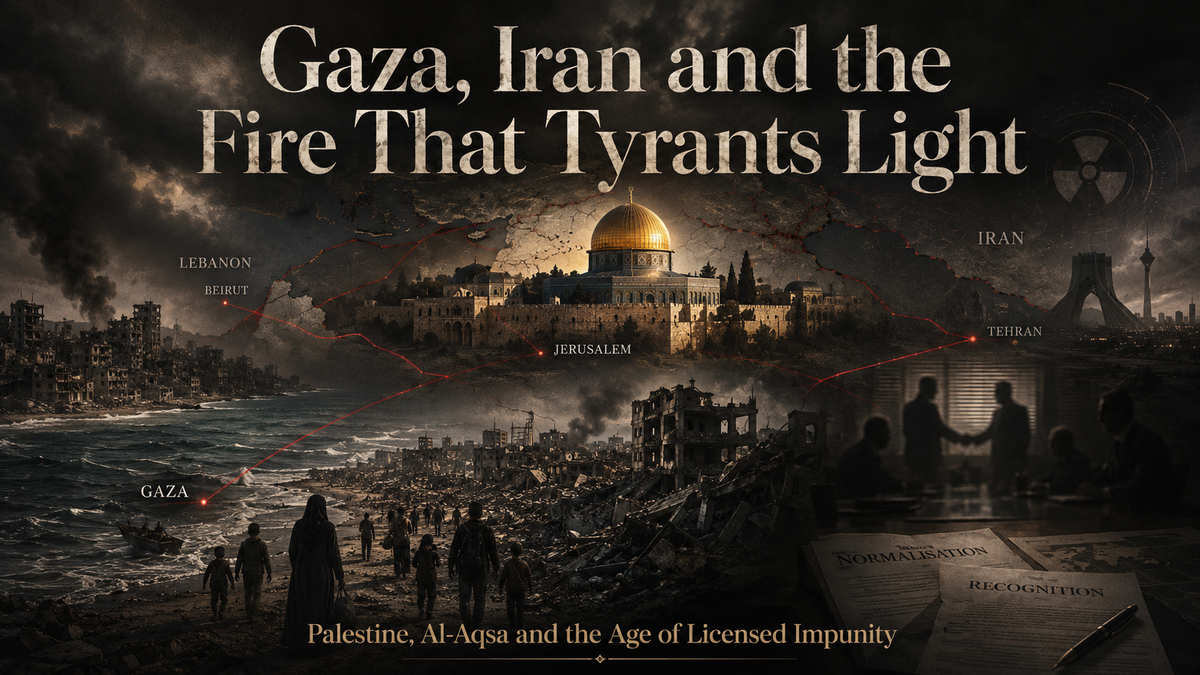
Palestine, Al-Aqsa, the Abraham Accords and the Age of Licensed Impunity
Colonel Maqbool Shah (Veteran) | 01 June 2026
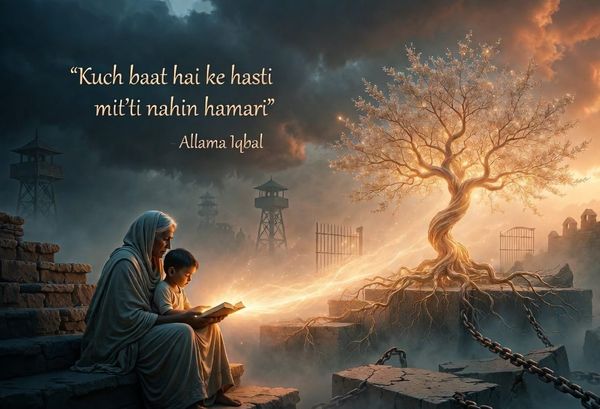
Power can dominate bodies for a time. It can flatten neighbourhoods, redraw military lines, rename conquest as security, and call displacement “humanitarian relocation”. It can arm one state to the teeth while disarming another in the name of law. It can turn the victim into a suspect and the aggressor into a permanently endangered party. It can make occupation sound temporary, annexation sound administrative, and impunity sound strategic. But power cannot permanently defeat memory, demography, law, dignity or the human instinct for justice. South Africa looked permanent until it was not. French Algeria looked permanent until it was not. European colonial empires looked eternal until they collapsed with astonishing speed. Tyranny does not merely devour its victims; in the end, it devours its own children. The fire created by tyrants returns, by a route they never foresee, to consume the house from which it was lit.
The crisis in Gaza, Lebanon, Iran and Jerusalem is no longer a set of disconnected emergencies. It is a single structure of coercion. Gaza is being territorially compressed. The West Bank is being slowly absorbed through settlements, military control and legal strangulation. Lebanon is being treated as a forward security zone. Iran is being disciplined through war, sanctions and nuclear coercion. Arab and Muslim-majority states are being pressed to normalise relations with Israel under the Abraham Accords. And now, even Al-Aqsa — Islam’s third holiest sanctuary — appears to be entering the field of strategic redesign through reported proposals that would alter its custodianship and religious character.
This is not merely another Middle East crisis. It is the collapse of restraint, law and shame in full public view.
The small newspaper page from The Indian Express on 30 May 2026 carried the entire tragedy in miniature. On one side was Lebanon: Israeli troops pushing deeper north, ground forces crossing the Litani River, and US-hosted talks being held under the language of “peace” and “disarmament”. On the other side was Gaza: Benjamin Netanyahu pushing for 70 per cent Israeli control of the Strip, with Hamas calling it escalation. This was not simply two reports placed side by side. It was the map of a new political order: Gaza compressed, Lebanon penetrated, Iran threatened, and America positioned not as an honest broker but as arsenal, banker, shield, negotiator and strategic custodian of the Israeli project.
The language is always administrative. “Buffer zones.” “Security corridors.” “Disarmament.” “Ceasefire architecture.” “Humanitarian relocation.” “Multi-faith access.” “Regional integration.” But beneath this vocabulary lies a harsher reality. Territory is being seized. Civilians are being herded. Sacred spaces are being reclassified. Military facts are being created before diplomacy can object. The law arrives after the bulldozer, the missile and the settlement have already done their work.
Gaza is no longer only a battlefield. It has become a laboratory of compression. People are being stripped of safe shelter, clean water, functioning hospitals, secure movement, political representation and any credible horizon of return. The question is no longer simply whether Gaza will be bombed. It is whether Gaza will remain territorially, socially and politically survivable. A people cannot live forever between rubble, sea, fences, drones and controlled corridors. Survival itself becomes a form of resistance when every structure of life is destroyed around it.
This is why the legal record matters. The question of genocide is no longer merely rhetorical anger. It now sits inside the architecture of international law. The International Court of Justice has not delivered a final judgment on genocide, but the matter is formally before it. The Court’s advisory opinion on the occupied Palestinian territory has already concluded that Israel’s continued presence there is unlawful and that states should not recognise or assist the situation created by that unlawful presence. The International Criminal Court has issued arrest warrants for Benjamin Netanyahu and Yoav Gallant. Whether these institutions can enforce their authority is another matter. But the moral and legal direction is clear: the world’s highest legal forums no longer treat the Palestinian question as a diplomatic inconvenience. They treat it as a question of legality, accountability and human survival.
The West Bank completes the picture. Gaza is the spectacle of devastation; the West Bank is the slow violence of dispossession. Settlements expand. Roads divide. Villages are pressured. Olive groves are uprooted. Movement is controlled. Land is fragmented into enclaves. East Jerusalem is pressed by demolition, residency rules, settler power and religious symbolism. This is how national existence is dismantled without always announcing the act. A people need not be expelled in one dramatic historical episode. They can be made politically impossible through a thousand smaller acts of administrative suffocation.
Lebanon now stands in the same chain. Israeli ground movement north of the Litani is not a minor tactical probe. It touches the heart of the post-2006 security architecture. The pattern is familiar: military escalation on the ground, diplomatic choreography in Washington, and a vocabulary of “peace” used to manage the consequences of force rather than restrain its use. The aim is not simply to defeat Hezbollah. It is to ensure that every neighbouring geography is reorganised around Israel’s security requirements.
Iran then becomes the larger theatre in which hypocrisy acquires nuclear form. Iran’s rulers are not innocent actors. They have repressed their own people, exported militancy, used regional causes for regime survival and converted anti-imperial rhetoric into domestic authority. But Iranians as a people are not the Islamic Republic. They should not be bombed, sanctioned, impoverished or humiliated for the designs of rulers and clerics. The demand that Iran surrender its enriched uranium may be framed as non-proliferation. But when the same order refuses even to discuss Israel’s undeclared nuclear arsenal, the language of law turns into the language of hierarchy.
A regional order that demands intrusive control over Iran’s nuclear programme while protecting Israel’s nuclear opacity is not a rules-based order. It is managed privilege. It tells the region that one state may hold ultimate deterrence outside the treaty system, while another may be bombed for approaching the threshold. No serious non-proliferation regime can survive such selective morality. Law that applies only to enemies is not law. It is strategy wearing the mask of principle.
The American role is not incidental. It is structural. The United States has supplied weapons, money, intelligence, diplomatic cover and strategic indulgence across the long arc of Israel’s occupation and wars. It has repeatedly shielded Israel from accountability while presenting itself as mediator. This contradiction is no longer sustainable. A state cannot be arsenal and umpire at the same time. It cannot arm one side, veto accountability, pressure the victims, and still claim the mantle of honest broker.
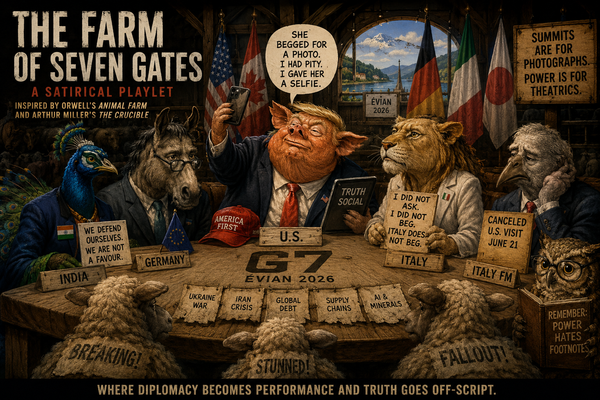
Trump’s latest push to link any Iran settlement with the expansion of the Abraham Accords gives the crisis a still darker meaning. His reported insistence that countries such as Saudi Arabia, Qatar, Pakistan, Turkey, Egypt and Jordan should join the Accords — and that even Iran may eventually be folded into this framework — is not merely diplomatic overreach. It is an attempt to convert a ceasefire architecture into a regional surrender document. It asks Muslim-majority states to normalise relations with Israel while Gaza is being compressed, the West Bank colonised, Lebanon penetrated, Iran coerced and Jerusalem’s sacred geography destabilised.
Such a demand does not deepen peace. It empties peace of moral content.
The Abraham Accords, as originally framed, already carried a fatal flaw. They normalised relations with Israel while bypassing the Palestinian question. They offered economic integration, technology, tourism, trade and strategic alignment, but left occupation, settlements, refugees, Jerusalem and sovereignty unresolved. Trump’s new demand worsens that flaw. It seeks to make recognition of Israel not the outcome of justice, but the price of being included in a US-managed regional order. Recognition without de-occupation is not reconciliation. It is the diplomatic consecration of conquest.
This is why the demand is nearly impossible for countries such as Pakistan, Turkey, Qatar or Saudi Arabia to accept without severe internal consequences. Palestine is not a marginal foreign-policy issue in Muslim societies. It is a wound in the political imagination of the region. For Saudi Arabia, custodian of Islam’s two holiest sanctuaries, recognition of Israel without a credible Palestinian state would carry profound religious and political consequences. For Pakistan, whose public opinion remains deeply attached to Palestine, such a move would be seen as ideological capitulation. For Turkey, it would expose the contradiction between rhetoric and policy. For Iran, participation in the Abraham Accords is almost unimaginable under present ideological conditions.
Trump’s formulation reveals two things. First, he appears less interested in a just ceasefire than in creating a spectacle of diplomatic victory around Israel. Second, the Iran file is being used not merely to contain Iran’s nuclear capacity, but to build a wider regional order in which Israel becomes the accepted strategic centre and Palestine is pushed to the margins of history. In that sense, the demand is not an eccentric flourish. It is a window into the hierarchy being imagined: Israel normalised, Iran constrained, Arab regimes incorporated, and Palestinians reduced from a nation with rights to a humanitarian problem requiring management.
This is where the phrase “Greater Israel” must be handled with care. One need not prove a single formal map or official doctrine to see the operational logic of a Greater Israel imagination. Such a project can proceed incrementally through corridors, settlements, buffer zones, military lines, recognition deals, security memoranda, border incursions, custodianship changes and managed facts on the ground. It does not always announce itself. It advances through cumulative realities. First Gaza is made unliveable. Then the West Bank is fragmented beyond sovereignty. Then Arab recognition is demanded without Palestinian freedom. Then Lebanon is treated as a forward security zone. Then Iran is disciplined as the remaining regional obstacle. Then Al-Aqsa is placed inside a new administrative vocabulary.
That last possibility is the most incendiary of all.
Reports that US and Israeli actors may be exploring a plan to strip Jordan of its historic custodianship over the Al-Aqsa Mosque compound and convert the site into some form of “multi-faith centre” must be treated with analytical caution until fully confirmed. But even as a reported proposal, it is explosive. Al-Aqsa is not simply a monument. It is not a tourist zone. It is not an interchangeable symbol in an Abrahamic branding exercise. It is the third holiest sanctuary in Islam, associated with the Prophet Muhammad’s Night Journey and Ascension, and embedded in the devotional memory of Muslims across the world.
Any attempt to alter its custodianship, dilute its Muslim character, impose Israeli-controlled religious administration, or convert it into a managed multi-faith spectacle would represent a civilisational provocation of the highest order. It would not create interfaith harmony. It would likely ignite religious mobilisation across the Muslim world. The issue is not whether Judaism and Christianity have deep connections to Jerusalem. They do. The issue is whether political power can use the language of shared sacredness to seize administrative control over a living Muslim sanctuary under occupation.
There is a difference between reverence and appropriation. There is a difference between access and sovereignty. There is a difference between interfaith respect and coercive redesign. A genuine interfaith ethic protects the integrity of each sacred tradition. A coercive interfaith project uses the vocabulary of harmony to rearrange power. If Al-Aqsa is placed under an Israeli-created administrative body, if imams and sermons are subjected to Israeli approval, if Jordanian and Islamic Waqf authority is removed, then the issue will no longer be worship. It will be domination disguised as pluralism.
This is why Al-Aqsa is uniquely dangerous. Gaza is the wound of Palestinian survival. The West Bank is the wound of territorial dispossession. Iran is the wound of regional power. Lebanon is the wound of border insecurity. But Al-Aqsa is the wound of sacred memory. To tamper with it is to move from geopolitics into civilisational injury. It risks transforming a political conflict into a religious convulsion. It risks telling nearly two billion Muslims that even their holiest sanctuaries are not safe from the redesigning ambitions of power.
The danger, therefore, is not to Muslim biological survival as such. That would be the wrong formulation. The danger is to Muslim political dignity, sacred custodianship, civilisational security and the survival of Palestine as a nation. If Gaza can be emptied, if the West Bank can be absorbed, if Lebanon can be entered, if Iran can be bombed, if Arab regimes can be compelled into normalisation, and if Al-Aqsa can be reclassified under Israeli-supervised “multi-faith” language, then the message to the Muslim world is unmistakable: your lands may be negotiated over, your peoples may be displaced, your regimes may be bypassed, and your sacred spaces may be redefined.
No Muslim society can view such a sequence with indifference. No responsible world power should treat it as manageable diplomacy. No serious analyst should underestimate the consequences. A region can survive border disputes, ideological rivalries and even wars. It may not survive the deliberate politicisation of its deepest sacred geography.
The irony is that such a move would not make Israel safer. It would endanger Israel more profoundly than any battlefield setback. It would convert the Palestinian cause from a national liberation struggle into a sacred emergency for Muslims far beyond Palestine. It would weaken every Arab regime that accommodates it. It would strengthen every militant narrative that claims diplomacy is a trap and moderation is surrender. It would turn Jerusalem from a contested city into the epicentre of a much wider religious rupture.
This is why restraint at Al-Aqsa is not a concession to Muslims. It is a necessity for regional survival. The sanctity of Al-Aqsa must not be converted into an experiment in coercive pluralism. The Jordanian and Islamic custodial framework, however imperfect, has helped prevent the site from becoming the ignition point of a civilisational fire. To dismantle it under US-Israeli pressure would be to strike a match in the most combustible sacred space on earth.
The same warning applies to the Abraham Accords. Normalisation cannot be demanded while Palestinian life is being dismantled. Peace cannot be built by erasing the people in whose name the conflict has endured for generations. Recognition cannot be extracted under the shadow of bombardment, occupation and nuclear double standards. If Trump truly seeks peace, he must begin with ceasefire, humanitarian restoration, Palestinian rights, settlement freeze, Al-Aqsa protection and regional de-escalation. If he begins instead with compulsory recognition of Israel, he is not making peace. He is laundering conquest into diplomacy.
The Arab and Muslim regimes have performed poorly in this moment. Some are frightened of Iran. Some depend on American security guarantees. Some fear their own populations more than they fear moral disgrace. Some prefer quiet alignment over public confrontation. But regimes are not peoples. Across the Muslim world, Palestine remains not merely a foreign-policy issue but a test of human decency. The question is no longer whether Arab rulers can rescue Palestine. The question is whether they can rescue their own legitimacy.
India too must examine its position. It should be wary of absorbing any security imagination — Israeli or otherwise — in which minority populations are viewed permanently through suspicion, surveillance, demographic anxiety and punitive control. That is not strategic maturity. It is civilisational regression. India has legitimate interests in defence technology, agriculture, cyber, drones, missiles, counter-terrorism and innovation. But legitimate state interests become dangerous when they produce moral numbness. A republic must never learn from another state the habits that may one day fracture its own constitutional soul.
The distinction between rulers and peoples must remain central. Palestinians are not Hamas. Iranians are not the Islamic Republic. Lebanese civilians are not Hezbollah. Israeli Jews are not Netanyahu. Americans are not their permanent-security state. People elsewhere under totalitarian regimes, democratic or otherwise, are not reducible to the calculations of their governments. Without this distinction, analysis becomes bigotry, and moral anger becomes a mirror image of the cruelty it condemns.
There is something heart-breaking and elevating in the dignity of ordinary Palestinians and Iranians under this pressure. The Palestinian mother who refuses to surrender the memory of her destroyed home; the Iranian family that wants neither foreign bombs nor clerical tyranny; the Lebanese villager trapped between Hezbollah, Israel and Washington; the Israeli Jew who protests occupation in the name of Judaism’s prophetic conscience; the American student punished for opposing the war machine — these are the people among whom a future moral order will be rebuilt. They are not the noise of history. They are its conscience.
The biblical parallels are striking, but they must be used carefully. They should never be turned into an anti-Jewish weapon. In fact, the strongest critique of state violence, land theft, siege, arrogance and false prophecy comes from the Hebrew prophetic tradition itself. The first parallel is Pharaoh: the ruler who hardens his heart, reduces an oppressed people to a demographic and security problem, and discovers too late that domination has consequences. The second is Ahab and Naboth’s vineyard: a king desires land, power manufactures legality, an innocent man is killed, and the prophet Elijah declares that blood will answer blood. The third is David and Uriah: the sovereign arranges death from a distance and is confronted by Nathan with the devastating words, “Thou art the man.” The fourth is Habakkuk’s warning: woe to him who builds a city with blood. The fifth is Isaiah’s condemnation of those who join house to house and field to field until there is no room left for others.
These are not foreign texts to Jewish moral memory. They are internal indictments of imperial arrogance, dispossession and blood-built security. The Hebrew Bible itself contains the fiercest warnings against land theft, royal arrogance, blood-built cities, false prophets and Pharaohic hardness of heart. This matters because the present catastrophe is often wrapped in biblical language by those who confuse scripture with title deeds and prophecy with policy. But the Bible is not a real-estate registry for modern conquest. Its deepest moral voice is not “take the land because God promised it”. It is “do justice, love mercy, and remember that you too were strangers in Egypt.”
The prophetic tradition does not bless permanent domination. It warns rulers that the cry of the oppressed rises higher than the architecture of kings.
History offers the same warning. Apartheid South Africa had nuclear capability, Western friends, internal collaborators, intelligence reach, economic depth and military power. It still lost legitimacy. France had a million settlers in Algeria, a hardened army and deep emotional investment in the territory. It still left. The Soviet Union had tanks in Afghanistan and a doctrine of historical inevitability. It still bled itself into exhaustion. The United States conquered Iraq, but the war degraded American credibility for a generation. Power can win campaigns and lose epochs.
Israel faces the same danger. It may gain tactical depth and lose strategic legitimacy. It may seize more territory and become less secure. It may destroy Hamas as an organisation and multiply the historical conditions that produce its successors. It may expand buffer zones and shrink its own moral horizon. It may demand recognition from Arab and Muslim regimes while becoming more hated by Arab and Muslim societies. It may enjoy American vetoes and emergency arms supplies while becoming, in the eyes of much of humanity, the emblem of privileged violence.
The United States, too, is playing with fire. A great power that allows one ally to operate above law cannot indefinitely claim to lead a rules-based order. The world sees the contradiction. It sees Russia punished for annexation while Israeli settlement expansion continues. It sees Iran threatened over enrichment while Israel’s nuclear opacity is politely ignored. It sees humanitarian language applied selectively. It sees international law invoked against enemies and negotiated away for friends. That is not order. It is managed hypocrisy. Managed hypocrisy eventually becomes unmanageable disorder.
The humane way out is not mysterious. Forced displacement from Gaza must be rejected absolutely. Humanitarian access must be restored without military manipulation. Reconstruction must be tied to Palestinian agency, not externally imposed trusteeship. Hostages and detainees must be addressed through negotiated mechanisms. Settlement expansion must stop. Al-Aqsa’s Islamic and Jordanian custodial framework must be protected. Nuclear transparency must apply regionally, not selectively. Normalisation with Israel must be conditioned on Palestinian rights, sovereignty, equality and security. Iran must be restrained through law and diplomacy, not humiliation and bombardment. Arab regimes must understand that peace without justice is only delayed unrest.
There is no final solution to the existence of a people. There is only justice or recurring catastrophe. Palestinians cannot be erased into the sea. Iranians cannot be bombed into liberalism. Lebanese civilians cannot be made secure by turning their villages into forward zones. Israelis cannot be made safe by the permanent humiliation of Palestinians. Americans cannot preserve global leadership by underwriting one law for allies and another for adversaries. Nations cannot defend civilisation abroad while absorbing majoritarian hardness at home. Muslim societies cannot surrender sacred custodianship and political dignity without losing faith in their own rulers.
The world should understand the danger before it is too late. Gaza is not an isolated tragedy. Iran is not an isolated confrontation. Lebanon is not an isolated front. Al-Aqsa is not an isolated shrine. The Abraham Accords are not merely trade agreements. They are now linked in a single chain of coercion, recognition and resistance. Break that chain through justice, and a different Middle East remains possible. Tighten it through force, and the fire that tyrants light will not stop at Gaza, Tehran or Jerusalem. It will travel across borders, regimes and generations, consuming those who believed they could command it.
The Palestinians have already entered history not as a defeated people but as a people who exposed the moral fraud of an age. The Iranians, trapped between foreign aggression and internal authoritarianism, have revealed the tragedy of civilians made hostage to geopolitics. The Lebanese, Syrians and others have become unwilling witnesses to the widening theatre of impunity. And Israel, unless rescued from its own extremists and militarised messianism, risks becoming the very thing its deepest moral inheritance warned against: a state that remembers persecution but forgets justice.
The last word will not belong to Netanyahu, Trump, Hamas, Hezbollah, Khamenei or any regime. It will belong to the human being under rubble, under sanctions, under occupation, under fear — still refusing to surrender dignity. That dignity is the real power in history. It is slow, wounded and often voiceless, but it outlives empires.
Tyrants always believe they control fire. History says otherwise. Fire has no permanent loyalty. It consumes the poor first, the weak next, the dissenter after that — and then, eventually, it reaches the palace.
“Ah, you who have built a town with crime,
And established a city with infamy.” - Habakkuk 2:12
Colonel Maqbool Shah (Veteran) is a retired Indian Army officer.